Sherlock Holmes
After glimpsing the trailer for Guy Ritchie's Sherlock Holmes, many Victorianists trembled in their shoes and reached for the smelling salts. Having now seen the film, I can certainly confirm that none of us will be assigning it for its historical details, let alone for its fidelity to the canon: it takes place at some undisclosed and unrecognizable moment in the late nineteenth century (shortly after the Civil War, apparently), involves mass hysteria brought on by supposed acts of black magic (Doyle always made sure to keep his conspiracies behind the scenes), and defies any attempts to relate it to the stories' chronology (Holmes has never met Mary Morstan, even though she was his client in The Sign of Four; Watson hasn't begun writing yet; Holmes and Irene Adler have had a long...er...relationship; etc.). So what can we make of it, either as an action film or, dare we say, as a Sherlock Holmes adaptation?
Although stories like The Hound of the Baskervilles at first seem to involve other-worldly situations, Holmes always brings them back down to empirical reality. In that sense, the stories descend directly from Radcliffean Gothic, with its manmade horrors. Ritchie's Sherlock Holmes blows up this rationalized Gothic mode into broad parody. The super-evil Lord Blackwood, whom we meet at a Black Mass, is hanged for five murders. And then, after he offers Holmes a pre-execution apocalyptic prophecy, Blackwood...rises again. Good heavens, it's Christ! Or the Antichrist! Or, er, somebody. It turns out that Blackwood is the illegitimate son of the leader of a mystical secret society, which, when its members aren't having hot sex under the guise of Ritual, apparently Controls the Government. (Somebody has been reading a little too much Dan Brown.) Meanwhile, accompanied by his trusty familiar, a crow, Blackwood offs daddy, then an impudent Yank named Standish, and finally plots to murder all of Parliament. Needless to say, this is bad. Complicating matters further, Holmes' old nemesis/flame Irene Adler returns, in the pay of someone who turns out to be a sequel hook. Last but not least, Holmes' investigation is mildly hampered by his bromantic sulks over Watson's imminent marriage.
To the extent that the film shows any sign of a functional brain, it lies in its heavy-handedly ironic take on imperialism. Lord Blackwood plots not only to subjugate a degenerate British government, apparently populated by legions of old men, but also a "corrupt," "weakened" United States; ultimately, he plans a new, "immortal" world order, united in its fear of his deadly magical abilities. (J. Hoberman calls this the film's "near-subliminal references to terrorism.") For backup, Blackwood has his steampunkish WMD. However, his fantasies of empire take place in a rotting capital, dominated by rust and filth, and decorated in a color palette that runs from grey to black. (And occupied by people with terrible teeth.) Several of the film's set pieces involve various examples of Victorian manufacturing prowess falling over, falling in, or blowing up. In other words, it's not as though the empire is in good shape at home. Blackwood's reign by superstitious terror meets its match, though, in Holmes' powers of empirical observation, in a moment that luxuriantly parodies the standard Summation. The forms of power involved all boil down to the Great Man, whether he's swaying thousands by sleight-of-hand (which, after all, is what this mysterious "order" basically is) or untangling deception to get at the truth. Just add reason, and the bad guy is left *cough* hanging.
Of course, when Holmes isn't reasoning, he's beating people up. This is not all that far out of line from Doyle's originals, although Ritchie's Watson is, somewhat oddly, a bad shot. (Decades ago, an article in The Baker Street Journal pointed out that if you wanted something dead, you'd best have Watson aim the gun.) Unfortunately, the action scenes all outlive their welcome (like the film, come to think of it); to make matters worse, they're edited in Ritchie's signature style, which renders the fight choreography almost totally incoherent. The violence itself quickly becomes cartoonish--often ludicrously so--not least because Holmes and Watson appear to be impervious to injury. When Watson gets blown up, for crying out loud, he winds up with a few minor cuts and an arm sling, instead of massive scarring (and, well, death). As Dad the Emeritus Historian of Graeco-Roman Egypt pointed out, there's definitely a B-movie feel to all the slapping, punching, exploding, shooting, and kicking, and some of the set pieces appear to have come straight out of the serials.
The somewhat homoerotic B-plot itself has been anticipated by several Sherlock Holmes pastiches (e.g., most explicitly, Sherlock Holmes and the Mysterious Friend of Oscar Wilde), and, to a lesser extent, the Jeremy Brett adaptations. (By this point, all Sherlock Holmes adaptations feel a bit belated.) But Holmes' prankish attempts at derailing Watson's marriage are a dead ringer for recent events in another Holmes knockoff: House M.D. Think House's various machinations to split up Wilson and Amber, and you've got this film's dynamic exactly. The conclusion, in which Holmes buys Mary Morstan the engagement ring--a suitably over-the-top diamond--seems to keep his part in this triangle alive (not least because Watson describes the ring as Holmes' gift to "us," suggesting a rather different view of who is marrying whom...). Of course, while Watson is heading off to domestic peace (at least, until Holmes grabs him again), Holmes finds himself unable to get it on with his One True Love, Irene Adler: alas, the only woman for Holmes turns out to be too amoral for Romance, and in a nod to The Maltese Falcon, he abandons her to justice. (Or not, depending on Irene's skills.) True Love would make Holmes much too bourgeois.
Irene Adler poses another problem, which is that actress Rachel McAdams has little presence and even less romantic chemistry with her Holmes, Robert Downey, Jr. Downey looks wrong for Holmes, especially for anyone who has had heavy doses of Brett and Rathbone, but his offhand, lightly rueful delivery actually works rather well; moreover, he has the requisite chemistry with Jude Law, who comes across as warmer than his general wont. Refreshingly, both men are the right age, for once, and Law also matches the Paget illustrations. It's nice to see another intelligent Watson, following on the revisionist Watsons (in the sense of revising the Nigel Bruce Watson) of David Burke, Edward Hardwicke, and, most recently, Ian Hart. Nobody else, the villain included, makes much of an impact, although character-actor spotters will notice James Fox and Eddie Marsan.

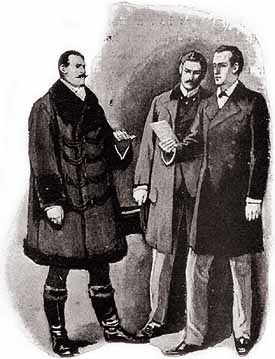
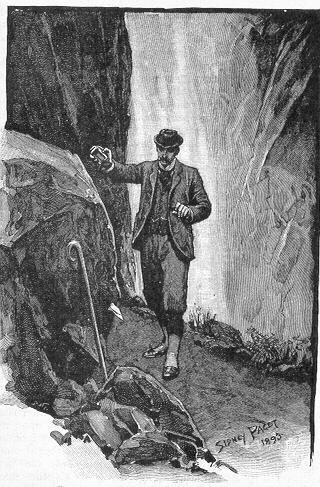
Overall, in the interests of avoiding any wailing and gnashing of teeth, it might be best to regard this film as a Sherlock Holmes send-up.1 There are the expected shout-outs to the stories themselves, from quotations (the pocket watch episode, game being afoot, etc.) to more subtle allusions (Gladstone the bulldog clearly refers to Watson's mysterious and much-explicated "bull pup" in A Study in Scarlet). At this point in the history of Holmes pastiches, such allusions are a wink at audience expectations; the characters come burdened under the weight of hundreds of adaptations. But the plot is so ludicrous, the violence so corny, the solution so hammy, that the whole affair eventually turns into fond, if ultimately wearisome, self-mockery.
1 Andrew L. Urban and Louise Keller also note the elements of "parody" coming into play (albeit, they suggest, not always intentionally).