Ten Great Novels
Thanks to a tweet by Ted Underwood, I was reminded of another "best novels" list, Ten Great Novels, this one put together for reading groups by the well-known Unitarian minister Jenkin Lloyd Jones. According to Lloyd Jones, the survey was taken in 1884 and the results originally disseminated in his church magazine.
The top ten results seem fairly typical for the period:
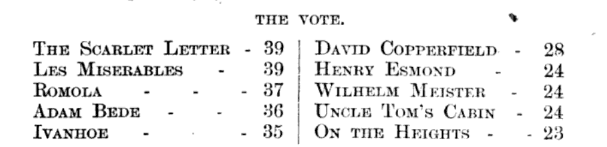
The list overlaps noticeably with one I discussed last year: Les Mis is also in second place, Romola and Adam Bede place above Middlemarch (ninth), and Dickens and Scott are similarly represented by David Copperfield and Ivanhoe; the other list differs, however, in being remarkably Thackeray-heavy (three novels, Vanity Fair in the top spot), Auerbach/Goethe/Stowe absent but Don Q present, and The Scarlet Letter in a three-way tie for tenth. In JLJ's list, the only authorial outlier from a twenty-first century reader's POV would be Berthold Auerbach, author of On the Heights, who is now pretty much in the sole domain of specialists. The differences are largely statistical blips--what's interesting is the more general agreement about "great" novelists, with which a twenty-first century reader might agree, and their great novels, with which they might not.
As is often the case with such top-ten lists, things get a bit more interesting once you reach further in:
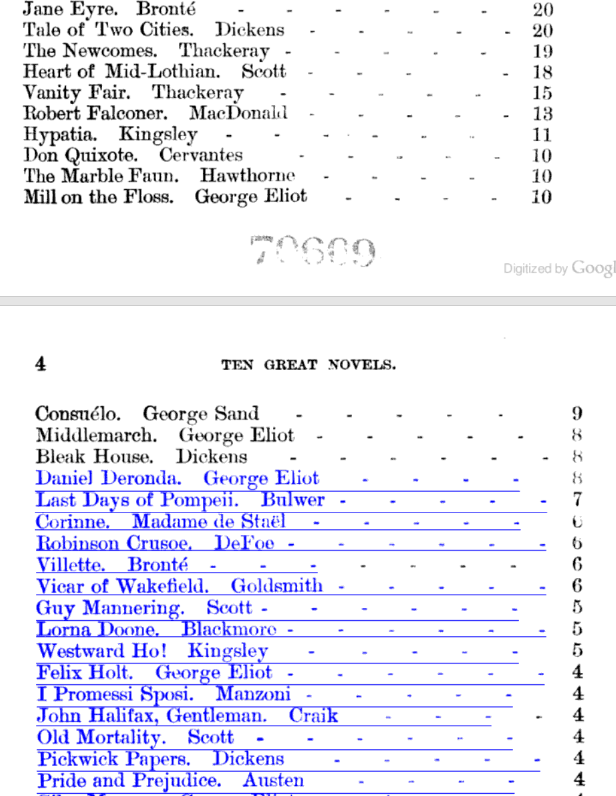
I'm not going to go through the entire thing, but notice the lack of Austenmania here: she only picks up four votes. In line with contemporary preferences, only Charlotte out of the Bronte sisters gets any love. Anne's reputation had long since gone kaflooey (that's an important technical term in literary history); meanwhile, while Emily was beginning to enjoy something of a renaissance, it was as a poet, not a novelist. Bulwer-Lytton's appeal was clearly on the wane, at least for this group, but some of them were still interested in Dinah Mulock Craik and Kingsley. There's relatively little interest in eighteenth-century fiction here, except for Defoe; poor Samuel Richardson picks up only two votes for Clarissa, as does Fielding for Tom Jones. And despite the list being produced by and for Americans, you have to read quite far down in the votes to find anybody except Hawthorne making an impact vis-a-vis the European novelists.
JLJ's list is also interesting, though, for the letters appended to it, as several of his contributors justified their choices. JLJ wanted recommendations for the "noblest" and the "best" (3) in European and American fiction, and his correspondents visibly struggle with the question of artistry vs. moral improvement. Part of the problem is that nobody appears to have been quite clear what fictional nobility might mean (some sort of "moral element," thought one slightly puzzled writer [10], while another bluntly said that JLJ had not provided a real "standard" [21]), and a librarian, Ella Giles, pointed out that lists like this were problematic in the first place (13). One writer, Emma S. Adams, argues that she can't put Austen in her top ten because a truly "great novel" is "inspiring in the lessons that it teaches" (6), which conflates great and noble. The Rev. J. H. Allen admits that he "should quite prefer Lorna Doone to Daniel Deronda, and The Last Chronicle of Barset to Les Miserables, if one wants either a natural or wholesome picture of life" (7), a judgment that seems to call for novels that are good for the constitution--less romanticism, one suspects, and also less sex--although how that fits Lorna Doone is not precisely clear. (Moral of the story: nineteenth-century "wholesome" doesn't necessarily translate.) Nevertheless, Allen turns out to be broad church in his literary leanings, and also plumps for Balzac (surely not wholesome) and Turgenev. Mrs. J. K. Boyesen, meanwhile, was all about "moral bearings" (8) over mere aesthetics, which explains her predilection for Romola (although she's also a Middlemarch fan)--but which also turns out to encompass Vanity Fair. Another writer, Mrs. J. L. Bullard, tries to distinguish between "great" and "noble" (9), putting both Jane Eyre and Vanity Fair only in the former category; C. F. Dole, similarly baffled, goes in the opposite direction and proposes Tom Brown's Schooldays as an example of something noble without being great (12). The Rev. C. J. Staples tries to theorize great vs. noble and comes down on "uplifting power" (19), but it's not clear if he prioritizes noble or great and noble in his selections. In other words, several of JLJ's correspondents felt that "great" literature might well lack any sort of strong moral project, didactic or otherwise, but they weren't sure they were comfortable with that position, or even if the position could be articulated coherently.