The Diary and Houres of the Ladye Adolie
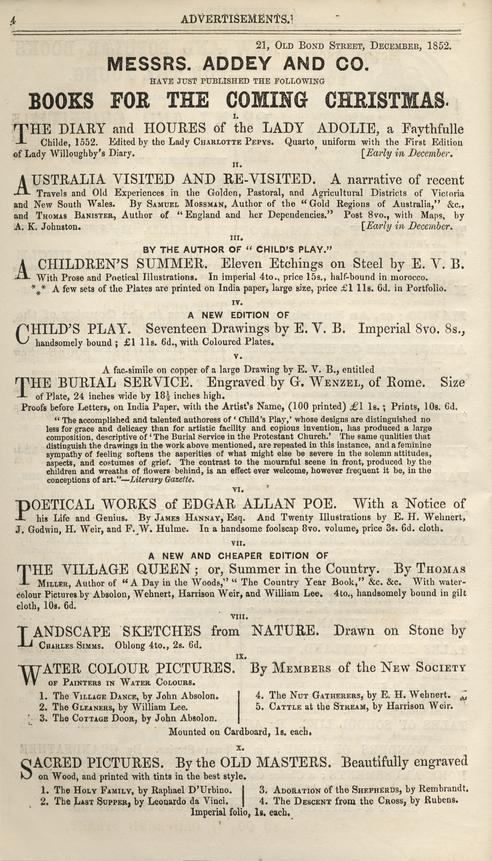
It's time for another excursion into the world of Victorian didactic fiction. Our special guest for today is Lady Charlotte Maria Pepys (1822-89), who "edited" (translation: authored) a diary novel set during the Marian persecutions, The Diary and Houres of the Ladye Adolie, A Faythfulle Childe, 1552 (London: Addey and Co., 1853). A couple of online bookdealers have noted that the book's primary claim to fame is its typography: it was marketed to readers already familiar with the popular Diary of Lady Willoughby, which today is one of the most famous examples of the Caslon revival. From a literary historian's perspective, however, there are some other things to note.
First, as is frequently the case with didactic fiction, the novel functions as a religious "reader" of sorts. (Leah Price's interesting book might have been enriched by more ventures outside of canonical literature.) The diary incorporates a full-fledged Protestant catechism, a "litel Historie of the Prayer-boke" (180), and, as an appendix, "Ladye Adolie's" personal book of hours. Even more explicitly than most nineteenth-century mock religious diaries--Elizabeth Prentiss' Stepping Heavenward, which remains in print, is perhaps the best-known example--Ladye Adolie models how to both read and write devotional texts. The diary itself offers a fictional example of spiritual self-examination, as the teenage Adolie meditates on and castigates herself for her various sins--most frequently, pride and a lack of charity. But the novel also casts spiritual growth in terms of scholarship. Pepys emphasizes the role of liturgical history in grounding the inquirer in Christian tradition; hence Adolie's study of the prayer book. Similarly, Adolie's revision of the Book of Hours to suit her own Protestant needs suggests potential continuities between Protestant and Catholic forms of devotion.
In fact, The Diary stands apart from most Protestant didactic novels in its more nuanced--if, as we shall see, also somewhat self-contradictory--attitude to Catholicism. Victorian novels and dramas about the Marian persecutions, whether or not they hold Mary personally responsible, nevertheless insist that the persecutions reveal Catholicism's essence--and, therefore, that they adequately demonstrate Catholicism's potentially corrosive effect on British culture. The Diary does something rather different. To begin with, it is not an "evangelical" novel, as the Protestant characters make no attempt to proselytize and, even more importantly, regard the distinction between Protestant and Catholic as a thing indifferent. Protestants and Catholics disagree, to be sure, but Adolie insists that these disagreements are simply artifacts of interpretation. As she says in her allegory of the bi-colored fish, God "did give us some of all Kindes of Fishes to eat, and they were verie goode" (52); in other words, differences in doctrine should not obscure that all Christian denominations grasp some share of the truth.
But the novel's pro-toleration discourse--fairly pointed for a book published in 1853, during the high tide of anti-Catholic sentiment--sits oddly in its overall narrative trajectory. For all that the Protestant characters decry extremism on their own side (e.g., attacks on Catholic ritual, Northumberland's power-mongering), it nevertheless remains the case that they are the only characters capable of thinking in tolerationist terms. When Adolie is imprisoned for heresy, her old Catholic friends readily enlist in the project to convert her; similarly, even the "nicest" Catholic figures, like Cardinal Pole, cannot think in terms of freedom of conscience. In the end, Adolie dies at the stake, while her parents flee to Bruges. While the novel suggests that there's room in England for a Catholic minority, it ultimately agrees with more staunchly evangelical texts in its insistence that Catholics probably cannot be trusted with political power--unless, of course, they become not Protestant, but simply more "Protestant."