An excursion into Victorian Protestant poetry: "Heart of Oak"
I've mentioned this collection once in passing, but thought that it might be interesting to some (two? three?) readers to vary my usual round of Victorian controversial fiction with a bout of Victorian controversial poetry. "Heart of Oak," while breaking zero new ground in terms of its tirade against the nebulous "priesthood" ("Not that again," I groaned on first reading), at least has ambitions to be a serious poem. (For unapologetically and unambitiously awful Protestant poetry, I direct you to James Augustus Page's Protestant Ballads. You have been warned.) Thirty-Six Nonconformist Sonnets (1846) was published by the pseudonymous "Young Englander," and my Victorianist readers may be struck by the unexpected juxtaposition of "Young England" sentiments with (unindentified) Nonconformism. As one Victorian reviewer noted, a Nonconformist Young Englander was an unusual find. While the collection received some breathless praise on its first and only appearance in volume form, it excited rather more exasperation than enthusiasm. The sonnets, which don't form any kind of ordered sequence, are united by their anti-Catholic and anti-Tractarian sentiments; they range in subject matter from martyrdom to Maynooth, with most of the poems having some sort of immediate topical reference.
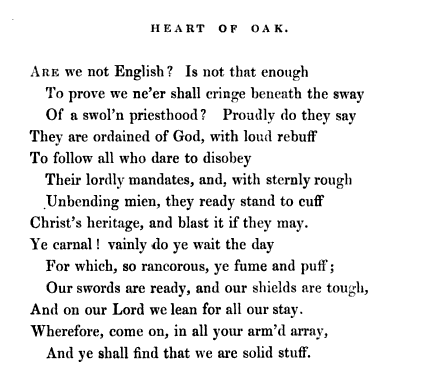
As sonnets go, this one is fairly odd. It's an Italian sonnet in straightforward iambic pentameter, but the sestet doesn't introduce any variant on the CD or CDE rhyme; instead, the sestet simply continues the octave's ABBA rhyme scheme, so that the final lines (AB) seem to interrupt the poem's forward progress. Instead of marking the transition from octave to sestet with the traditional change in rhyme, the poet shifts from enjambed to endstopped lines. Notably, the poet sections off the final two lines, emphasizing their role in the poem with paralleled alliteration (arm'd array/solid stuff). It's as though he wanted a couplet at the end, but swerved.
The poem's title alludes to the famous song by David Garrick, and this "Heart of Oak" appropriates Garrick's militarism and nationalism in a distinctly Protestant key. The rhetorical question that opens the sonnet, "Are we not English?" (1), virtually ends the poem before it begins: it posits that Catholicism (and, by extension, Tractarianism) is fundamentally un-English, and therefore incompatible with both English government and English sentiments. Although this is an entirely unoriginal position in anti-Catholic polemic, and not just of the Victorian variety, the rest of the collection actually qualifies it; after all, one of the tensions driving these sonnets is Catholicism's and/or Tractarianism's appeal to the English minds which "naturally" resist it. (Given the broad sweep of "priesthood," the Nonconformist poet is probably including the CofE in his denunciation.) This and the next rhetorical question, which seem to make the rest of the sonnet entirely unnecessary ("and a good thing, too," I can hear some readers saying), suggest that the English may need to remind themselves of their natural immunity to all forms of sacerdotalism. Englishness ought to be "enough" (1), and yet, at the present time, it looks as though it isn't. How to distinguish between Englishness and that deadly "priesthood" (3)?
In the sentence that occupies the next five and one-half lines, the poet suggests at least part of the answer. His representation of the priesthood is, again, entirely unoriginal, dwelling on the harsh and heartless nature of priestly power. Priests resist sympathy, repelling the onlooker (that "sternly rough/Unbending mien" [6-7]) instead of inviting personal communion; the impenetrable exterior cloaks a potentially blasphemous violence, directed against "Christ's heritage"(8) itself. But the poet arrests the priests at speech. They declare their place in the apostolic succession, and snarl at those who refuse to acknowledge their rightful role (e.g., Nonconformists), yet they only "ready stand" (7) to act against "Christ's heritage," and they would "blast it if they may" (8). The pretensions of this priestly speech, hinted at in the somewhat contorted syntax of these lines, are all-encompassing. This, however, is where Englishness makes its grand entrance.
At the opening of the sestet, the poet stops referring to the priests as "they" and, instead, apostrophizes them as "ye." He thus brings them into the poem, as it were, calling them into direct conflict with the unified "we" (English Protestants) instead of describing them to that "we." The assonance ("vainly"/"wait"/"day" [9]) duns it into the priesthood's head that the English will allow them to proceed no further than empty words. In contrast to priestly language, the poet introduces (in smoothly paralleled clauses) the threat of "swords" and "shields" (11), both of which are prepared now. Moreover, the poem is coyly ambiguous about just how metaphorical those swords and shields are: are Protestants going to wield the sword and shield of the Scriptures against Popery, or are they going to rise up and engage in a little smiting--in line with "Heart of Oak"? The taunt in the closing lines not only dares the priests to do something, but also answers the rhetorical questions with which the poem began: it declares instead of asks. The English (or, at least, the poet) have found their confidence. And the AB rhyme at the end, separated from the rest of the sestet by the period, itself declares the irreconcilable differences between the priesthood and the English.