Victorianist and inveterate book buyer.  

Posts tagged with religion

Brief note: A Christian with Two Wives

The Christian Socialist clergyman and satirist James Dennis Hird got into some hot water over A Christian with Two Wives (1896), a novel (for some definition of "novel") that understandably failed to impress the Church of England hierarchy.  Hird's novel mostly falls into the relatively capacious category of late-Victorian "faith and doubt" fiction: its viewpoint character, Wentworth Manley ("manly," get it?) is a disaffected Anglican clergyman who has fallen into the business because he inherited his father's living, even though on taking up his duties, "his sensations resembled those of a man who should become conscious that he was in a coffin" (17).  While by no means an intellectual, Manley understands the basic currents of German biblical scholarship, and does not believe in Biblical inspiration (of any sort), the miracles, etc., etc., etc.  To make matters worse, he is surrounded by odious Christian hypocrites, ranging from his half-sister (whom the novel diagnoses as suffering from a bad case of sexual frustration) to the sanctimonious Mr. Skipworth (who turns out to be sexually harassing his servants).  Life, in other words, is bad.  But it's even worse for young Mary Skinner, who is ostracized after her lover impregnates her.  There is an alternative, however, in the form of Mr. George Bretton and his two wives, Raven and Lily, whom he purchased in a Cairo slave market and converted to Christianity.  As the initials may hint to the reader, Raven and Lily are stand-ins for Rachel and Leah; if you fail to notice this on your own, the novel cheerfully points it out to you.  Bretton's life with Raven, Lily, their six children (another Rachel/Leah parallel), and various cast-off women whom they have rescued is a Christian Socialist utopia, a veritable Eden within the otherwise fallen landscape of industrial Britain (the gorgeous garden should be a clue).   

In fact, Bretton is quite clear that he is a devout, if heterodox, believer, someone who insists that "the Bible is the guide of life in all things" (79).  What he isn't, of course, is an Establishment Christian.  Bretton's back-to-the-Bible position is, also of course, isomorphic with standard-issue Victorian Evangelical discourse, which fuels much of the novel's polemical energy.  (He's all about the sola scriptura, although somewhat hand-wavily so.) Once we get into the second half of the novel, in which Manley and Bretton chat, Hird turns the format of the controversial novel to heterodox ends: the two men exchange prooftexts, Bretton argues that a literal reading of the Bible supports a pro-polygamy interpretation, and Manley's objections are all overturned with miraculous ease.  In particular, Bretton insists that it is important for Christians to reinstate a non-allegorical reading of the Song of Songs as a key aspect of faith: by celebrating the Bible's endorsement of "the ecstatic embrace of two young lovers" (123), Bretton claims, Christians can liberate themselves from their oppressive attitudes to sexuality (female sexuality in particular).  Thus, Mary, whose name also seems to be pertinent, is no sinner in this line of argument, but someone who has been horribly treated by the powers that be; by novel's end, she has accepted Bretton's offer of help.  Meanwhile, Manley's religious doubts are alleviated by his conversation with Bretton, and--now converted to Bretton's brand of belief--he takes off at the end to Cairo.

Beyond the novel's "Song of Songs, yay!" approach to things, there are a couple more things of interest.  One is the novel's association of Christian Socialism with benevolent patriarchy.  For all that Bretton and his little society live what appear to be an egalitarian lifestyle, the endeavor is Bretton's project, the wives start out as literally Bretton's property, and Bretton's voice is the only one we really get to hear.  Bretton educates his wives into Christianity, and in turn his wives appear to submit wholeheartedly to his wishes.  By the same token, much of what evil befalls the other characters derives from behavior inspired by "bad" patriarchs, like Skipworth.  The second has to do with Bretton's engagement with the Middle East.  Bretton explicitly parallels the Cairo slave market, the Bristol slave trade, and the British marriage market--"our modern method of selling them secretly to any leprous old lecher" (69)--and this rhetorical slippage enables him to cast himself as both a non-hypocrite and a liberator.   Moreover, as a member of the "chosen race" (68) (whether ironically or not), Bretton understands his purchase of the two girls as a civilizing act: he teaches them to semi-assimilate (even though, in Britain, they cannot socialize with anyone outside their utopian space) and to interpret their lives through the lens of the Old Testament.  At one point, Bretton tells Manley, Raven and Lily suggested that he ought to father more children with "two lovely Nubians" (115-16)--another link to the Song of Songs, but one that here raises some unanswered questions about Hird's understanding of Christian Socialist masculinity.  On the one hand, his wives propose it (nobody owns anyone's body); on the other, his wives themselves apparently have no other sexual outlets (in fact, even a "fallen woman" like Mary is monogamously in love); on a third, Hird seems to have a vague "universal brotherhood through eroticism" notion going on, but with no attention to any actual power dynamics on the ground. 
British Library (Day II)

A couple of Catholic children’s books today, before I nipped off to have coffee with my cousin (we have an English branch on my father’s side).  Tomorrow is the last day before I begin officially conferencing.  

J. J. Kelly, With Lance and Shield: A Romance of the East (Washbourne, 1895).  A boy’s adventure book set during the Crusades.  An awesome Spanish knight who is the exemplar of chivalry (etc.) wants to marry Berengaria, niece of Conrad of Montferrat.  Alas, Conrad is kind of a jerk, and so the knight keeps winning Berengaria’s hand, then losing it, then winning it, etc.  Then Conrad is assassinated, which solves the knight’s problem.  Meanwhile, there are various undertakings against Saladin.  Less overtly religious than most of the novels put out by Washbourne, but the reader is invited to contemplate the workings of Providence.

Edward Cox, The Lord’s Prayer and the Hail Mary! Tales for the Young (Washbourne, 1889).  Various short stories centering on the importance of prayer and/or the rosary, including a dream vision and a couple of historical tales set during the Reformation and Elizabethan periods.  

British Library (Day I)

I’m on the other side of the pond for a few days, attending the Victorian Popular Fiction Association conference.  Before the conference begins, though, I’m getting in a couple of days at the British Library, reading some novels of the usual aesthetic quality.  Most of the books I want to look at have actually been digitized at this point, which makes life easier.  However:

Robert Torrens, Coelibia Choosing a Husband: A Modern Novel, 2 vols.  (D. N. Shury for J. F. Hughes, 1809).  One of the multiple unauthorized sequels to Hannah More’s Coelebs.  This is a critique of More’s novel: the heroine forms her ideal of masculine behavior by reading an (overlong) inset narrative told by Mary, an overly sensible (as in “sense and sensibility” sensible, not rational) woman who commits adultery with Awesome Guy Henry.  After a happy adulterous life with Henry, Mary discovers that everything falls apart once her transgressions have been revealed, and after many disasters (including sexual assault, prostitution, attempted theft) she is reunited with Henry, only to believe that he has been executed.  Mary commits suicide.  Coelibia, though, thinks Henry the Adulterer is still an Awesome Guy, and goes through a sort of Goldilocks and the Three Bears approach to courtship: she turns down the Poet (too sentimental) and the Peer (too rigid) before falling for the Artist (just right!), who is just like Henry.  That’s because he is Henry.  They get to live happily ever after.  Torrens gets in some cracks at the dangers of extreme religiosity, which he believes leads to skepticism.  There are also some interestingly Wollstonecraftian overtones to the novel, including calls for complete egalitarianism in marriage and for the necessity of avoiding prudishness in women’s education (in effect, Torrens recommends botany for learning the facts of life).  

Mary Herbert, Baroness of Lea, Edith: A Tale of the Present Day (Richard Bentley, 1881).  A Catholic novel.  In Generation I, beautiful Madeline commits adultery (the day’s unintentional theme, I guess) and abandons her children.  The children in question, including Edith, grow up to have a conflicted relationship with their father, whom they blame for their mother’s disappearance (even after they realize what she did).  In Generation II, Edith falls in love with Sir Edward Baker (Not Good) but winds up married to Lord St. Aubyn (Good but Boring, and also a Nervous Wreck).  Nevertheless, Sir Edward keeps pursuing her, even though he is married to an ugly heiress.  Edith, however, manages to resist temptation, thanks in part to the assistance of saintly Dr. Murray, who is (gasp) a Catholic priest.  After her husband’s death, Edith spends more time thinking seriously about religion, but gets no help from either the evangelical parson (too much Bible-thumping) or the Ritualist (too dishonest).  Catholicism suits the bill, though.  After her conversion, Edith is alienated from her son, and once he marries, she decides to become a Sister of Charity.  Not surprisingly, she eventually runs into her mother, now Dying in Agony in a State of Squalor but Repentant.  At the end, Edith is off to serve with the foreign mission in China.  Sir Edward, meanwhile, dies in a hunting accident.

The Victim of Intolerance: or, The Hermit of Killarney, a Catholic Tale

The ecumenical "tolerance tale" is a tiny subgenre of the nineteenth century religious novel, and an overwhelmingly Protestant one.  The political economist Robert Torrens' quad-decker The Victim of Intolerance: or, the Hermit of Killarney, a Catholic Tale (1814) is, while rather clumsily executed (Torrens had only one previous novel under his belt, and...it shows), a good example of the tolerance tale's approach to religious reconciliation: it turns denominational allegiances into interchangeable group identifiers, in which all religious practices essentially reduce to adiaphora (things indifferent).  Thus, aside from quick references to attending Mass, funeral rites, and a possible miraculous vision of the dead (which O'Connor, the titular hermit, nevertheless admits that readers might believe to be a hallucination), the novel renders both Catholicism and Protestantism entirely indistinguishable as forms of Christianity, even as it also concedes that their practices are considerably different.  The differences exist--the novel simply remains almost completely silent about them. Actual discussions of religious faith are conducted on the basis of either natural theology--one can detect a bit of William Paley wandering through--or philosophy, with the Bible nowhere to be seen.  As is often the case in such novels, interfaith marriage both "proves" and models the possibility of tolerance: as O'Neil, an old friend of O'Connor's, explains to him, "[w]henever our [O'Neil and his wife, Mary Ann] opinions happen not to coincide, each is anxious to leave the other free, and to keep at a distance every thing that might interrupt the cordial sympathy arising from the thousand other instances in which our ideas and sentiments agree" (I.104).   The successful tolerant marriage, like the successful tolerant country, acknowledges yet remains silent about difference, while reaffirming mutual similarities.  (Nevertheless, as Julia M. Wright points out, the novel's overall trajectory criticizes this attempt to figure national politics in terms of interfaith marriage [1].)  This position enables Torrens to effectively secularize the "Catholic question" as one of citizenship (much as Charles Dickens would do in Barnaby Rudge). 

O'Connor, Torrens' hero, has the worst luck, all because he is Catholic.  His "found" memoirs narrate how his Catholicism interferes at every turn with his ability to function as both a man and a citizen.  Born of an ancient Irish family, O'Connor "had struggled ardently to distinguish myself in the world; but the remnant of the penal code, which was still in force, had blasted all my hopes, and left a sense of injustice rankling at my heart" (I.41).  O'Connor's struggle to uphold the burden of his patrimony against the power of the state will be blocked at every turn.  Moreover, this "rankling," which hints at his strong sensibilities, is one of our first hints that the penal code warps Catholic subjectivity.  While the novel frequently invokes the language of sensibility to describe O'Connor's feelings, especially his passion for the beautiful Protestant Julia (a shout-out to Rousseau's Julie from La Nouvelle Heloise, discussed in the text, and Henry Mackenzie's Julia de Roubigne), sanctioned prejudice consistently twists his sensibility into something more dangerous.  At the end, when he has become an unwilling revolutionary, just the mention of his now-lost Julia is enough to make him rejoin the "desperate project" (IV.276) of the revolution's dangerous young leader.  Thwarted sensibility, that is, runs into dangerous channels.  And O'Connor's sensibilities are indeed thwarted everywhere, from school (his anti-Catholic rival Browne gets unfair advantages), to politics (he's ineligible to become an MP), to the military (he can't rise in the ranks without converting), and to trade (he discovers that the Protestants running the courts are against him).  These obstacles leave him no possible route of development as a gentleman, with "'desires that can never be gratified'" (III.198).  Although the novel's periodic forays into soapboxing for Torrens' views on economics, the Constitution, and politics more generally are not what you would call graceful, their presence reminds the reader that an O'Connor who talks like Torrens can only disseminate his positions if he's of the same religion as Torrens.   O'Connor's unwilling turn to insurgency is, from the novel's point of view, the only option left open to a character with a desire for fame and the heightened emotional sensitivities to go along with it--even though it's also the wrong option.  There's a minor parallel in the form of a bloodthirsty rebel--the illegitimate son of a deceitful Protestant man and a Catholic woman--animated by vengeance for the wrongs done to his family in general and his mother in particular; this man, a murderer and rapist, horrifies O'Connor, but as another character makes clear, his personal trajectory has been shaped by the same prejudices.  (As the reader may no doubt have figured out, Torrens spends a lot of time explaining why Irish Catholics want to rebel, while insisting that patience is the best political choice.) 

The novel's interest in balked sensibility carries over to its sense that sensibility in its own right may not be all that helpful, politically speaking.  The narrative of O'Connor's wrongs that occupies most of volume III is told to Mr. Russel, the lovely Julia's father, who initially feels that O'Connor is "the best calculated both to render my daughter happy, and to restore to me a son" (III.4).  At various points, the narrative is interrupted so that we can appreciate Russel's appropriately sensible response.  Russel is "strongly moved" and "seemed to sorrow over the wrongs of his adopted son" (III.57); he "paced the room with violence" (III.119); he manifests "strong emotion" (III.209).  Throughout, his sympathies with O'Connor's sufferings appear complete, as he lives over O'Connor's agonies and thoroughly agrees with O'Connor's critique of Protestant prejudice.  And then...he refuses to allow O'Connor to marry Julia, on the grounds that the penal codes that debar O'Connor from enjoying the full benefits of citizenship make him an inappropriate husband; he wants Julia to marry a man capable of entering Parliament, and that isn't O'Connor.  Later, Russel momentarily recants when there is a promise of Catholic Emancipation, only to re-recant when it falls through.  Having opened up the prospect of interfaith reconciliation with the O'Neils, Torrens then sweeps it away.  In fact, to make matters worse, Russel then marries off Julia to Browne, O'Connor's lifelong enemy--despite knowing the fact perfectly well.  As a Protestant, Russel is perfectly willing to sympathize with O'Connor; he isn't, however, willing to do anything to upset his own goals with that sympathy, and indeed, his choice of Julia's husband suggests that "sensibility" is perfectly compatible with betrayal. 

[1] Julia M. Wright, Representing the National Landscape in Irish Romanticism (Syracuse: Syracuse UP, 2014), 39, 41-42. 

Brief note: Ethel's Book, or Tales of the Angels

I continued my Thomas Richardson and Sons read-through with F. W. Faber's Ethel's Book, or Tales of the Angels (1858), which Faber dedicated to a young Etheldreda Fitzalan Howard (1849-1926), later a Sister of Charity.  Faber was not, shall we say, a natural story-teller, but the longest story in this collection, "The Melancholy Heart; or the Child to Whom Nobody Was Kind," is interesting as a loose response to A Christmas Carol.  The book's foreword (dated on Christmas) in fact makes it clear that it is intended as a Catholic intervention of sorts into the "Christmas Book" tradition: "Suppose we take the Angels instead of fairies, and the Dead instead of ghosts, and then see how we get on?"  In part, Faber asks the child to contemplate the real workings of the divine, as opposed to the fictional (and, in the case of fairies, frequently amoral) workings of the fantastic, but the stories also presuppose an entirely different relationship between children and angels than between humans in general and ghosts.  It's not just that Victorian ghosts can be malicious, but that ghosts frequently exist in a kind of temporal loop (playing out a series of specific events over and over again) that nevertheless has an endpoint (a living person "solves" the haunting and lays the ghost to rest, the ghost's location burns down, etc.).   Faber's point, as one might expect, is that the angels are ever-present and ever-engaged with human life; they respond actively, they take an interest in particular beings, they communicate. 

"The Melancholy Heart" takes the basic narrative of A Christmas Carol--jerk undergoes a conversion experience thanks to ghosts awakening his powers of self-reflection via a grand tour of time and space, everyone lives happily ever after--and reworks it by, ironically enough, taking the human beings out of it.  Our protagonist, Rosamond (who must learn to be less a rose of the world and more a Marian rose), "was not a nice child" (56), and Faber makes a point of associating her non-niceness with her dislike of Nature itself.  While Faber is clear that Rosamond's problems are not wholly of her own making--she's a not-very-pretty orphan, her guardians treat her poorly, and other children misjudge her--he nevertheless notes that she suffers from "melancholy" (60), which fatally affects her worldview.   However, she also fantasizes based on her reading, and in fantasizing that her lost mother is a "fairy" (65) (a call-back to the foreword), she entraps herself in that most stereotypical Victorian danger--misreading the world through books--and thus forgets the presence of both her guardian angel and, implicitly, the divine mother, Mary. 

The novella thus tries to distinguish between a self-imprisoning fantasy life, in which Rosamond directs all of her emotions towards a purely private construct, and an opening-out of the self, in which Rosamond can learn to find joy in a world that everywhere speaks of God.  While, unlike Scrooge, Rosamond has the right idea about how to proceed (praying, for example), she consistently fails to put ideas into proper practice.  More seriously, whereas the adult Scrooge is truly brought face-to-face with the prospect of his own death only in his final vision, Rosamond's experience begins with the actual threat of death, as she finds herself "floating like a white speck on the black and stormy sea" (75) after a shipwreck.  The sea both externalizes Rosamond's own conflicted self and echoes Mark 4.36-40 (Douay-Rheims), in which Christ quiets the sea during a potentially deadly storm.  Indeed, the first step of Rosamond's conversion occurs when, out of "fear" (77), she truly prays for the first time, and promptly loses her fear while gaining her first sight of her guardian angel.   Notably, the experiences that follow, in which she is immersed in the worlds of fish, birds, insects, animals, and angels, are not about herself, or even humanity, but rather about recognizing the signs of divine love and "happiness" everywhere--even among wasps (91).  And unlike Scrooge's terrifying vision of his own tombstone, Rosamond sees instead the promise of her own future amongst the angels (97).  Rosamond's journey, that is, instructs her in her own failings precisely by diverting her from herself; even her ultimate reward in heaven appears as an empty space awaiting her arrival, whereas part of the terror of Scrooge's experience rests in the unseen presence of his body (the corpse on the bed or beneath the tombstone).  Her realization that "I do not care any longer for people being kind to me; I only want to be kind to them, to be kind always, and to be kind to everybody" (99), with which her vision climaxes, is very similar to Scrooge's promise to "honour Christmas in my heart, and try to keep it all the year."  But Scrooge's primary reward is this-worldly and mutual: he reenters society, acquires an extended family via the Cratchits, and apparently lives happily ever after within his newfound community.  Rosamond, too, becomes a boon to all in her new life as "The Kind Lady" (101)--yet this is explicitly a celibate life of good deeds and self-sacrifice, and the novella leaves her, not enjoying her happiness in the present (like Scrooge), but dead, mourned, and (implicitly) among the angels. 

Maud Hamilton; Or, Self-Will and Its Consequences

Since there have been novels, there have been other novels warning that novels are dangerous.  Such is the case with Mary Agatha Pennell's Catholic novel Maud Hamilton; Or, Self-Will and Its Consequences (1884), which sets itself against insufficiently moralizing books for boys and girls.  Or, rather: it sets itself against the ways in which those books might be read.  Unlike Eva, the previous entry from the Thomas Richardson catalog, Maud Hamilton was probably written to attract a crossover market: the only hints of Catholic content (such as Maud's self-imposed penance near the end and the French-language boarding school) are all subject to multiple Christian interpretations; there are no references to any religious practices or devotions beyond private prayer; and, similarly, there are no mentions of Mary, the saints, rosaries, scapulars, &c.  (This is not to say that a Victorian evangelical would approve of the lack of Bible-reading.)   As novels go, it is primarily distinguished by its episodic quality.  Something inspires Maud to be Naughty; she does or doesn't get away with it (usually doesn't); she does or doesn't learn something from her punishment; she is Naughty once again.  By contrast, there is Maud's sister Edith, who is always Good, and is therefore a Bore (but admirable).  The reader is not asked to think of Maud as "developing" until the very end, when we are told that she "improved in many respects" during her schooling (143).  This end, though, is not really an end at all, as the narrator invites the reader to look forward to the "future time" (143) when the girls will reappear in another story, perhaps set in India, where their absent parents live.  And indeed, they are still at the school when the book grinds to a halt, leaving them suspended between childhood and incipient adolescence.  Having offered us a moralizing plot, that is, the narrator keeps the reader hanging about its ultimate outcome: it's not clear that anything can or need be done for Edith, but what about Maud? Is she fated to only be mildly improved?

This non-ending is actually rather interesting, because Maud's fault as a reader is that she never thinks about endings.  When we first read Maud, she is too absorbed in Fanny Wheeler Hart's The Runaway to help her sister with the packing, and declares that she will emulate one of that novel's protagonists, Olga, by absconding.  "I am so glad I have read the book, for now I know exactly how to manage everything," Maud exults, "and shall begin this very day to practice how to let myself down from the bedroom window" (2-3).  Of course, this doesn't work, so poor Maud only winds up dirtying her dress.  While The Runaway is almost certainly too amused by its protagonists' adventures for Pennell's tastes--the two girls do receive some comeuppance at the end, but wind up rewarded for their behavior in some ways--Maud doesn't so much misread the story as treat its episodes as though they were severed from an overarching plot. The girls don't "manage" everything in the sense that Maud means (how far has she read?), and The Runaway doesn't quite offer a step-by-step guide to the proper construction of bedsheet ladders.  Later, Maud receives Mayne Reid's The Castaways as a gift, and promptly dreams of all the fun one might have being stuck on an island: "It would be a delightful life; no bother with lessons; all the day would be taken up with hunting and fishing. And then there would be the house to build; in fact, we should hardly find time enough to get through all our work" (66-67).  From the novel's point of view, it's not just that Maud mixes up labor and play--a "delightful" form of work that is apparently much easier than the "lessons" she loathes--but that in her mini Robinsonnade, she imagines playful work that somehow never ends (in, for example, likely death by starvation).  Her story is, to borrow a turn of phrase from Stefanie Markovits, "all middle."1 Moreover, given what The Castaways actually describes, Maud confuses the reader's pleasure with the participant's pleasure--the novel starts, after all, with the shipwreck survivors nearly dead, and they spend much of the book having one near-fatal experience after another.  Her fantasies about shipwrecks get a brutal rejoinder when she and one of her friends, Harold, manage to cajole a rather sleazy man to take them out in a fishing boat (boats being peculiarly perilous objects in Victorian children's literature), and they are all nearly killed in a storm.  Fictional endings, safely encased between the book's covers, run aground on human endings.

Maud Hamilton's second half, though, also raises questions about how Maud interprets the novel's own generic affiliations.  When she and her sister head off to boarding school, she finds herself in a school story--but what kind? Harold's entertaining stories about his own boarding school, complete with "wars" (84), initially shape how Maud understands her own school experiences to come.  But, as she quickly realizes, "I was stupid to believe him" (129).  This moment suggests that Maud has advanced somewhat since the beginning, inasmuch as she quickly identifies the discrepancies between Harold's tales of school-life among boys and her own initial experiences; the problem now is not fiction, but a false application of fact.  Nevertheless, even though she can now discern that some narratives are not universally applicable, she is still shaky when it comes to thinking about story ends.    Maud's rebellion at the school links her to another famously rebellious young girl: Jane Eyre. Denied access to her mother's letter from India as punishment, Maud self-destructs: she gives way to a "burst of passion" (133), destroys her workbook, and insists that unless she gets her letter, "I won't learn one single lesson" (135).  Jane Eyre's righteous resistance to Aunt Reed (which even Jane Eyre condemns as morally dangerous) returns as mere immature pique, with which the reader is never invited to sympathize.  Instead, Maud's punishment includes what, for Jane, was one of her greatest youthful torments--doing penance for her faults in front of the school (wrongly, of course, in Jane's case).  But Maud actively collaborates in her own punishment, immediately asserting that she will be "glad" (139) to apologize before the school, and further asking that she wishes to undergo a penance that will be a "real pain"--namely, not getting her letter at all (139).  This moment of self-imposed suffering (one of the most identifiably Catholic points in the text) contrasts sharply with Jane's suffering through wrongful humiliation, and marks the true beginning of Maud's development: not merely accepting consequences, but actively seeking them out.  In that sense, the novel promises to stop being purely episodic--and yet, it promptly stops entirely.  While Maud is the character who drives the story--what can one say about a character who never does anything wrong?--her need for "improvement" also leaves her permanently inferior to her sister.  Her future appears to stretch out as one long sea of additional reproofs...

1 Stefanie Markovits, The Victorian Verse-Novel: Aspiring to Life (Oxford, 2017), 79. 

Brief note: Eva; or, As the Child, So the Woman

I'm in the process of reading through Thomas Richardson's catalog of Catholic fiction, as far as I'm able.  As his list consisted primarily of short(er) novels for young people, it's not a hugely onerous project.  Alice Ismene O'Neill Daunt, the daughter of Irish politician and occasional novelist William J. O'Neill Daunt, contributed Eva; or, As the Child, So the Woman (1882), a good example of the novel-as-instruction-manual: specifically, it's an instruction manual in how to prepare for and receive one's first Communion, with fairly detailed descriptions of the retreat process and the actual celebration; later, it explains how nuns take their vows.  The novel's explicitness about Communion is balanced with a more cautious reserve about other Catholic devotions, especially Continental devotions, which is par for the course in both English and Irish Catholic fiction.   Thus, there's a flying mention of Margaret Mary Alacoque and a couple of references to the Sacred Heart, but no discussion of what the devotions entail; Eva's deathbed scene also includes a quick reference to the brown scapular and Sabbatine privilege, but with little explication.  Attached to all of this, of course, is something doing its best to be a plot: the wealthy Eva Allington, somewhat frail daughter of an English-turned-Irish landowner, and Bessie Martin, much stronger daughter of one of her father's tenants, both take their first Communion and decide that "it would be very nice to be always with Him, belonging to Him more than other people" (43).  As Eva ages, however, she falls in love with James Lowell and abandons her plan.  As this is a Catholic novel, that's not a good idea, and Mr. Lowell promptly dies of injuries from a train accident right before the marriage.  (That being said, Lowell's death-by-engagement is not quite as dramatic as the death of Geraldine's husband in the eponymous Geraldine [1837-39]: after finally giving in to her wish for a celibate marriage, he immediately drowns, opening the way for her to become a nun.)  On his deathbed, Lowell begs Eva to wear their ring because "[y]ou will never find any one to love you as I would have done" (69), but Eva hears the voice of Christ, reminding her that "[n]o one has loved you as I have done" (69).  Eva's interrupted marriage plot thus dramatizes an irreconcilable conflict between an entirely worldly eros (signified by Lowell's dying gift of jewels, intended to tie her to the irretrievable past) and a divine agape (signified by Eva's choice to become a nun and "forget [James] totally"[74]).  Pointedly, James' jewels are later counterpointed to the "beautiful jewels" of consecrated labor that the nuns will offer their "Divine Spouse" (84): the earthly lover uses his own material jewels to keep his fiancee forever fixated on himself, whereas the nuns devote their own spiritual jewels to their true husband and thus ensure their future in heaven.   In temporarily choosing James, despite her vocation, Eva indulges in a form of selfishness prefigured by her relatively mild childhood thoughtlessness.  Interestingly, Eva's own early death can be taken as similarly liberating Bessie, who retains her particular love for Eva well after they enter the convent together (apparently, such love results in leaving the convent, having a terrible marriage, and committing suicide). 

Like a number of Catholic novels for adults, Eva simultaneously celebrates Ireland as a truly Catholic nation and points to a kind of Catholic cosmopolitanism: the true Catholic is at home in any Catholic country, irrespective of their national origin.  Thus, Mr. Allington is an Englishman who becomes a Catholic by traveling to the Continent, where he converts on the example of the "daily pious lives of the Catholic population" in Tyrol (4) and is received in Rome, before finally marrying an Irish woman and relocating.  It is Europe that undoes his Protestantism and Ireland that finally enshrines his Catholicism.  Similarly, Eva travels extensively in France, as does Bessie later on; in Italy, they meet the Pope, who tells them that "he loved Ireland dearly, that was always so faithful to him and the Catholic faith" (76).  For Eva, such spiritual tourism (although it involves churches, it's not represented as a pilgrimage) affirms, rather than undermines, Eva's and Bessie's vocations. In a way, the novel represents their own tour as a progression from Mr. Allington, who converts abroad and returns to domestic sanctity.  The girls, already good Catholics, strengthen their faith abroad and return to a higher marriage.  The novel thus praises Ireland as a nation in which Catholics can be fully at home, both physically and spiritually, while reminding its child readers that their earthly home is both part of a much larger international community and, at any rate, only prefigures their final home in heaven. 

The Tudor Sisters: A Tale of National Sacrilege

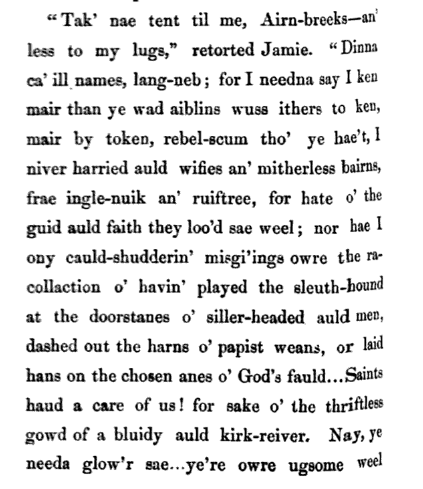
It takes talent to write an entirely incompetent novel, and whoever wrote The Tudor Sisters: A Tale of National Sacrilege (1846) undoubtedly had talent.  There is absolutely nothing right about this novel.  It defies close reading.  (Indeed, at times it defies reading.)  The plot frequently makes no sense and, on two notable occasions, requires important characters to behave like complete fools, in order that they may become dead.  The characterization is innocent of even the remotest attempts at psychological verisimilitude, especially when it comes to Elizabeth I (here represented as such a violent "virago" that it's hard to see how she survived Mary I's reign, let alone her own).  The prose style is Edward Bulwer-Lytton as reimagined by the annual Bulwer-Lytton contest, copiously dotted by random outbreaks of ellipses and, worse still, dubious explosions of Scots dialogue:

Uploaded image

For pages on end, mind you.

One of the novel's more ill-advised decisions involves a new interpretation of Lady Jane Grey's fate in the Tower, which can be summarized thusly:

THE NOVEL: Our perfect and pure heroine will now convince Mary I that it would be a great idea to break Lady Jane out of prison.

READER: Um, that can't possibly--

THE NOVEL: Mary, who is practically a saint, will go along with this plan.

READER: I...I don't think...surely not?

THE NOVEL: Our perfect and pure heroine will interrupt the jail break with some controversial dialogue about Bible-reading and the right of private judgment.

READER: THIS IS NOT THE RIGHT TIME.

THE NOVEL: Hooray! We have now helped Lady Jane escape!

READER: [experiences moment of panic, worries that she has forgotten something important in the history books]

THE NOVEL: Lady Jane, who is extremely intelligent, will now fall for an obvious ploy to recapture her.

READER: [smacks head hard against the desk]

THE NOVEL: Once again, our perfect and pure heroine will try to convince Mary I to let Lady Jane go.

READER: AGAIN?!

THE NOVEL: Our perfect and pure heroine's exhortations bring Lady Jane to at least consider converting to Catholicism, just prior to her execution. 

READER: ...No.

Despite this novel's total lack of redeeming virtues, it probably would have made it into Book Two, at least in passing, as an example of Catholic attempts to recuperate Mary I.  Its attitude to Mary is recognizably derived from the revisionist work of John Lingard and, following Lingard, the Strickland sisters, in which anything bad that Mary did resulted from the pressures of bad political advisers and her Spanish husband.  (Thus, the novel argues that Mary's poor decision-making doomed Catholicism in England for the next several centuries, but those decisions often had good excuses, whereas Elizabeth was just a horrible human being who, apparently, offed Catholics for the heck of it.)   Moreover, its obvious cod Walter Scott qualities (granted, overcooked cod), like the presence of a Meg Merrilies-cum-saintlier-Madge-Wildfire knockoff, exemplify something else I've argued about nineteenth-century Catholic historical novels: in religious fiction, Scott's interest in historical relativism was far more appealing to Catholic novelists than Protestant ones, because it enabled Catholics to locate persecution in specific cultural and national contexts that would not repeat in nineteenth-century England.  Protestant novelists, by contrast, argued that Catholicism was a danger whatever the context, and so the historical record paradoxically testified to the transhistorical nature of Catholic evil. 

One thing about this novel that is slightly unusual is how it materializes Catholicism.  Certainly, in emphasizing Catholicism as a totalizing world-view, one that structures all aspects of human life (festivals, eating, sleeping, worship, etc.), along with its physical presence in the landscape in the form of cathedrals and great manor houses, the novel is conventional enough.  (Similarly, its historical narrative--from Catholic organic wholeness to Protestant fragmentation--is also standard for Catholic fiction.)  But it also spends much more time than is common on clothes and jewelry as embodiments of Catholicism, along with handicrafts such as embroidery.  When Mary appears as a "very meteor of regal splendour" (II: 74) and everyone else at the court dons their brilliant dresses, their spectacular displays of fashion and wealth perform what the novel represents as an explicitly Catholic aesthetic--a celebration of divinely-ordained prosperity in the form of unapologetic ornament.  Similarly, our heroine sleeps in a luxurious bedroom whose beauties are inseparable from faith, whether in the paintings on the walls or the exquisite "coverlet," "bearing in its centre a Roman cross of threads of gold, embroidered by her own fair hand" (I:144).  For the novelist, making, wearing, and using beautiful objects are all ways of participating in a kind of perpetual worship--but a kind only suitable for a world in which Catholicism reigns entirely.  Once the surviving characters are forced into exile after Elizabeth's accession, they immediately abandon their hallowed enjoyments for extremely brief lives of asceticism and atonement, one as an almoner and another as a Poor Clare.  Inasmuch as these shifts doom the novel's central family, they call a symbolic halt to Catholicism's English future on earth (not least because both die in exile) while affirming it in heaven.  The novelist, I think, intends the reader to contrast the fragile qualities of Catholic jewels, paintings, statues, and textiles (easily put aside, destroyed by iconoclasts, etc.) with the more resilient nature of Catholic buildings: the former are ephemeral signs of Catholic success, the latter reminders of its permanence in the face of persecution.

Stumpingford: A Tale of the Protestant Alliance; Jonah, and La Salette

My readers were no doubt waiting with bated breath to hear whether or not Daniel Parsons' Stumpingford (1854), newly rediscovered (in somebody's attic, presumably), would revolutionize our understanding of nineteenth-century British religious fiction--Catholic fiction, in particular.  And the answer is...

Er, no.

I suspect there wasn't a lot of suspense on that score.

Stumpingford satirizes the Protestant Alliance (founded in 1851) and the more general environment of anti-Catholic panic that followed the so-called "Papal Aggression" in the early 1850s.  Like E. C. Agnew's earlier Geraldine, Stumpingford parodies anti-Catholic public meetings, as well as Protestant home missions and--not so light-heartedly--anti-Catholic mobs.  Parsons shares with Protestant controversialists the position that religious belief is the base that enables and explains all other behaviors, so it is no surprise that, given that the Catholic Mr. Preston describes Protestantism as "in itself [...] an umitigated evil" (98), it turns out that Protestant Stumpingford is entirely corrupt.  Elections come with a general helping of bribes, residents over-imbibe on a general basis, the clergy are mostly lazy and un(der)educated, and women in the Burial Club hasten their children's deaths in order to get a payout.  (This last talking point reflects contemporary debates about Burial Clubs; Parsons reprints a newspaper article in an appendix on the topic.)  Moreover, the town is populated by every known Protestant denomination under the sun, a surplus of churches that is one of the novel's significant targets.  Yet in the midst of all the Protestantism, there is the new Catholic church, "built from the designs of a great master" (7) (Pugin, perhaps?), that simultaneously represents historical continuity and religious resurgence.  Significantly, the Prestons are a recusant family, both sides having persisted "with unchanged faith" (64) during the persecutions, and as is often the case in Victorian Catholic fiction, their house is pierced with the secret spaces (priests' holes, concealed chapels) that symbolically testify to Catholic persistence in times of violence.  (Catholicism, that is, is always there.)  But while the new Catholic church attests to growing Catholic self-confidence in the nineteenth century, as they literally exit the concealed chapel for the public place of worship, it also proves to be a lightning rod for renewed assault; for Parsons, newfound toleration for Catholics in the public sphere is fragile at best. 

The novel's real protagonist turns out to be a lapsed Catholic, a working-class man named William Exton who clearly has radical tendencies.  Indeed, the book could just as well have been called The Conversion of William Exton.  Parsons' cautionary tale about how Protestant influence inevitably transformed the orphaned Exton into a free-thinker is the mirror image of Protestant claims about Catholic influences: Parsons insists that Protestantism's ever-subdividing nature naturally leads to atheism because multiple denominations make it impossible to put forward any authorized truth claims, whereas a Protestant would argue, contrariwise, that Catholicism's unified hierarchy naturally leads to atheism because its limitations on individual inquiry make it  impossible to put forward any authorized truth claims.  (As far as Parsons is concerned, "Protestant Alliance" is an oxymoron, as none of his various Protestant characters actually agree with each other, or even like each other all that much.)   In any event, the novel's sub-subtitle refers to the two key questions raised at the Protestant Alliance meeting.  First, do miracles still happen? Second, as Exton himself asks, "'How do you prove [...] that Jonah was ever in the whale's body?'" (35)  Although the novel doesn't do much with the miracles, for some reason (despite it being, you know, in the sub-subtitle), the story of Jonah raises questions about Biblical authority, canonicity, and transmission, which (predictably enough) the Protestants all prove themselves unable to answer.  Poor Exton soon becomes the target of various evangelizing activities, none of which take, especially since both he and Mr. Preston make quick hash of everyone else's arguments.  In terms of narrative form, this is actually the novel's most substantive point, and one that directly engages with evangelical conversion plots: instead of being converted by a) arguments or b) private reading, Exton returns to Catholicism by c) attending Mass.  Nobody argues anybody out of their beliefs; religious transformation only occurs by experiencing communal worship.  In that sense, the novel is both controversial (in that it lays out a number of talking points about apostolic succession, Church authority, and so forth) and anti-controversial (in that it disclaims the sufficiency of such talking-points to get anything accomplished). 

Like many Catholic novels, Stumpingford resists poetic justice.  Bad people live happily ever after, while good people, well, die.  After the Protestant mob nearly destroys the Catholic church and murders both Exton (about which more in a moment) and a policeman, nothing actually happens to them: the mob's leader evades justice entirely (indeed, he winds up testifying to the virtue of all the other Protestant accused) and the Protestants are, by and large, let off with a slap on the wrist, while the Catholics who fought against them wind up prosecuted instead.  The town hits the reset button and returns to normal--that is, to its usual state of corruption.  Exton's death is, in fact, the plot's greatest moment of triumph, a modern martyrdom.  As the mob tears down the crucifix and the statue of Mary--reenacting Reformation iconoclasm, in other words--Exton enters the church in order to save the Sacrament.  After successfully grabbing the ciborium from the ringleader, Exton manages to give it to the priest and then briefly "fell on his knees" (148), a spontaneous act of reverence that signals his full return to faith before he is abruptly trampled during a sudden melee.  This death, the novel explains, is full of divine significance: "Exton's guardian angel would not let him leave the church, where he had nobly risked his life for his Divine Master, without completing the sacrifice.  And so he received a wound, which was to him like the wound of St. Ignatius, a salutevole colpa, a health-giving stroke, and sealed his conversion with his blood" (151).  Exton's shattered body both suggests his own crucifixion and joins him to Ignatius Loyola (who gave up his soldiering for religion after being severely wounded in battle): in Exton's case, the destruction of his body signals not a turn to monasticism, but rather the reenactment of Christ's sacrifice in his own death.  Although Exton's death has no effect on the Protestants, he is posthumously enshrined in the local Catholic community, and the Catholic books from his childhood (not to mention his pet canaries) incorporated into the Preston house library, perpetuating his memory within the tradition maintained by the recusants.  The ultimate effect of the novel is fairly pessimistic: Exton is reintegrated with the Catholic community in death, but otherwise erased, and there's little or no prospect of the Catholics experiencing anything more than the most superficial toleration in the future.  Later Victorian Catholic novels will assume rather different possibilities for social engagement. 

Brief note: not so different

I've spent a fair amount of time here noting that Catholic and Protestant novels tended to take noticeably different paths--in terms of narrative structure and expected outcomes, in particular--but it can be just as interesting to note which authors managed to achieve crossover status by writing works that could be assimilated to multiple theological traditions.  A case in point is the German Catholic children's author Christoph Schmid, whose work, as David Blamires points out, "contains little that is specifically Catholic" (105).  Schmid's Der Zitronenhändler, translated into English as Kainer; Or, the Usurer's Doom, is identifiable as a Catholic work in its English translation only because it was brought out by a Catholic publisher, R. Washbourne.  In fact, the doom in question, in which the nasty Kainer is struck by a lightning bolt and left "lying lifeless on the floor with blackened face" (50), is almost identical to the fate of the equally nasty Tom Watson in Hannah More's Cheap Repository Tract The Thunderstorm, whose body is "scorched by lightening" and turned into a "shocking spectacle" (15).  Similarly, both Kainer and Watson are then turned into edifying texts for the public, Kainer by a funeral marker that tells the "whole simple tale" (63) of his attempt to persecute a local farmer and his punishment, Watson by a funeral sermon and, again, an epitaph that warns readers not to behave like the "bold blasphemer" (16).  The good ended happily, and the bad unhappily, as Oscar Wilde once said--which is normally not, as it happens, a given in Catholic fiction, but is far more likely to be the case in its Protestant counterpart. This is not to say that Schmid could always pass comfortably with his Protestant readers; as Blamires shows in some detail in regards to The Basket of Flowers (1823), his translators usually felt the need to add more explicit "moralizing" (111), among other things (110-13).  But the basic framework of his narratives could be left intact.  It's a useful reminder to be careful about "boxing" authors according to their denominational affiliations, as if the theology necessarily predetermined narrative form...

Some thoughts on the "unreadability" of Victorian religious fiction

My last post was about a novel that was well-nigh unreadable.  By which I mean that, while I certainly read it, it was with a constant aggravated awareness that this novel violated pretty much any principle of formal coherence, aesthetic judgment, or what-have-you that anyone might care to bring to it (and, as the sole reviewer certainly hinted, nobody at the time found it exactly pleasurable either).  It was not quite a "why didn't I become a sports announcer instead" novel, but certainly a "I wish I had a triple chocolate brownie right about now to dull the pain" novel.  But there's another kind of unreadability out there.  I've noted more than once that nineteenth-century religious fiction has a bad habit of thwarting many literary-critical approaches: although didactic genres in general do have some animating tension--most obviously between the goal of controlling the reader's response and the use of formal techniques (dialogue, suspense, etc.) that might open up alternate interpretations--most religious novels resist surface/depth modes of interpretation, and equally resist the kind of close reading you might perform on, say, George Eliot.  One doesn't "unpack" most Victorian religious novels;  with rare exceptions, they come already opened, or they don't do their job.  Instead, they become much more interesting when understood in groups, at which point one begins to see experiment and contestation along with norms and conventions.  The downside of that, of course, is that one has to read...rather a lot of them.   Not surprisingly, most literary critics interested in talking about religion-related matters in the nineteenth century prefer to work on George Eliot than they do on Emma Marshall, and would certainly much prefer to spend time with monographs about George Eliot than they would Emma Marshall (and, indeed, one of the problems I faced with Book Two was that I was interested in tracing a nineteenth-century obsession that canonical novelists wouldn't touch with a proverbial ten-foot pole--and yet, without a canonical novelist in the book, I wouldn't be able to place it).  This is the professional difficulty involved with working on any kind of "minor major genre," not just this one.1

In his recent Good Form: The Ethical Experience of the Victorian Novel, Jesse Rosenthal in part sets out to analyze what comprises the "readable" (127) in a disciplinary sense.  He argues near the end that  "[i]n spite of the fact that we're talking about works from another century, and another country, most of the critical apparatus built around the field depend on the notion that, in talking about the nineteenth century, we are talking about ourselves" (192).  He points out that "we can say that Victorian novels are those novels that do not need to be mediated by historians or interpreters"--that is, even though "[t]hey might benefit from such mediation," the novels "do not seem like they need it" (126-27).  These novels are "readable," especially for our undergraduates, precisely because, in other words, they appear to require no further reading; the Victorian religious novel, by contrast, would qualify as "unreadable" because the reader cannot engage with either their form or their content without spending lots of time getting up the distinctions between the assorted varieties of pre- and post-millennialism, or the like.  But that's an interesting slippage between the students (not all of whom are excited by such things) and the faculty (who surely don't quite have the same excuse).  Significantly, his list of the "twenty-six" writers who inform our "expectations of shared reference" (192) is primarily composed of authors whose writing is often extracted from its theological context (e.g., Austen, the Brontes), can be treated as though the religious references are extraneous (e.g., Stoker) or are mildly to extremely skeptical (e.g., Eliot, Gissing, Hardy, Thackeray).  One can put pressure on Rosenthal's "we" and "ourselves"--the discipline envisioned here seems not to include anyone from Great Britain, to begin with--but the perhaps unconscious underlying point is that "we," the academics, don't see "ourselves" in novels that bear a label saying "Hi, I'm religious," or even, much more expansively, "Hi, I think this is relevant for understanding how my own historical moment works,"  without having any personal identification with a religious tradition, or even religious belief at all.  

But what would it mean to make such a claim? After all,  it's important to remember that many Victorians didn't see themselves in religious fiction--including a considerable number of evangelicals (who suspected that religious fiction was just as corrupting to the moral sense as any other fiction), readers whose religious beliefs ranged from unenthusiastic to non-existent, and a legion of book reviewers (the Saturday Review being an especially good resource for scarifying responses).  Most or all of those readers, given access to a time machine that downloaded twenty-first century syllabi and scholarship, might well think that, really, keeping Victorian religious fiction out of the frame of "shared reference" was no great loss.  Although the anti-novel evangelicals would no doubt have a lot to say about teaching Victorian fiction, period.  And just as the Romantic "big six" would be horrified to find that they've been lumped in with each other, so too would many religious novelists be equally appalled to discover that in the act of recovering them, we've thrown them into the same pile...  Indeed, Rosenthal's point about readability and mediation could be projected back to the period itself: were any novels marked off as "unreadable," and by and for whom? Contrariwise, which religious novels became eminently readable, and again, by and for whom? 

1 It's major, because...really, have you seen just how much nineteenth-century religious fiction exists? But it's minor, because a) we've lost how it intersects with the now-canonical tradition, b) it was always marginal in some respects (the Athenaeum, for example, often refused to review it) and  problematically "serious," for some definition of serious, and c) only a handful of scholars are interested in contemporary religious fiction as part of its own literary tradition. 

The Irish Priest; Or, What for Ireland?

There are some novels so poorly written and constructed that the critic winds up trying to argue that, surely, the failure must be intentional in some fashion.  Take, for example, The Irish Priest; Or, What for Ireland? (1847), a rare example of polemically ecumenical fiction.  Despite the "Preamble," which references the Famine and "falsifications" about the Irish, the novel neither takes current events as its subject nor spends much time on the physical sufferings of Ireland's poorest people (although they are certainly discussed more than once).  Instead, the novel provides a fragmentary and highly-fraught narrative devoted to Father Michael, a conscientious Catholic priest who, nevertheless, has no "vocation," but instead became a priest because "it was all that lay open to me" (51).  Appearing in the otherwise irrelevant Doctor's introduction as a "haggard and meagre" man clearly beset by "disappointment" (6), among other similarly gloomy emotions, Father Michael immediately dies--but not before convincing the Doctor that he is a "'good and pious man'" (10).  Of course, Father Michael leaves behind him a narrative of his life, to which the reader is duly subjected.  The reader who seeks a plot in this narrative is doomed to as much disappointment as Father Michael: it jumps about from topic to topic, from main narrative to inexplicably long inset narrative, and (most notably) from sudden death to sudden death.  This is not one of those books where characters make it to comfortable old age. Father Michael dies in his forties; his beloved childhood friend Marion dies suddenly of some mysterious disease (although not without speechifying at considerable length); his later friend Cornelia is saved from an awful marriage when her evil aristocratic suitor is killed in a duel; a mysterious "Charles," a former priest, sends letters to his beloved before dying of something or other; and Cornelia's saintly brother Cornelius ("C" names are at a premium in this novel--there's also a Conrad and a Cecilia) dies when he is mistaken for another landlord and murdered by a Ribbonman.  All of these characters undertake their adventures in uniformly high-flown prose, whether nostalgically reminiscing about the "turfy green" (98) or enthusing about the "multitudinous firmaments that make up the star-stream" (52), sometimes with disastrous results.  Strictly speaking, as one of its lone (and somewhat sardonic) Victorian reviewers suggests, the endlessly gushy (and mushy) prose, along with the fractured structure, suggest that the novelist was probably trying to imitate eighteenth-century sentimental fiction of the Man of Feeling variety.1  If only it had been published in the eighteenth century, and not in 1847.

Nevertheless, as always, there are a couple of points of interest.  The first, as I said, is the novel's polemical ecumenicism.  On the one hand, the book is not exactly in favor of the priesthood as currently constituted: it repeatedly attacks clerical celibacy, suggests that Maynooth provides almost nothing useful for priests, and represents confession as an often hypocritical undertaking that is more emotionally traumatic for the beleaguered priest than anything else.  Father Michael, who is a priest solely because it's a job, is obviously "disappointed" in part because he can't marry.  On the other, there's no religious controversy and, indeed, nothing in the way of conversion experiences.  The Doctor's house in the beginning is represented as an open space of universal hospitality, a "home house" (5) that admits both the "Presbyterian minister and the priest" (5) alike.  Free of sectarian conflict, the Doctor's house, with its almost magical comings-and-goings of food and wine, is a kind of miniature utopia, one that anticipates Cornelius' much grander ideal estate in the end, with its happily co-existing and subsidized clergy: "Cornelius paid the rector his tithes, the priest his dues, the presbyterian minister his stipend, the methodist preacher his salary; for each was satisfied to receive his conventional hire, without driving the unwilling or coercing the destitute" (161).  In the novel's dream of clerical collaboration, denominational differences give way before the power of divine love, as celebrated as Father Michael's overlong sermon.  Enabled by the ideal landlord, rather than the state, the clergy abandon both conflict and competition in the service of a universalized (if diversified) faith, devoting their time to their congregations instead of their theological differences.  The Doctor's house, with its free inflow and outflow of gifts in the service of total hospitality (his friends are entitled to partake even when he's absent), thus turns out to model an ideal Irish polity, in which differences among (and between) Catholics and Protestants give way to sociable collaboration--but a collaboration which requires that the funding model be strictly impartial, privileging neither Established churches nor Dissenters.  Everybody can "eat," but nobody can demand to eat exclusively.  

Cornelius' utopian estate certainly requires a lot of outlay  As the reviewer rather dryly pointed out, Cornelius' death is "greatly to be regretted, as it deprives us of the opportunity of learning how the very beneficent plans of Cornelius would work."  (Or, more to the point, how they would be funded.)  His project, which involves subsidizing an advanced education, medical care, housing, optional relocation to deluxe colonial outposts, and, of course, religious instruction for all of his tenants, also includes giving the tenants "a direct interest in the fruits of their toil" (155).  The ultimate goal is social harmony, eliminating the bones of contention between landlords and tenants while simultaneously eliminating political agitators.  But Cornelius has something more grand in mind: one day, "the producer and the consumer, the creator of enjoyments and he who revels in them, shall be one and indivisible once more" (158).  Once again, the Doctor's house, in which all are entitled to comfort, returns in Cornelius' utopian (and milennialist) world, where contemporary class divisions give way before a new order of universal luxury--luxuries, however, for which everybody also works.  At the same time, by making the landlord the prime mover in social change, the novel suggests that transformation occurs only in the context of decentralized, face-to-face local relationships; it is key, that is, that utopian hospitality come from somebody.  This position is, in fact, part of the novel's sentimentalism: the landlord must learn to feel for his people.  Social change is paternalist in form (it comes from the top down), but only with the goal of eliminating paternalism altogether in favor of complete social unification.  As Cornelius' murder indicates, however, a bad landlord will produce tenants who feel badly (and, therefore, do bad things); Cornelius' utopia, however, is an estate of entirely good feeling.    In theory, given that the novel itself was supposed to raise money for Irish charities, the whole point of the narrative's elevated emotional temperature was to produce, at a remove, similar effects on its (English?) readership.

1 "Literary Notice," Northern Whig, March 27, 1847: 4.

Rowland Hill's Village Dialogues

Rowland Hill's enormously popular (and enormously long) Village Dialogues (1801; republished frequently thereafter) is notable, as Adrian J. Wallbank argues, for its "eclectic assortment of residual literary techniques and strategies of the type associated with eighteenth-century didacticism, catechetical guidance, parables, and 'stories-within['] while also drawing heavily upon sentimental aesthetics, pathos, and more contemporaneous, if not 'new' strategies such as narrative realism, characterization, and satirical invective."1 Unlike Hannah More's Cheap Repository Tracts, the Village Dialogues function as a coherent novel, albeit with some loose ends not tied up.  In terms of genre, though, the Village Dialogues are also the kitchen sink of Romantic-era evangelical fiction: there are multiple death-bed narratives (good and bad), an abolitionist narrative, multiple conversion narratives, and various diatribes against Catholicism (not good) and Unitarianism (also not good), interspersed with outbreaks into epistolarity and inset lyric verse.  (I did wonder, incidentally, if Jane Eyre's response to her unexpected inheritance, which involves subdividing it amongst her newfound relatives, was a reaction to Hill's Mr. Lovely, who gives away much of his inheritance to his family and others [although the inheritance was expected] and receives some criticism for it from the evangelical clergyman Mr. Lovegood.)  The Village Dialogues2 are at their most novelistic, though, in their treatment of the adulterous and stereotypically emotional Mrs. Chipman, whose fate is notably different than it would have been some decades later.

Mrs. Chipman's passionate affair with the evil and atheistic Sir Charles Dash does not come to a good end, as one would expect from this type of narrative.  Dash is a classic rake, a type Hill tackles three times, insisting that the only means of reforming a rake (an implicit critique of Pamela) is his own conversion.  Hill represents not the affair but its aftermath, in which Mrs. Chipman, overcome by remorse after hearing Lovegood preach on Hebrews 13:4, comes to him and Mr. Worthy in search of assistance.  What interests me about Hill's approach to the situation is that his critique of Mrs. Chipman is at the level of narrative form, far more than it is in terms of the text's content.  Messrs. Lovegood and Worthy, although obviously disapproving, nevertheless spend most of their time trying to restrain Mrs. Chipman from blaming herself too much: Mr. Worthy points out that Dash was obviously a designing seducer who took advantage of her while her husband is gone, an "accidental circumstance" that "must be considered an alleviation of your crime" (XVIII); similarly, Lovegood immediately agrees to intercede with her father in hopes of returning her to her home, on the grounds that she has become a truly "humble penitent" (XIX).  Mrs. Chipman, however, is a problematic narrator of her own plot and characterization, as it were.  When first invited to tell her story, she immediately collapses into "strong hysterics" (XVIII) and castigates herself, leading Lovegood to finally interject "[b]e calm" (XVIII)--but, instead of beginning her narrative, she again berates "the pride and wickedness of my own heart" (XVIII), which prompts a perhaps understandably exasperated Lovegood to point out that they cannot really get anywhere with this subject unless she is "not somewhat more particular in relating your calamities" (XVIII).  The novel in fact sets up Mrs. Chipman's self-loathing as moral excess, incompatible with faith in Christ's ability to save sinners.  Her fragmented narrative is not only punctuated by such stage directions as "too much overcome" to keep going (XVIII), but also by inappropriate attempts to manipulate her audience into a negative reaction; when she cries "[a]fter hearing no more than this, surely you will say that I am the most abominable wretch that ever lived upon the earth" (XVIII), Mr. Worthy simply notes that they really don't have sufficient information to judge her story yet.  Hill treats her hyperbolic and, in some ways, narcissistic interpretation of her own behavior, which the men clearly don't think is all that unusual (i.e., adultery is sinful, but not some shocking novelty), as itself the ongoing manifestation of the emotional flaw that allowed her to give in to Dash's blandishments in the first place.  "Again her grief is excessive" (XVIII), as another stage direction observes. A letter from her father again reduces her to "strong hysterics" (XIX); after praying, she is the "picture of misery and frantic grief" (XIX); thinking of her child, she gives way once more to "excessive grief of mind" (XIX).  Far from being fully converted, the novel suggests, Mrs. Chipman's passionate and self-imploding narrative strategies actually entrap her at the stage of being convicted of sin, in such a manner as to prevent her from contemplating the possibility of transformation or forgiveness.  As tract narration goes, this is the "wrong" approach, one that frustrates and upsets its auditors.   In fact, when other characters spot her later on, one of them inquires if she is suffering from "melancholy derangement" (XXII)--which proves to be foreshadowing.  Upon hearing of her husband's death, she collapses into "total derangement" from her agony (XXVI), and experiences, among other things, Gothic visions of her husband's "murdered emaciated apparition" (XXVI).  But this (temporary) situation, which momentarily reduces her to the status of Gothic victim, is itself an aberrant mode of narration--the most extreme section of the text, even worse than the "bad" death of Mr. Lovely's uncle Mr. Greedy.  Mrs. Chipman is consistently incapable of developing an autobiographical character for herself that does not involve some form of eternal emotional self-punishment, maintained at fever pitch. 

But this is not, in fact, the destiny that the novel intends for her: far from sending her to Australia (as happens to another female character married to a rake) or, as Mrs. Gaskell would later do, immuring her in an isolated valley or killing her off, Hill sends her back to her home town to help run her deceased husband's business and raise her child.  Although her plot is never fully resolved, Hill pointedly insists that she needs to be fully reintegrated with her family and community in order to thrive, physically and spiritually.  Forgiveness, in the world of this novel, is precisely that.   Yet in leaving the conclusion of her plot open-ended, Hill also rejects the mode of evangelical narrative that insists on clearly elucidating all of the this-worldly consequences for behavior.  When she returns home, Mrs. Chipman is still in emotional overdrive; Lovegood is finally reduced to speaking "rather sharply to her" (XXXVI) in order to get her to knock it off.  In a sense, Lovegood becomes the good version of Dash, this time seeking to redirect her emotions to religious rather than erotic purposes.  And like Dash, Lovegood leaves--not because he is disgusted, but because conversion can only be between Mrs. Chipman and God.  While Lovegood offers the community the parable of the Prodigal Son as a means of developing their own narrative about her return, he cannot intervene beyond a certain point in how she chooses to tell her story--and it is at that point that the novel brings her plot to an end, with Hill leaving her to her own narrative devices, as it were, just as Lovegood does. 

1 Adrian J. Wallbank, Dialogue, Didacticism and the Genres of Dispute (2012; Routledge, 2016), 70. 

2 Dialogue numbering varies between editions; I'm citing from the 1825 printing.   

Earl Nugent's Daughter; Or the Last Days of the Penal Laws: A True Story

I celebrated handing in my final grades by reading a Victorian religious novel, as, ah, one does.  Agnes M. Stewart's Earl Nugent's Daughter (1883) is a historical novel about Mary Elizabeth Grenville, Marchioness of Buckingham, who was, as the title advertises, the daughter of Robert Nugent, 1st Earl Nugent.  The novel is rooted in a memoir by Mary's daughter, Lady Mary Arundell of Wardour, and perhaps for that reason suffers from biofic-itis--that is, the tendency to confuse plot with chronological order.  Although the title advertises penal laws, the novel only sporadically remembers to address them; although it also advertises Nugent, he's a relatively minor character (Mary's husband, George Nugent-Temple-Grenville, is far more important); and the novel decides about midway through to spend lots of time on the French Revolution, which is not entirely lacking in sense (Mary helped settle French refugees), but, story-wise, is also not entirely sensible.  Nevertheless, as a Catholic novel it has some interesting features, not least of which is its progressivist vision of English national history when it comes to the Catholic population.

At one level, the novel is a narrative of apparently individual moral mistakes that, in actuality, emerge from political forces beyond anyone's control.  Nugent converts to Protestantism in order to secure his upward political trajectory, early on realizing that "those whose faith he professed were small in number amongst an overwhelming majority"; ranking earthly power above his heavenly salvation, he joins the ranks of "the oppressors" (13) and, indeed, becomes violently anti-Catholic.  His career addresses the paradox articulated by other nineteenth-century Catholic novelists, like Edmund Randolph: under Protestant rule, how is it possible to shape a gentlemanly public identity and retain one's faith? Nugent's fall into Protestantism, which manifests itself in a host of other private failings--not least of which is his authoritarian rule over his daughter--mistakes the sordid negotiations of political life for the true community afforded by the corporate body of the Roman Catholic Church.  Only on his deathbed is he at least partly reconciled with his daughter, as he admits that he has returned to Catholicism (as did the real Robert Nugent) and "beg[s] God to have mercy on you and me" (128).  But this deathbed reunion is subverted by the conditions of Mary's own interfaith marriage to the Protestant Grenville, which forbid her from admitting that, far from remaining Protestant as she had been raised, she too is a Catholic (128).  Yet all this, the novel admits, is not just a matter of Nugent's personal failings and Mary's excessive scrupulousness:

As to the Marquis of Buckingham, his conduct to his wife--in the highest degree a talented and accomplished woman; as a wife, circumspect, faithful, and affectionate--betrays too truly the odious and fearful spirit of the times; that he, an English nobleman of exalted rank, a statesman, highly educated, esteemed and beloved, could yet so fearfully coerce his own wife, shows up in all their horror the fearful penal laws, and the effect they produced.  They made to that unhappy lady, for many years, amidst all her wealth, tyrants of both husband and father, and caused the latter to die, not daring to proclaim himself as one returned to the old faith, because the barbarous laws would take from his own child her rightful inheritance.  (130-31)

The novel is not so much invested in the specifics of the penal laws, then, as it is in how they deform private life.  Mary's life with her husband is blighted not because he is naturally inclined to dominion, but because his own anti-Catholic education and the laws of the time make it essential that he repress her beliefs in order to maintain his position; her relationship with her father is equally blighted for the same reason.  Catholic domestic life under the penal laws is effectively Gothic, with overbearing patriarchs, an "odious and fearful spirit," and a general air of "horror."  At the same time, note how the novel's two primary male characters naturalize unequal relationships under the penal laws: Nugent simply opts for the role of "oppressor" in order to gain power, rather than the far more difficult option of resistance, while the cultured Grenville is unable (for most of the novel, at least) to question his own belief that Catholicism is not something for a "sensible or well-educated person" to "believe" (48).  As the thwarted moment of truth with her father suggests, Mary exists in an in-between space, trapped between the rock of her husband's Protestantism and the hard place of her own Catholicism; her inability to resist her father and, for most of the novel, her husband suggests the limits to her Catholic heroism.  Unlike other Catholic novels, which emphasize characters experiencing Catholicism in community (hearing Mass, for example), Earl Nugent's Daughter represents the tragedy of Catholic life under the penal laws in Mary's forced isolation: until her husband slowly relents in the wake of his experiences with French clergymen, she spends most of the novel communicating alone, at one point hearing Mass only by eavesdropping.  The penal laws forcibly dismember the Catholic body.

At the same time, the novel celebrates an emerging English tolerance for its Catholic community--symbolized in Grenville's slowly-increasing willingness to give his wife religious liberty, until eventually her beliefs are no secret at all--and here, I think, is where both the Gordon Riots and the French Revolution come in.  In a sense, the novel goes double Dickens, reworking (not very subtly or gracefully) both Barnaby Rudge and A Tale of Two Cities.  Like Dickens, Stewart stews about mobs.  But in counterpointing the Gordon mobs and the Revolutionary mobs, Stewart arrives at what seems like a paradoxical conclusion: Protestant England ultimately does a much better job of containing violence against its Catholic community than does Catholic France.  For that matter, Protestant England turns out to be a welcoming save haven for the French Catholic community, complete with monetary support that was "honourable to the charity of the English nation" (216).  Earl Nugent's Daughter shows surprisingly little interest in converting Protestants--notably, Grenville remains Protestant throughout (as per the historical record), something unusual in Catholic fiction.  Instead, it cheers for a more capacious understanding of Englishness, one in which, contra Dickens, it is possible to speak of one's Catholicism and fully participate in civic life.  In a key flash-forward, the novel conjures up the "attentive and well-conducted Protestants" (78) who calmly listen to Cardinal Wiseman speak in St. George's Cathedral, near one of the sites where Lord George Gordon urged the rioters on (78).  But despite the Papal Aggression controversy, we are informed that "John Bull has become more sensible" (79), and so there is no retread of the Gordon Riots.  The Protestants show no sign of converting en masse, but they have nevertheless learned to be "sensible"--a sensibility that enables them to enter a Catholic church as honorable guests, not rioters.  This "sensible" Englishness does not make Protestantism and Catholicism interchangeable, but it does enable a kind of mutual hospitality, in which Protestants are welcomed into Catholic churches in much the same way that French Catholics had been welcomed into England.  Everyone is at home, and everyone is a guest.  

Crane Pond: A Novel of Salem

At the end of Richard Francis' Crane Pond, its protagonist, Samuel Sewall, takes a walk with his oldest daughter, Hannah, and shows her, far off in the distance, the eponymous pond.  As they look at it, she sees some cows, and muses, "I love cows" (347)--which is news to Sewall, who remembers her earlier loathing of said animal.  But, he thinks, "she didn't mislead him then, and she isn't telling untruths now.  As the past makes its pilgrimage to the future it must transform itself or there would be no heaven to look forward to" (347).  Although Crane Pond is a novel about the Salem Witch Trials, told from the point of view of the one judge who later confessed that he had wrongly convicted innocents, it is also a meditation on the junction of truth, history, and community--or, to use another word important to the novel, "fellowship."  The conclusion, in which Sewall envisions the possibility of a new America in a world perhaps less self-confident than that of the previous generation, is optimistic, even though the narrative that has led up to it is far more guarded.  In part, that may be because of the literary-historical past of the Trials, from Hawthorne forward.  Certainly, for many twenty-first century Americans, at least, the Trials come mediated to us via Arthur Miller's The Crucible, and in some respects, Crane Pond dissects that play--indeed, one of the first characters to see through the girls' behavior, Mr. Brattle, does so because he has actually gone to the theater, and recognizes that "[w]atching them at their tricks is exactly like watching a play in Covent Garden" (176).  Sewall, as it happens, is nowhere to be found in The Crucible, but his journey to self-accusation parallels that of Miller's John Proctor, who finds redemption ("a shred of goodness") in the act of refusing to confess.  This is a journey, however, from the point of view of the persecutor, not the persecuted.

Mr. Brattle's insight about the girls' behavior highlights the role that cultural frames play in interpreting events.  Significantly, Sewall did not go to the theatre in England, and early on, he dissuades a local tavernkeeper from building a little theater for a magician (53).  Sewall's disinterest in to dislike of theatricality turns out to be his Achilles heel, as he cannot imagine that the girls' contortions and expressions of pain are anything but authentic testimony to spiritual suffering.  Although the novel puts a number of other characters in the dock for cruelty, Sewall is represented throughout as a believer in childhood innocence and an optimist about election; his actions during the trials reflect compassion for the girls, whose witness he believes to the point of disavowing his own senses.  When the girls accuse John Proctor of somehow projecting himself up to the roof, Sewall both sees him there and doesn't (120).  Sewall lives in a world inhabited by spirits and divine portents, where empirical evidence seems simply inadequate.  Unlike The Crucible, Crane Pond is not interested in the accusers' motivations; instead, it turns them into embodiments of contemporary terror, colonial fears (mysterious animal attacks, raids by local Native American tribes, etc.) made manifest.  (When Betty Parris, one of the original accusers, is separated from the others, she simply returns to "normal.") The adults see what their beliefs prime them to see, even though in some cases it's obvious that a girl is being manipulated (physically, in one instance) by someone else.  Mr. Brattle sees through the girls not because he is a religious skeptic, but because of his greater cultural competency; Sewall, by contrast, is proud to say that when he went to England, he not only left his "wits" in America, but his "heart" and "soul" along with it (178).  Brattle's very mild cosmopolitanism primes him to detect ambiguities where Sewall can only see truth/lies, yes/no--a belief in binaries and absolutes that does not stand up against the complex forces at work in the trials. 

Sewall himself is a character of mixed motives, as he occasionally admits.  He is a devout man who excitedly interprets events in the light of Biblical prophecy, but he also temporizes and waffles when decision is called for.  He is merciful (not, in other words, the fanatical Puritan famous from centuries of stereotyping), but his refusal to stand up during the trials is also compensation for what he perceives as his own wishy-washiness during a piracy case some years earlier.  He disavows the worldly pleasures of theater, but loves to eat--in fact, he spends a good chunk of the novel eating, thinking about eating, or buying things to eat.  (In a particularly creepy moment, his first thought after condemning a woman to death is to get to his dinner as quickly as possible.)  Although the eating is comical,  it also carries more substantive force: when he feels himself being tweaked by Mr. Brattle over eating habits, Sewall thinks to himself, "[s]o many discussions and meetings take place over a good meal; so much business can be transacted; so many friendships cemented.  Dinner is at the heart of family life, just as the Lord's Supper is at the heart of congregational worship" (291).  For Sewall, eating represents one of the primary forms of community-building, domestic and divine.  Eating together is an act of fellowship, defined by mutuality and exchange, a moment of hospitality and openness.  Significantly, after Sewall's confession, the most influential of his former colleagues on the bench snubs him by not inviting him to a dinner, an act that echoes his minister's decision to exclude him from the congregation after Sewall insists on burying his stillborn child in the family vault.  

One cause for Sewall's increasing anxiety during the trials (even though he mostly remains silent) rests on a different form of disfellowship: the clergymen who refuse to pray with the condemned prisoners. Brattle angrily describes to Sewall how all the ministers in attendance at one of the final executions refused the prisoners' requests for final prayers (244), something that one of the clergymen, Mr. Noyes, had earlier twice refused to do.  When Sewall asks Noyes to pray for Rebecca Nurse, Noyes instead sneers that "I am not her man of God [...] Not now, nor ever was" (212).  Their attitudes are discomfiting to him in part, it is implied, because they simply reenact his own belief in binaries and firmly-delineated truths: one is or is not saved, one is or is not of the church, one is or is not telling the truth, and so on.   But refusing to pray with someone, like refusing to eat with them, is more about the self than the other.  Noyes and the other ministers prioritize their own purported holiness over the needs of another soul; they desire an essentially selfish form of being-with-others (I do not render myself vulnerable; I only share another's pain only when I believe it safe to do so), instead of the commonality that Sewall associates with eating and prayer.  (Sewall's understanding of community is itself limited, inasmuch as he cannot even begin to conceptualize "fellowship" with non-Christians--he believes in the possibility of full fellowship with Native Americans, for example, but only insofar as he also thinks that they are descended from the Ten Lost Tribes of Israel and potential future converts.) Yet the yearning for fellowship can be just as dangerous, Sewall comes to realize, as the refusal to extend it: as he eventually admits to himself, he has been desperately salving his conscience by taking "a collective view of the whole tragedy, concentrating on the notion of fellowship, a fellowship that disappeared when the community divided against itself, then formed again" (325).  Calls for fellowship may be about mutuality, openness, and sharing--but, as Sewall realizes, they can also be a form of sleight-of-hand in which the community is forced to bear a burden that rightly belongs to the individual soul.  If everyone was responsible, then nobody was.

Sewall's decision to confess in front of his congregation, taking full responsibility for his sins during the trial, is rendered deliberately anti-triumphal.  It is here that the novel most obviously inverts The Crucible, which ends with John Proctor heroically affirming his "goodness" and heading off to martyrdom, accompanied by his wife's praise and the frantic breakdowns of the Revs. Hale and Parris.  In Sewall's case, the moment turns into theater, the theater that Sewall has resisted all the way along.  First, Sewall finds himself wondering if his confession was just "an act of sinful vainglory" (337), given how many others were involved--is he assuming too much guilt in the act of confessing his own? And then, in order to somehow exit the confessional scene, he winds up bowing to the congregation, "a hypocritical action, as you would expect of the theater, since it pretends humility while claiming credit" (337).  The confession, intended to reveal the sinner's self, turns out to be both scripted and easily appropriated for unintended purposes; having spent the novel worrying about community, Sewall finds that he cannot escape the demands imposed by his own.  The self he believes he creates for himself in the act of confession rapidly escapes him.  Sewall's unexpectedly theatrical confession turns out to be cathartic for the congregation, as they now think there's nothing more to be done, but that is not, to say the least, a desirable outcome. Indeed,  Sewall's unease in the wake of his confession registers the non-heroism of his act: to accept and publically proclaim one's guilt in the death of innocents is moral, but hardly reverses the fact of the crime.  As Sewall quietly thinks to himself, ruminating on the men and women who refused to lie to save themselves, "[t]hose were the brave acts, not this one" (339).  Ultimately, Sewall's confession turns him into a kind of scapegoat, leaving him "half in, half out" (340) of his church and, symbolically, both badly-fed at an inn and denied a dinner invitation.  Having finally told the truth in a novel that is all about people denying truths right in front of their eyes, it makes sense, as even Sewall himself admits, that his fate is "ostracism" (342).