Victorianist and inveterate book buyer.  

Wuthering Heights

I have not read any full-length reviews of the new Wuthering Heights adaptation. However I did see a number of responses on social media that were, shall we say, somewhat acerbic in tone. I therefore entered the movie theater (with all of five other people) with...well, not optimism, to be frank, but a bit of trepidation. "It can't be that appalling," I told myself.

Reader, it indeed could be that appalling.

Now, look: I occasionally teach classes on adaptation (one on Sherlock Holmes, another on Jane Eyre), and so I don't judge adaptations on fidelity alone. And creative appropriations of original works can be extraordinarily interesting in their own right. Yet both adaptation and appropriation succeed or fail on their engagement with the original--exploiting the potential of the shift to a new medium or even genre; exploring a work's key elements from a historical distance; moving a secondary character to the front; etc. (For example, the famous 1940s Picture of Dorian Gray--the one that shifts to technicolor for Ivan Albright's painting--cleverly brings out a point that students often miss in the novel, which is that Dorian is the only character for whom the painting makes any sense. Far from being a legible confession, to anyone else the painting is not even recognizably Dorian.) As even a loose reworking of Wuthering Heights, this film simply does not say much of anything about the novel. It does not even say much of anything about previous adaptations, even though its elimination of Generation Two is itself a conventional choice, as is its reading of Heathcliff's and Cathy's relationship as a fairly mundane romance.

In the interest of fairness, I will admit that the film does pick up on the role of windows in the novel--Heathcliff and Cathy watch each other through windows, Heathcliff comes into Isabella's bedroom through a window, Heathcliff breaks a window in anger, Cathy does the multiple last name thing on her bedroom window, and so on. Turning Nelly Dean into the villain in Heathcliff's and Cathy's relationship, while stretching a critical point, does at least draw on an interpretive tradition that sees some holes in her unreliable narration when it comes to her agency, as well as her interest in Heathcliff (and it's worth noting that in the novel, she inadvertently gives Heathcliff the idea for his revenge). By the same token, Nelly is correctly represented as a near-contemporary of Heathcliff and Cathy, not considerably their senior.

My fairness has now exhausted itself. It's not that the film has no ideas; it just drops them in and drops them out again. Hareton's illiteracy, for example, is given to Heathcliff, but Heathcliff never learns to read or write (not true in the novel), and is bizarrely reduced to demanding that Isabella write fictions about how terrible her life with him is in order to get Cathy to come visit. When Cathy II teaches Hareton to read, the characters enter into a relationship of care very different from Heathcliff dictating Linton Heathcliff's love letters. In the film, Heathcliff refuses to learn to read (perhaps not surprisingly, as Cathy is an incompetent teacher), and then...the point never comes back until the very end, when Isabella sneers at him in the midst of their (completely unbelievable) sadomasochistic, er, thingy that they have going on. (No, I don't know why they have a sadomasochistic, er, thingy going on either.) Similarly, Heathcliff buys Wuthering Heights from Earnshaw, but the film's Earnshaw, doing double duty for Hindley, doesn't need to be tricked out of it. It's not even clear that there's a revenge motive in play, let alone that Earnshaw cares all that much. Meanwhile, there actually are hints that the film meant to do something meaningful with the casting for Nelly and Edgar Linton, given Earnshaw's very specific snobbishness in relation to the two of them (this Nelly is the illegitimate daughter of a lord, and Edgar Linton is nouveau riche), but...it does not do that? What is the point?

What is the point, indeed. Despite the frequently bizarre set and costume designs--adult Cathy never foregoes a chance to show off her decolletage, including in the middle of winter--the film fails to be surreal, let alone Gothic. No, lots of fog and weird rock formations are not sufficient unto the day. There's some attempt at color painting with Cathy's endless red and white costumes (blood! passion! get it?) and, perhaps more successfully, the candy-colored Thrushcross Grange, but the stylization never truly comes off. There is a lot of sex, adulterous and otherwise, frequently in some extraordinarily stupid places. ("Yes, we can get it on in my bedroom, which is right across from Edgar's. Of course, sex in a carriage. No, I didn't have to explain anything to the coachman. Sex on the grounds is an excellent idea.") Oh, and the sex equals death, of course, given the fakeout introduction (where the apparently orgasmic sounds we hear are actually a man dying on the gallows, which...arouses...several members of the public). Given how relentlessly secular the film is, aside from the unexplained presence of a nun in full habit, it's not surprising that there's no real sense of forces at work beyond the material. Heathcliff and Cathy are not larger than life in their selfishness; in fact, this Heathcliff is a rather boring non-entity, lacking the original's malevolent energy. His manipulation of Isabella is the closest he gets to evil--not surprising, given that most of the evil manifests during his revenge plot--but here, she seems to be enjoying herself and has to be forcibly dragged away in the rain. (Characters do get rained on a lot.) Spoiler: the cute dog remains unhanged. You can't see either Heathcliff or Cathy bothering to come back from the grave.

Academics vs. technology

Last week, we had a bit of a scare: GoogleBooks suddenly stopped returning search queries. Of anything. Initially, it appeared that they no longer wanted us to be able to search inside copyrighted materials; then, those books came back, as did all the others. I haven't found any comment from Google about what was perhaps just a glitch in the code.

In any event, to say that this struck terror into the hearts of academics is not too much of an understatement. While there had already been some very longstanding issues with the search function--trying to get it to perform a keyword search within your own library has been a useless endeavor for years--the GoogleBooks library is still essential for literary historians in particular. Or, rather, it has made itself essential. The only real competitors are HathiTrust and archive.org (the latter of which sometimes has full text of public domain material that GoogleBooks only has in snippet view, for reasons unclear to, well, anyone). If you are an academic at a regional comprehensive, like yours truly, then you have only limited access to subscription databases and even more limited access to travel funds. (Even I can acquire only so many Victorian religious novels.) The free online libraries enable us to do everything from annotating (e.g., tracking down misquotations) to assembling virtual collections (e.g., Victorian novels about colportage). They're now part of the academic infrastructure, so to speak.

My Year in Books

  • Favorite historical novels: Graeme Macrae Burnet, Benbecula; Michael Crummey, The Adversary
  • Best historical novel with a ghost as one of the protagonists: Laura Elvery, Nightingale
  • Historical novel with the most unusual narrator: Olga Ravn, The Wax Child
  • Neo-Victorian novel with the most unexpected mashups: Virginia Teito, Victorian Psycho
  • Historical novel with the most abrupt ending: Suzanne Desroches, A Bride of New France
  • Favorite genre deconstruction: Anna Biller, Bluebeard's Castle
  • Favorite single-author horror collection: Nathan Ballingrud, Wounds 
  • Favorite horror (?) novel: Steven L. Peck, A Short Stay in Hell
  • 1930s horror novel with the most uncomfortably realistic subplot: Alexander Laing's The Cadaver of Gideon Wyck (one of the protagonists is the president of a state college who is forever worried about the likelihood of the legislature stripping its funding)
  • Favorite Victorian novels I had not read previously: Anthony Trollope, Mr. Scarborough's Family; Mary Taylor, Miss Miles
  • Best novels reread for a class: Anthony Trollope, Doctor Thorne; Jeannette Ng, Under the Pendulum Sun 
  • Best twentieth-century ghost (sort of) story reflecting on Jane Eyre: Marjorie Bowen, "Elsie's Lonely Afternoon"
  • Most times the line "the author doth protest too much, methinks" swam into my head while reading a novel: Philip Pullman, The Rose Field
  • Novel I suspected that I would dislike intensely, and, in fact, I did: Martha Wells, All Systems Red  
  • Most surprisingly competent Victorian religious novels: Jean Ingelow, Allerton and Dreux; Lily Watson, The Vicar of Langthwaite
  • Victorian religious novelist most defeated by any format longer than three hundred or so pages: William Francis Barry
  • Favorite twentieth-century religious novels: Sheila Kaye-Smith, The End of the House of Alard; Rumer Godden, In this House of Brede
  • There really were an unusual number of nuns and pseudo-nuns in my reading this year: Agustina Bazterrica, The Unworthy; Rumer Godden, In this House of Brede; Lauren Groff, Matrix; Viggy Parr Hampton, The Rotting Room; Caitlin Starling, The Starving Saints
  • Book bargain that most people would probably find it odd to be excited about: William Jackson, Stories and Catechisings in Illustration of the Collects (all three volumes)
  • Most useful yet exasperating bibliographical discovery while in the British Library: slowly realizing that some cataloger in the nineteenth century had misattributed a number of tracts
  • Unexpurgated memoir belatedly expurgated: the first edition of William Carus Wilson's Memoir of a Beloved and Long-Afflicted Sister (1831) (the second edition erases its subject's rather, um, snippy comments about various guests, as well as all the complaints about one of her brothers being a terrible correspondent)
  • Most antiquarian purchases: three volumes of Berquin's The Children's Friend (1786); Harriet Corp, Coelebs Deceived (1817); Elizabeth Sandham, The Twin Sisters (1819)
  • Most useful but ill-advised purchase while traveling: three volumes of Chester W. Topp's Victorian Yellowbacks and Paperbacks, which was a bit heavy to lug back in one's suitcase
  • Arguably the oddest book to be carting around in one's purse: John Mahoney, The Making of Moral Theology
  • Most interesting Victorian studies monographs: Alexander Murray, Decadent Conservatism; Joseph McQueen, Liturgy, Ritual and Secularization in Nineteenth-Century British Literature
  • Most interesting non-Victorian studies monographs: Arnold Hunt, Protestant Bodies: Gesture in the English Reformation; Timothy Rosendale, Liturgy and Literature in the Making of Protestant England
  • Book that I apparently misshelved somewhere and therefore wound up buying a second time out of sheer frustration: Peter Sangster, Pity My Simplicity

Brief note: Miss Miles

Mary Taylor's Miss Miles: A Tale of Yorkshire Life Sixty Years Ago (1890) sounds firmly Walter Scott-ish in its subtitle, but Taylor had in fact been working on it since at least the early 1850s, and its claim to be in the classic mode of nineteenth-century historical fiction is therefore the ironic result of the extraordinarily long stretch between initial drafting and eventual publication.  If anything, to a reader in 1890 Miss Miles would appear to slot into the "New Woman" subgenre (although the novel's skepticism about the false pieties associated with genteel womanhood overlaps with some of Geraldine Jewsbury's work, like the short story "Agnes Lee").  The novel's religious history, meanwhile, is a sort of reverse Robert Elsmere situation: whereas Mrs. Humphry Ward projects a number of past religious  controversies forward into the novel's present, Miss Miles retrojects the late-Victorian "Nonconformist conscience" into the 1830s.  Miss Miles' unidentified Dissenters (who appear to be some sort of Independent) divide into the parents' generation, who are devout believers, and the new generation, who even when apparently devout seem to think little about salvation and damnation.  (One of the novel's running minor conflicts is about a new chapel, which some of the younger characters want specifically for the singing, not so much the preaching.)  The title character, Sarah Miles, has inherited what the narrator repeatedly calls her family's "Puritan" sensibilities, but in practice this Puritanism (as well as that of her eventual husband, Sam Sykes) is articulated in secular terms: seeking after honest speech and action, self-improvement, and independence rooted in working-class community.  But the novel's best Anglicanism, too, is largely a matter of moral culture rather than godliness.  Maria Bell, a clergyman's daughter, shapes her life not around her father's preaching, but rather his call to think beyond personal sufferings: "'When your own affairs seem past mending, where there seems no hope of gladness in your life, try to help someone else, and light will come'" (32).  This call to think about the self in relation, rather than in staunchly individualist terms, is one of the novel's rare examples of functional didacticism, in the sense that it is not only shown to be true within the narrative (rather than simply being a truism), but also that it can be done.

Miss Miles has didactic things to say, but much of the novel is pitched against "the didactic" as an incompetent educational strategy.  Its most tragic victim is the agonizingly earnest Amelia Turner, youngest daughter of a family whose fortunes go fatally off the rails over the course of the novel.  Sarah, who yearns to understand the undefinable knowledge purportedly possessed by "ladies," is initiated early on into Amelia's sayings: "She earnestly informed Sarah that one ought always to speak the truth, to be industrious and frugal, etc., etc.  Sarah listened approvingly, having all these commonplaces bred in the bone, and looked anxiously for something more" (201).  Amelia believes in the one-to-one application of commonplaces to both everyday and extraordinary circumstances; she engages with other characters as though all of their speech is entirely expressive of their interiority.  She inverts Jane Eyre's Mr. Rochester, who repeatedly authorizes his moral choices by their purely local "circumstances."  By contrast, Amelia cannot register situational complications, whether class prejudices or gendered expectations--something that puts her at a distinct disadvantage in conversation with the creepy Mr. Thelwal, her father's primary creditor, who listens to her with a "covert sneer" (204) and always changes course when she firmly informs him that something "'would not be right'" (205).  Amelia is, to a very great extent, precisely what she says, which is why of all the novel's characters she is the only one who cannot rebound once her worldview shatters.  (Such shattering characterizes the narrative arcs of all four major female characters, and--except for Amelia--abruptly forces them to revalue their emotions, choices, and futures.) Her rejection of her mother's authority near the novel's end ("'I will never again do what you tell me, or believe a word you say'" [416]) heralds her death, not her independence.  Whereas Maria Bell, who has a bad habit of resorting to platitudes early on, can nevertheless reflect and build on moments where the platitudes conspicuously fail to yield results, Amelia has developed no mental resources to rewrite her commonplaces in a new key.   

The Little Professor has relocated

As Typepad will be closing down at the end of September, I have (thanks to Olly) relocated my blog here.   Although there's no longer a sidebar, just about everything present in the last iteration should be here.   This is the blog's third incarnation, after coming to life as an anonymous endeavor on Blogspot.  

My Year in Books

Favorite fiction: Jon Clinch, The General and Julia; Amy Crider, Kells; Liam Davison, The White Woman; John Ehle, The Land Breakers; Percival Everett, James; Fiona Kidman, The Captive Wife; Karen Powell, Fifteen Wild Decembers; Ann Schlee, Rhine Journey.

What is this I have just read, the sequel: Brendan Connell, Cannibals of West Papua.  

Novel least like what I was expecting: Rachel Cantor, Half-Life of a Stolen Sister.  

Novel with the best unreliable narrator: Sebastian Barry, Old God's Time.  

I admit that I did not anticipate this plot twist: Hannah Kent, Devotion.  

Most (unintentionally?) unappealing protagonist of a trilogy: Rain in Gregory Maguire's Another Day series.

Detective novel with most implausible stunt by the main character: Ian Rankin, A Song for the Dark Times.  

Detective novelist who appears to have developed Doyle/Christie Syndrome: Ian Rankin (albeit in regards to supporting character Malcolm Fox).

Most lugubrious detective series, ongoing: John Banville, The Lock-Up.

Most metafictional detective novel: Kate Atkinson, Death at the Sign of the Rook.  

Horror author I'm enjoying at the moment: Nathan Ballingrud.  

Most brutal Victorian historical novel: Emily Lawless, Maelcho.  

Best novel reread for class: Charles Dickens, Bleak House.  

Victorian religious novel title most likely to cause confusion in the 21st century: W. J. Conybeare, Perversion.  

Most "I'm beginning to think this author may be confused" experience while reading a Victorian religious novel: F. W. Robinson, High Church.  

Excerpt from a Victorian religious novel most likely to make students go "???!!!!": the "Story on the Sixth Commandment" from Mrs. Sherwood, History of the Fairchild Family (the one with the rotting corpse).

Victorian novel eliciting the most "This novel is a great candidate for distant reading.  As in, why am I not 100 miles distant from this novel" response from me: Lucas Malet, The History of Sir Richard Calmady.  

Moment of greatest not-altogether-scholarly exasperation: discovering that a novella by Malet was a loose sequel to Richard Calmady.  

Most "well, that was convenient" death in a early twentieth-century religious novel: Josephine Ward, The Light Behind.  

Best antiquarian acquisition: Anne Carus Wilson (wife of William, a.k.a. Mr. Brocklehurst in Jane Eyre), Children's Stories in Children's Words. (Most copies of this book have vanished.)

Monograph I'm really excited to read next year: Joseph McQueen, Liturgy, Ritual, and Secularization in Nineteenth-Century British Literature.  

Saltiest monograph: M. Wynn Thomas, In the Shadow of the Pulpit.  

My Year in Books

Favorite historical fiction: William Golding, The Spire; Benjamin Myers, Beastings; Benjamin Myers, Cuddy; Kate Atkinson, Shrines of Gaiety; Fred D'Aguiar, Feeding the Ghosts; Hernan Diaz, In the Distance.  

Favorite neo-Victorian mashup: Adam Roberts, The Death of Sir Martin Marprelate.

Favorite political allegory: Raphaela Edelbauer (trans. Jen Calleja), The Liquid Land.  

Favorite biofiction: Karen Powell, Fifteen Wild Decembers.  

Only religious memoir with an autopsy report included?: William Carus Wilson, Memoir of a Beloved and Long-Afflicted Sister.

Best horror-cum-social satire: Joan Samson, The Auctioneer.  

Novel eliciting the most "wait, what did I just read" reaction: Brendan Connell, The Translation of Father Torturo.

Victorian ghost stories I'm always happy to reread: Mary Elizabeth Braddon, "At Chrighton Abbey"; Elizabeth Gaskell, "The Old Nurse's Story."

Most Gothic biography: Daphne du Maurier, The Infernal World of Branwell Bronte.   

Favorite little-known psychological horror novel: Frank Baker, The Twisted Tree.   

Trend that I hope is coming to a close: Sherlock Holmes mashed up with Lovecraft.  

Mystery series I thought couldn't get any more lugubrious, and yet, it did: John Banville's Quirke (no longer published under the Benjamin Black pseudonym?).

Novels with endings that made me say "...really?!": Maggie O'Farrell, The Marriage Portrait; Elizabeth Hand, A Haunting on the Hill.  

Most unusual horror collection: Brian Evenson, The Glassy, Burning Floor of Hell.

Favorite horror anthology: Joyce Carol Oates, ed., A Darker Shade of Noir.  

Most competent long poem by Branwell Bronte?: "Sir Henry Tunstall."

Most competent Victorian religious novelist: Emma Jane Worboise.  

Most cheerful Victorian religious novel: J. W. Keyworth,  Willie's Secret

Best friend (well, arguably) of a famous novelist with the worst handwriting: Ellen Nussey.  

Victorian clergyman-diarist least willing to take a stand on anything: Henry Nussey.  You would think that the man could at least have an opinion about witnessing people speaking in tongues, but apparently not.  

Grimmest experience reading nineteenth-century correspondence: a tie between Thomas J. Wise making off with chunks of Ellen Nussey's collection of Charlotte Bronte's letters and his buddy Clement Shorter making off with (just about all of) Arthur Bell Nicholls' collection of Charlotte Bronte's everything else.   

Most grudging antiquarian purchase: a volume of William Carus Wilson's sermons.  

Most aggravating experience teaching with e-texts: a website I had been using for years suddenly vanished without a trace.  

There is no excuse for a POD book to cost this much: Margaret Smith, ed., The Letters of Charlotte Bronte: Volume Three.  

A Victorian religious novelist sells a copyright, 1870

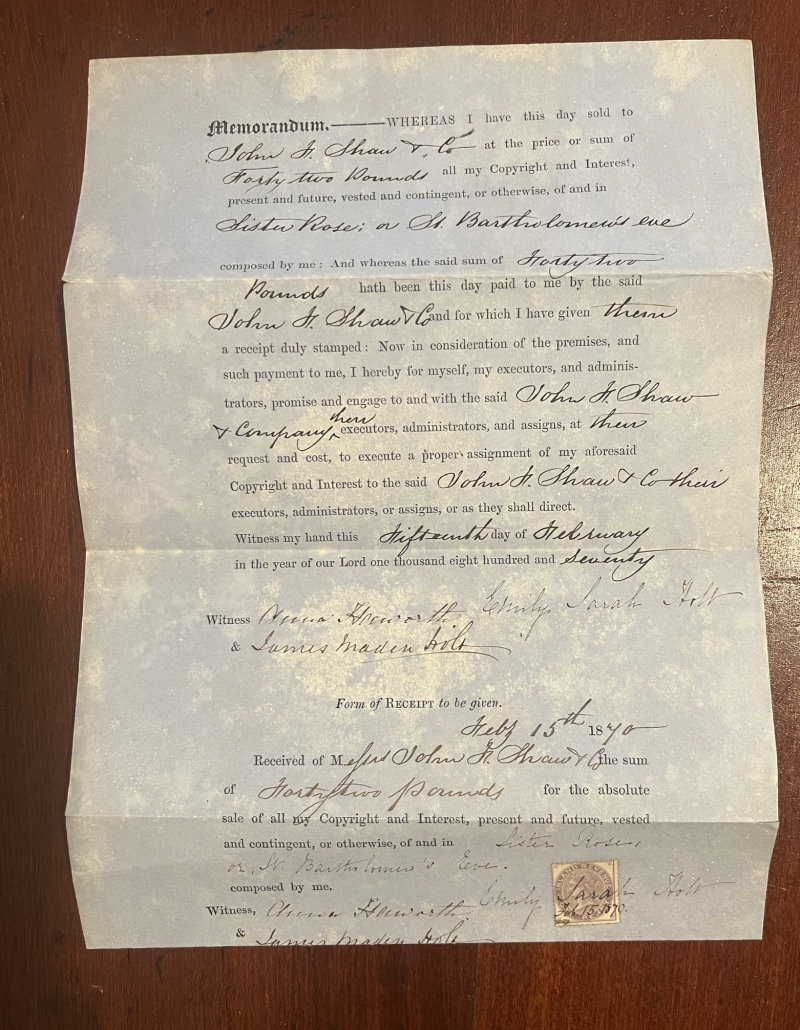
Here's an interesting document that just came into my possession: it's a memorandum between Emily Sarah Holt and the publisher John F. Shaw for the sale of copyright to her novel Sister Rose:

Uploaded image

The witnesses are Holt's brother James Maden Holt, MP and his fiancee, Anna Haworth.  Holt sold the copyright for forty-two pounds.

One of the problems with writing the history of nineteenth-century religious fiction from the nuts-and-bolts angle--copyrights, royalties, correspondence with publishers, recruiting authors, in-house readers, etc.--is that virtually all of the publishers' archives have simply vanished.  This is true even for still-extant publishers like the Religious Tract Society (now Lutterworth), where only partial records are available, and Burns and Oates (now Sheed and Ward), where the backfile survives but apparently not anything else.  It's quite possible that some archives are still hanging about in attics or on top of wardrobes!  This is the first time I have come across anything from John F. Shaw, a publisher with a large trade in relatively inexpensive Evangelical prize books.  

In 1870, Holt would have been at the beginning of her novel-writing career.  She had published a work of historical biography in 1861, Memoirs of Royal Ladies (2 vols.), with Hurst and Blackett, but the book was not well-received--not least because such collective biographies were regarded as an overworked genre by that point.  However, after regrouping, she had a good reception for Mistress Margery: A Tale of the Lollards (Shaw, 1868).  Holt was therefore not an unknown quantity, but not an established bestseller, either.  For comparative purposes, one of the Religious Tract Society's most popular novelists, Hesba Stretton, had up until the mid-1860s been receiving "between 30 guineas and £50 for single-volume stories," [1] which suggests that for this type of publisher and this type of book, £42 would not have been outrageously low.  It would be interesting to see what Holt was able to command a decade later.  

[1] Elaine Lomax, The Writings of Hesba Stretton: Reclaiming the Outcast (Farnham, Surrey: Ashgate, 2009), 74.  

My Year in Books

Favorite historical novels: Naivo, Beyond the Rice Fields; Mirandi Riwoe, Stone Sky Gold Mountain; Julie Janson, Benevolence; Stevie Davies, Awakening; Rose Tremain, Lily: A Tale of Revenge.

Favorite genre anthologies: Jess Walter, ed., The Best American Mystery and Suspense 2022; Mark Morris, ed., Close to Midnight.

Favorite single-author short story genre collection: Lisa Tuttle, The Dead Hours of Night.

Favorite genre deconstructions: John Darnielle, Devil House (true crime); J. W. Ocker, Twelve Nights at Rotter House (haunted house).

Favorite horror novel: Alison Rumfitt, Tell Me I'm Worthless

Author whose willingness to make himself look terrible in fiction never ceases to amaze: Anthony Horowitz's Hawthorne series.

Guaranteed to be the least-interesting villain in any neo-Victorian novel: Jack the Ripper.

Series detective with the most unconvincing ongoing career: Ian Rankin's Inspector Rebus.

Somewhat puzzling genre development: multiple haunted-house novels that were just not...scary? (Not even in a "protagonist forced to plumb the depths of their misbegotten psyche" way.)

Biography with the most overblown title: John Lock and W. T. Dixon, A Man of Sorrow: The Life, Letters, and Times of the Reverend Patrick Bronte,  1777-1861.

Favorite biography: Michael Ledger-Lomas, Queen Victoria: This Thorny Crown.

After owning this monograph for nearly three decades, I finally have a reason to cite it: Gananath Obeyesekere, The Apotheosis of Captain Cook.

Favorite book reread for class: Henry James, The Turn of the Screw.

Most antiquarian book purchase: a Religious Tract Society sammelband, featuring tracts published between 1785-90.  

Howl! It's the annual Halloween Horror post...Christmas edition?!

Well, technically,  the Christmas Annual edition! As all good Victorianists know, the proper season for ghost stories was Christmas, so this year, I bring ghost stories published in Victorian periodicals' Christmas numbers.

  • Anon., "Catherine's Quest" (Tinsley's Magazine, 1868).  A young woman has a very detailed dream about the intrigues (and murders) committed by her ancestors.  Also, there's a chest with human remains.  
  • ---, "Experiences of Farthing Lodge" (Chambers' Journal, 1864).  Renters discover that on the fifteenth of each month, they share their lodgings with...something else.  
  • Charles Collins, "No. 3 Branch Line.  The Compensation House" (All the Year Round, 1866).  A man has a very strange aversion to mirrors.
  • W. W. Fenn, "The Steel Mirror: A Christmas Dream" (Routledge's Christmas Annual, 1867).  Prophetic mirrors are always aggravating, especially when somebody misreads the prophecy.  
  • Eliza Lynn Linton, "Christmas Eve in Beach House" (Routledge's Christmas Annual, 1870).  An artist's wife has a very bad feeling about one of the locals.  Scandalous revelations eventually ensue.  This annual also includes a comic (and not well-executed) story about a young clerk obsessed with his employer's money, with what one presumes are ultimately fatal results, and another one about a tyrannical ship's captain who gets his comeuppance.
  • ---, "The Legend of Lady House" (Routledge's Christmas Annual, 1869).  Women with dubious pasts, poisoning, curses, etc.  
  • W. E. Norris, "The Specter of Strathannan" (Unwin's, 1887).  Apparently, a ghost appears to anyone who has terrible deeds upon their conscience.  Or does it?
  • John Oxenford,  "His Umbrella" (All the Year Round, 1862).  A gentleman finds himself stuck with an aggravatingly persistent umbrella.
  • Robert Reece,  "The Ghost in the Green Room" (Routledge's Christmas Annual, 1880).  The ghost of a failed actor decides it's finally time to get onstage.  

My (Second) Pandemic Year in Books

(Like rather a lot of other people, or so Twitter tells me, I found myself unable to read for anything except work for much of 2021.  More recently, I've found myself getting fully back into the swing of things.)

Best postcolonial rewrite of Adam and Eve: Michael Crummey, The Innocents.  

Best historical novels: Maggie O'Farrell, Hamnet; Mudrooroo, Master of the Ghost Dreaming.

Best postapocalyptic novel: Paul Kingsnorth, Alexandria.  

Neo-Victorian fiction will be immensely improved by forgetting this personage ever existed: Jack the Ripper.  

"Well, that's a plot twist," I said, dubiously: Christian Klaver, The Classfied Dossier: Sherlock Holmes and Count Dracula.

Sherlock Holmes novel that unintentionally makes a good case for the current Mrs. Watson divorcing the Doctor: Nicholas Meyer, The Return of the Pharoah: From the Reminiscences of John H. Watson, M.D.

Perhaps we are exhausting this mine of pastiches: Sherlock Holmes.  

Novelist most willing to make himself look incompetent in fiction: Anthony Horowitz, A Line to Kill.  

Most interesting tribute anthology: When Things Get Dark: Stories Inspired by Shirley Jackson.

Best horror anthology: The Valancourt Book of World Horror Stories, Volume One.  

Most epic schlimazels in the history of horror?: the protagonists of Gretchen Felker-Martin, Ego Homini Lupus.  

Creepiest use of medical terminology: Michael Blumlein, "Tissue Ablation and Variant Regeneration: A Case Report" (in Ellen Datlow, Body Shocks).

Most disturbing revenge tale: Kaaron Warren, "A Positive" (ditto).

Favorite monograph sent for review: Josephine McDonagh, Literature in a Time of Migration: British Fiction and the Movement of People, 1815-1876.

Favorite monographs on literature and religion: Christopher Stokes, Romantic Prayer: Reinventing the Poetics of Devotion, 1773-1832; Christopher D. Phillips, The Hymnal: A Reading History

Favorite historical monographs: Joseph Hardwick, An Anglican British World: The Church of England and the Expansion of the Settler Empire, c. 1790-1860; Rachel Wheeler, To Live upon Hope: Mohicans and MIssionaries in the Eighteenth-Century Northeast.

Academic publisher whose business model I continue not to understand: Palgrave Macmillan.    

Finally, I found a copy of this: Rachel McCrindell, The Convent; A Narrative, Founded on Fact.  

Physically smallest book purchased this year: Old Jessie, The Hindoo Mother (a Methodist tract).

Most underrated short story by a Victorian woman writer?: Geraldine Jewsbury, "Agnes Lee."

Best mildly irate Victorian response to Jane Eyre: Margaret Oliphant, "The Story of a Wedding-Tour."

Least-enjoyable epic-length nineteenth-century poem: Charlotte Elizabeth, Osric.  

Every time I teach it, I am again convinced that this is Mary Elizabeth Braddon's best short story: "At Chrighton Abbey."

Victorian ghost stories of a sort that tend not to be anthologized: Mrs. Molesworth, The Collected Supernatural and Weird Fiction.  

Modernist novel with the worst TV adaptation: Ford Madox Ford, The Good Soldier

Hark! It's this year's installment of Hellacious and Horrific Happenings for Halloween! Academia Edition

This blog arises from the dead for its annual cavalcade of horror stories.  This year, we feature...haunted professors, students, and academics of all stripes, somewhat loosely construed.  OK, very loosely construed.  In a number of cases, the horror is also somewhat loosely construed...

  • "The Harvard College Ghost" (Ghost Stories: Collected with a Particular View to Counteract the Vulgar Beliefs in Ghost and Apparitions, 1846).  A prank goes off script.  
  • "The College Ghost.  A Legend of Old South Middle" (Yale Literary Magazine, 1856).  A young man is visited by a ghastly vision that actually turns out to be a pretty terrible pun on this edition of Horace.
  • S. Baring-Gouid, "The Brunswick Ghost" (Cassell's Family Magazine, 1887).  The ghost of an academic with some unfinished business comes back looking for help.
  • J. Edmund V. Cooke, "The Hypnotized Ghost" (Overland Monthly, 1893).  A hypnotist finds himself controlling his the ghost of a dead man.
  • M. R. Gilkeson, "Hobgoblins" (Oliver Optic's Magazine, 1873).  For children.  A German professor is invited out to help investigate the mystery of some ghostly sounds.  
  • Henry Hill, "Professor Falkenstein's Ghost Story" (Godey's Magazine, 1878).  Professor Falkenstein narrates a story about making a deal with a musical ghost, only for there to be an unexpected twist.
  • [Mary Ann Hoare], "The Ghost-Raiser" (Household Words, 1852).  A skeptical student faces off against the horror raised by a fellow traveler.  Er, sort of.
  • M. R. James, "Oh, Whistle, and I'll Come to You, My Lad."  A professor ignores one of the most important rules in horror fiction: never take a vacation.  
  • Augustus Jessopp, "An Antiquarian's Ghost Story" (Lantern, 1977; first published in 1880).  An antiquarian doing some research has a visitor.  And that's pretty much it.
  • J. S. Le Fanu, "An Account of Some Strange Disturbances in Aungier Street" (Dublin University Magazine, 1851).  Two medical students discover that they're sharing their rooms with an unpleasant resident.
  • Bram Stoker, "The Judge's House" (1891).  In a tip of the hat to Le Fanu, a student rents a house and, again, discovers that he's sharing his rooms with an unpleasant resident.
  • [Walter Thornbury], "How Professor Gaster Lectured a Ghost" (All the Year Round, 1862).  After eating rather too much at dinner, Professor Gaster is surprised by the company of two chatty skeletons.  He out-chats them, however.  (In some versions, "Professor Gaster" is "Professor Pepsine.")

Semester Report: Fall 2019

What sound do I hear? The sound of readers wondering where on earth I went, I imagine.  The physical "where" has to do with House the Trilogy, which had various, uh, issues that left me without furniture until (checks notes) mid-October and without unpacked books until (checks notes again) now.  As in, I finished unpacking them on Tuesday (proper shelving has now commenced).  The mental "where" followed on from the physical one, as I was admittedly rather depressed for a good chunk of the semester--and also really, really behind.  Who would possibly have thought that finishing articles on time with no access to your library might be...hard? Impossible, even?  In any event, I decided that while I could justify tweeting while I had articles overdue, I most certainly could not justify blogging.  

*sigh* Anyway.

Here are the ongoing adventures of a full professor at a regional comprehensive college in Western New York:

Teaching:

  • I taught two courses (I have a course release for administrative reasons; see below), one a seminar on early Gothic and the other Honors Composition.  The seminar was an updated version of an earlier course, while composition was, as always, entirely new.  

Service:

  • This is my final year as associate chair (the associate chair's position runs concurrently with the chair's, and the chair decided not to come back for another term).  There may be a further adventure on the horizon, however...
  • I served on an ad hoc committee for promotion to full professor.
  • I was on the graduate committee.

Scholarship:

  • I completed two commissioned articles, one on women writers and Victorian Unitarianism (awaiting editorial corrections) and one on the novel and religion for a Cambridge Companion.
  • I sent back the proofs on an article that may annoy some historians.  It is, appropriately enough, appearing in a history journal.
  • I completed two book reviews.  
  • I delivered a paper at NAVSA.  
  • I signed a book contract.  

In which I check in

Life has been interesting! Also, I am behind on an article, and as I had to request an extension, I felt guilty about doing much in the way of blogging.  Nevertheless, a couple of things have happened:

1) I'm writing a book about...Charlotte Bronte! An author of whom people have actually heard! This is a momentous occasion that may never occur again, so mark the date.  (Religion, however, is still involved.  Religion is actually the point.)  In any event, the book is under contract for OUP's "Spiritual Lives" series, with a manuscript delivery date of 2024.  

2) I purchased a house with my parents, so I have been dealing with putting my current house on the market, packing up (I move next month), and handling contractors.  Needless to say, this has been eating a lot of my spare time since about March.  The new house is a Victorian mansion--

BLOG READERS: Oh, she's speaking figuratively--

--No, I mean, it's an actual 7200 sq ft Victorian mansion from 1850--

BLOG READERS: What the--

--With, um, parlors, cool decorative ceilings, lots of mahogany--

BLOG READERS: Are you even kidding me--

--OK, so we just had to install a third furnace--

BLOG READERS: Please describe your thought processes--

--It's...just a really cool house, OK? (Also, the twentieth-century section of the house is suitable for long-term parental stays, which was the point.). The twentieth-century addition has to be completely redone, but the original house, most of which will be given over to yours truly, just needs cosmetics (floor restoration, painting) and some electrical updating.  

I am now officially banned from ever complaining about a lack of space for books.

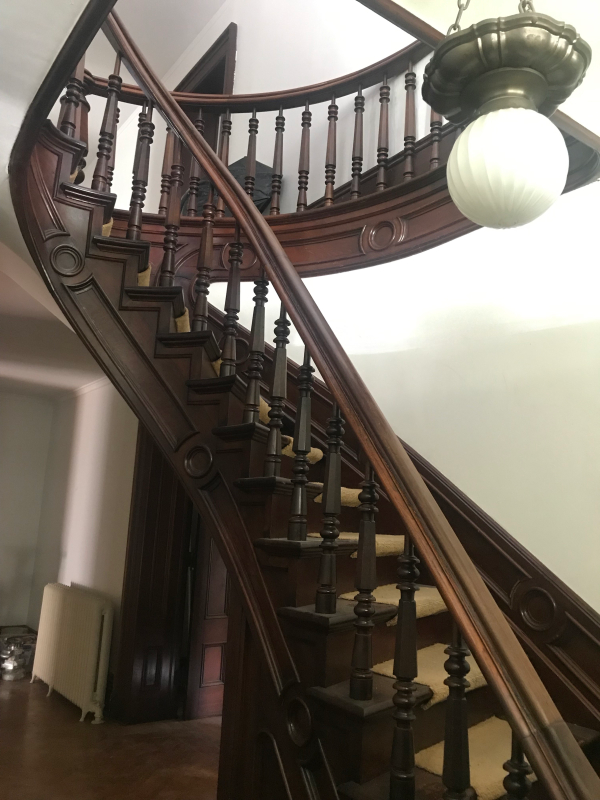
Main staircase drama (I'll need to replace the runner once all the upstairs painting is finished):

Uploaded image

One of the neat things about the house is that many of the original details have been preserved, like the doorknobs:

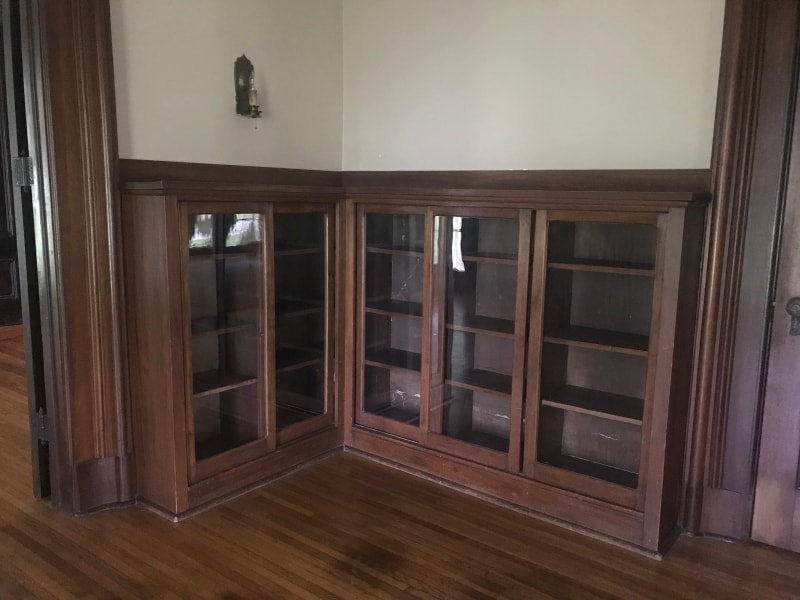
Nineteenth-century glassed-in bookcases in the second parlor:

Uploaded image

If nothing else, I will now have 19th-c. vibes to help me while I write.

This Last Few Weeks' Acquisitions

  • Frederika MacDonald, Nathaniel Vaughan: Priest and Man (Asa K. Butts, 1874).  US reprint of novel about an Anglican priest suffering from increasing religious doubt.  
  • Mrs. J. Sadlier, trans., Ten Stories from the French of Balleydier (Sadlier, 1866).  Catholic didactic tales for children.
  • Marly; or, a Planter's Life in Jamaica, ed. Karina Williamson (Macmillan Caribbean, 2005).  Scholarly edition of an anonymous pro-slavery novel, following the experiences of a young man trying to regain his property.  First published in 1828.
  • Varley O'Connor, The Welsh Fasting Girl (Bellevue, 2019).  Historical novel about an American journalist investigating Sarah Jacobs.
  • Matthew Plampin, Mrs. Whistler (Borough, 2019).  Historical novel about Maud Franklin during Whistler's lawsuit against John Ruskin.  
  • Marlon James, Black Leopard, Red Wolf (Riverhead, 2019).  First installment in a fantasy trilogy about a man's quest for a mysterious child, and its repercussions.  
  • David Ceri Jones, Boyd Stanley Schlenther, Eryn Mant White, The Elect Methodists: Calvinistic Methodism in England and Wales, 1735-1811 (University of Wales, 2016).  Studies the branch of Methodism associated with George Whitefield and its influence. 
  • Todd Webb, Transatlantic Methodists: British Wesleyanism and the Formation of an Evangelical Culture in Nineteenth-Century Ontario and Quebec (McGill-Queen's, 2013).  Complex international (and interpenetrating) relationships between the British and Canadian Methodist churches.
  • Mary Hilton, Women and the Shaping of the Nation's Young: Education and Public Doctrine in Britain 1750-1850 (Ashgate, 2007).  How domestic pedagogy in particular was linked to the nation's moral, political, and spiritual health.
  • Valerie Grosvenor Myer, Charlotte Bronte: Truculent Spirit (Barnes and Noble, 1987).  Literary study with emphasis on intellectual and religious influences.  
  • Joshua King and Winter Jade Werner, eds., Constructing Nineteenth-Century Religion: Literary, Historical, and Religious Studies in Dialogue (Ohio, 2019). Expanded papers based on a conference at Baylor in 2015.  (I'm in here.)
  • Allan Hepburn, ed., Troubled Legacies: Narrative and Inheritance (Toronto, 2007).  Essays analyzing the inheritance trope in relationship to religion, the Gothic, national identity, gender, etc.  
  • Sarah Graham, ed., A History of the Bildungsroman (Cambridge, 2019).  Essay collection covering the bildungsroman from its beginnings to the present.  (I'm reviewing this for Choice.)