Victorianist and inveterate book buyer.  

Posts tagged with academic

My Year in Books

Favorite historical fiction: William Golding, The Spire; Benjamin Myers, Beastings; Benjamin Myers, Cuddy; Kate Atkinson, Shrines of Gaiety; Fred D'Aguiar, Feeding the Ghosts; Hernan Diaz, In the Distance.  

Favorite neo-Victorian mashup: Adam Roberts, The Death of Sir Martin Marprelate.

Favorite political allegory: Raphaela Edelbauer (trans. Jen Calleja), The Liquid Land.  

Favorite biofiction: Karen Powell, Fifteen Wild Decembers.  

Only religious memoir with an autopsy report included?: William Carus Wilson, Memoir of a Beloved and Long-Afflicted Sister.

Best horror-cum-social satire: Joan Samson, The Auctioneer.  

Novel eliciting the most "wait, what did I just read" reaction: Brendan Connell, The Translation of Father Torturo.

Victorian ghost stories I'm always happy to reread: Mary Elizabeth Braddon, "At Chrighton Abbey"; Elizabeth Gaskell, "The Old Nurse's Story."

Most Gothic biography: Daphne du Maurier, The Infernal World of Branwell Bronte.   

Favorite little-known psychological horror novel: Frank Baker, The Twisted Tree.   

Trend that I hope is coming to a close: Sherlock Holmes mashed up with Lovecraft.  

Mystery series I thought couldn't get any more lugubrious, and yet, it did: John Banville's Quirke (no longer published under the Benjamin Black pseudonym?).

Novels with endings that made me say "...really?!": Maggie O'Farrell, The Marriage Portrait; Elizabeth Hand, A Haunting on the Hill.  

Most unusual horror collection: Brian Evenson, The Glassy, Burning Floor of Hell.

Favorite horror anthology: Joyce Carol Oates, ed., A Darker Shade of Noir.  

Most competent long poem by Branwell Bronte?: "Sir Henry Tunstall."

Most competent Victorian religious novelist: Emma Jane Worboise.  

Most cheerful Victorian religious novel: J. W. Keyworth,  Willie's Secret

Best friend (well, arguably) of a famous novelist with the worst handwriting: Ellen Nussey.  

Victorian clergyman-diarist least willing to take a stand on anything: Henry Nussey.  You would think that the man could at least have an opinion about witnessing people speaking in tongues, but apparently not.  

Grimmest experience reading nineteenth-century correspondence: a tie between Thomas J. Wise making off with chunks of Ellen Nussey's collection of Charlotte Bronte's letters and his buddy Clement Shorter making off with (just about all of) Arthur Bell Nicholls' collection of Charlotte Bronte's everything else.   

Most grudging antiquarian purchase: a volume of William Carus Wilson's sermons.  

Most aggravating experience teaching with e-texts: a website I had been using for years suddenly vanished without a trace.  

There is no excuse for a POD book to cost this much: Margaret Smith, ed., The Letters of Charlotte Bronte: Volume Three.  

A Victorian religious novelist sells a copyright, 1870

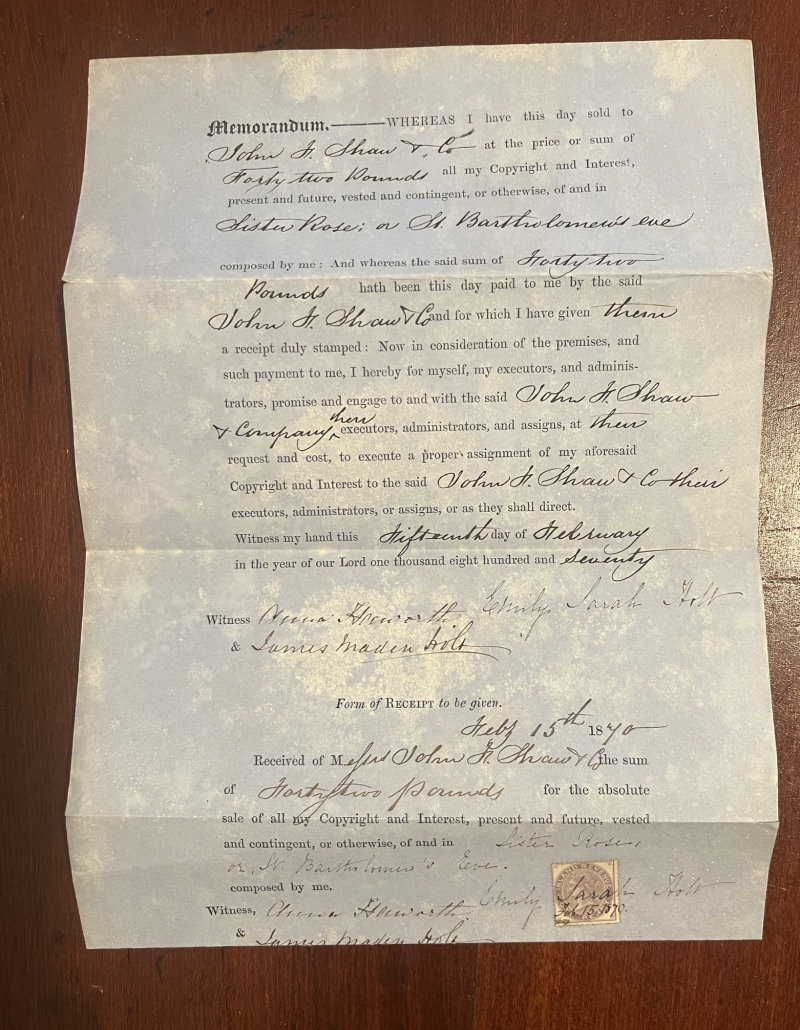
Here's an interesting document that just came into my possession: it's a memorandum between Emily Sarah Holt and the publisher John F. Shaw for the sale of copyright to her novel Sister Rose:

Uploaded image

The witnesses are Holt's brother James Maden Holt, MP and his fiancee, Anna Haworth.  Holt sold the copyright for forty-two pounds.

One of the problems with writing the history of nineteenth-century religious fiction from the nuts-and-bolts angle--copyrights, royalties, correspondence with publishers, recruiting authors, in-house readers, etc.--is that virtually all of the publishers' archives have simply vanished.  This is true even for still-extant publishers like the Religious Tract Society (now Lutterworth), where only partial records are available, and Burns and Oates (now Sheed and Ward), where the backfile survives but apparently not anything else.  It's quite possible that some archives are still hanging about in attics or on top of wardrobes!  This is the first time I have come across anything from John F. Shaw, a publisher with a large trade in relatively inexpensive Evangelical prize books.  

In 1870, Holt would have been at the beginning of her novel-writing career.  She had published a work of historical biography in 1861, Memoirs of Royal Ladies (2 vols.), with Hurst and Blackett, but the book was not well-received--not least because such collective biographies were regarded as an overworked genre by that point.  However, after regrouping, she had a good reception for Mistress Margery: A Tale of the Lollards (Shaw, 1868).  Holt was therefore not an unknown quantity, but not an established bestseller, either.  For comparative purposes, one of the Religious Tract Society's most popular novelists, Hesba Stretton, had up until the mid-1860s been receiving "between 30 guineas and £50 for single-volume stories," [1] which suggests that for this type of publisher and this type of book, £42 would not have been outrageously low.  It would be interesting to see what Holt was able to command a decade later.  

[1] Elaine Lomax, The Writings of Hesba Stretton: Reclaiming the Outcast (Farnham, Surrey: Ashgate, 2009), 74.  

My Year in Books

Favorite historical novels: Naivo, Beyond the Rice Fields; Mirandi Riwoe, Stone Sky Gold Mountain; Julie Janson, Benevolence; Stevie Davies, Awakening; Rose Tremain, Lily: A Tale of Revenge.

Favorite genre anthologies: Jess Walter, ed., The Best American Mystery and Suspense 2022; Mark Morris, ed., Close to Midnight.

Favorite single-author short story genre collection: Lisa Tuttle, The Dead Hours of Night.

Favorite genre deconstructions: John Darnielle, Devil House (true crime); J. W. Ocker, Twelve Nights at Rotter House (haunted house).

Favorite horror novel: Alison Rumfitt, Tell Me I'm Worthless

Author whose willingness to make himself look terrible in fiction never ceases to amaze: Anthony Horowitz's Hawthorne series.

Guaranteed to be the least-interesting villain in any neo-Victorian novel: Jack the Ripper.

Series detective with the most unconvincing ongoing career: Ian Rankin's Inspector Rebus.

Somewhat puzzling genre development: multiple haunted-house novels that were just not...scary? (Not even in a "protagonist forced to plumb the depths of their misbegotten psyche" way.)

Biography with the most overblown title: John Lock and W. T. Dixon, A Man of Sorrow: The Life, Letters, and Times of the Reverend Patrick Bronte,  1777-1861.

Favorite biography: Michael Ledger-Lomas, Queen Victoria: This Thorny Crown.

After owning this monograph for nearly three decades, I finally have a reason to cite it: Gananath Obeyesekere, The Apotheosis of Captain Cook.

Favorite book reread for class: Henry James, The Turn of the Screw.

Most antiquarian book purchase: a Religious Tract Society sammelband, featuring tracts published between 1785-90.  

Howl! It's the annual Halloween Horror post...Christmas edition?!

Well, technically,  the Christmas Annual edition! As all good Victorianists know, the proper season for ghost stories was Christmas, so this year, I bring ghost stories published in Victorian periodicals' Christmas numbers.

  • Anon., "Catherine's Quest" (Tinsley's Magazine, 1868).  A young woman has a very detailed dream about the intrigues (and murders) committed by her ancestors.  Also, there's a chest with human remains.  
  • ---, "Experiences of Farthing Lodge" (Chambers' Journal, 1864).  Renters discover that on the fifteenth of each month, they share their lodgings with...something else.  
  • Charles Collins, "No. 3 Branch Line.  The Compensation House" (All the Year Round, 1866).  A man has a very strange aversion to mirrors.
  • W. W. Fenn, "The Steel Mirror: A Christmas Dream" (Routledge's Christmas Annual, 1867).  Prophetic mirrors are always aggravating, especially when somebody misreads the prophecy.  
  • Eliza Lynn Linton, "Christmas Eve in Beach House" (Routledge's Christmas Annual, 1870).  An artist's wife has a very bad feeling about one of the locals.  Scandalous revelations eventually ensue.  This annual also includes a comic (and not well-executed) story about a young clerk obsessed with his employer's money, with what one presumes are ultimately fatal results, and another one about a tyrannical ship's captain who gets his comeuppance.
  • ---, "The Legend of Lady House" (Routledge's Christmas Annual, 1869).  Women with dubious pasts, poisoning, curses, etc.  
  • W. E. Norris, "The Specter of Strathannan" (Unwin's, 1887).  Apparently, a ghost appears to anyone who has terrible deeds upon their conscience.  Or does it?
  • John Oxenford,  "His Umbrella" (All the Year Round, 1862).  A gentleman finds himself stuck with an aggravatingly persistent umbrella.
  • Robert Reece,  "The Ghost in the Green Room" (Routledge's Christmas Annual, 1880).  The ghost of a failed actor decides it's finally time to get onstage.  

My (Second) Pandemic Year in Books

(Like rather a lot of other people, or so Twitter tells me, I found myself unable to read for anything except work for much of 2021.  More recently, I've found myself getting fully back into the swing of things.)

Best postcolonial rewrite of Adam and Eve: Michael Crummey, The Innocents.  

Best historical novels: Maggie O'Farrell, Hamnet; Mudrooroo, Master of the Ghost Dreaming.

Best postapocalyptic novel: Paul Kingsnorth, Alexandria.  

Neo-Victorian fiction will be immensely improved by forgetting this personage ever existed: Jack the Ripper.  

"Well, that's a plot twist," I said, dubiously: Christian Klaver, The Classfied Dossier: Sherlock Holmes and Count Dracula.

Sherlock Holmes novel that unintentionally makes a good case for the current Mrs. Watson divorcing the Doctor: Nicholas Meyer, The Return of the Pharoah: From the Reminiscences of John H. Watson, M.D.

Perhaps we are exhausting this mine of pastiches: Sherlock Holmes.  

Novelist most willing to make himself look incompetent in fiction: Anthony Horowitz, A Line to Kill.  

Most interesting tribute anthology: When Things Get Dark: Stories Inspired by Shirley Jackson.

Best horror anthology: The Valancourt Book of World Horror Stories, Volume One.  

Most epic schlimazels in the history of horror?: the protagonists of Gretchen Felker-Martin, Ego Homini Lupus.  

Creepiest use of medical terminology: Michael Blumlein, "Tissue Ablation and Variant Regeneration: A Case Report" (in Ellen Datlow, Body Shocks).

Most disturbing revenge tale: Kaaron Warren, "A Positive" (ditto).

Favorite monograph sent for review: Josephine McDonagh, Literature in a Time of Migration: British Fiction and the Movement of People, 1815-1876.

Favorite monographs on literature and religion: Christopher Stokes, Romantic Prayer: Reinventing the Poetics of Devotion, 1773-1832; Christopher D. Phillips, The Hymnal: A Reading History

Favorite historical monographs: Joseph Hardwick, An Anglican British World: The Church of England and the Expansion of the Settler Empire, c. 1790-1860; Rachel Wheeler, To Live upon Hope: Mohicans and MIssionaries in the Eighteenth-Century Northeast.

Academic publisher whose business model I continue not to understand: Palgrave Macmillan.    

Finally, I found a copy of this: Rachel McCrindell, The Convent; A Narrative, Founded on Fact.  

Physically smallest book purchased this year: Old Jessie, The Hindoo Mother (a Methodist tract).

Most underrated short story by a Victorian woman writer?: Geraldine Jewsbury, "Agnes Lee."

Best mildly irate Victorian response to Jane Eyre: Margaret Oliphant, "The Story of a Wedding-Tour."

Least-enjoyable epic-length nineteenth-century poem: Charlotte Elizabeth, Osric.  

Every time I teach it, I am again convinced that this is Mary Elizabeth Braddon's best short story: "At Chrighton Abbey."

Victorian ghost stories of a sort that tend not to be anthologized: Mrs. Molesworth, The Collected Supernatural and Weird Fiction.  

Modernist novel with the worst TV adaptation: Ford Madox Ford, The Good Soldier

Semester Report: Fall 2019

What sound do I hear? The sound of readers wondering where on earth I went, I imagine.  The physical "where" has to do with House the Trilogy, which had various, uh, issues that left me without furniture until (checks notes) mid-October and without unpacked books until (checks notes again) now.  As in, I finished unpacking them on Tuesday (proper shelving has now commenced).  The mental "where" followed on from the physical one, as I was admittedly rather depressed for a good chunk of the semester--and also really, really behind.  Who would possibly have thought that finishing articles on time with no access to your library might be...hard? Impossible, even?  In any event, I decided that while I could justify tweeting while I had articles overdue, I most certainly could not justify blogging.  

*sigh* Anyway.

Here are the ongoing adventures of a full professor at a regional comprehensive college in Western New York:

Teaching:

  • I taught two courses (I have a course release for administrative reasons; see below), one a seminar on early Gothic and the other Honors Composition.  The seminar was an updated version of an earlier course, while composition was, as always, entirely new.  

Service:

  • This is my final year as associate chair (the associate chair's position runs concurrently with the chair's, and the chair decided not to come back for another term).  There may be a further adventure on the horizon, however...
  • I served on an ad hoc committee for promotion to full professor.
  • I was on the graduate committee.

Scholarship:

  • I completed two commissioned articles, one on women writers and Victorian Unitarianism (awaiting editorial corrections) and one on the novel and religion for a Cambridge Companion.
  • I sent back the proofs on an article that may annoy some historians.  It is, appropriately enough, appearing in a history journal.
  • I completed two book reviews.  
  • I delivered a paper at NAVSA.  
  • I signed a book contract.  

In which I check in

Life has been interesting! Also, I am behind on an article, and as I had to request an extension, I felt guilty about doing much in the way of blogging.  Nevertheless, a couple of things have happened:

1) I'm writing a book about...Charlotte Bronte! An author of whom people have actually heard! This is a momentous occasion that may never occur again, so mark the date.  (Religion, however, is still involved.  Religion is actually the point.)  In any event, the book is under contract for OUP's "Spiritual Lives" series, with a manuscript delivery date of 2024.  

2) I purchased a house with my parents, so I have been dealing with putting my current house on the market, packing up (I move next month), and handling contractors.  Needless to say, this has been eating a lot of my spare time since about March.  The new house is a Victorian mansion--

BLOG READERS: Oh, she's speaking figuratively--

--No, I mean, it's an actual 7200 sq ft Victorian mansion from 1850--

BLOG READERS: What the--

--With, um, parlors, cool decorative ceilings, lots of mahogany--

BLOG READERS: Are you even kidding me--

--OK, so we just had to install a third furnace--

BLOG READERS: Please describe your thought processes--

--It's...just a really cool house, OK? (Also, the twentieth-century section of the house is suitable for long-term parental stays, which was the point.). The twentieth-century addition has to be completely redone, but the original house, most of which will be given over to yours truly, just needs cosmetics (floor restoration, painting) and some electrical updating.  

I am now officially banned from ever complaining about a lack of space for books.

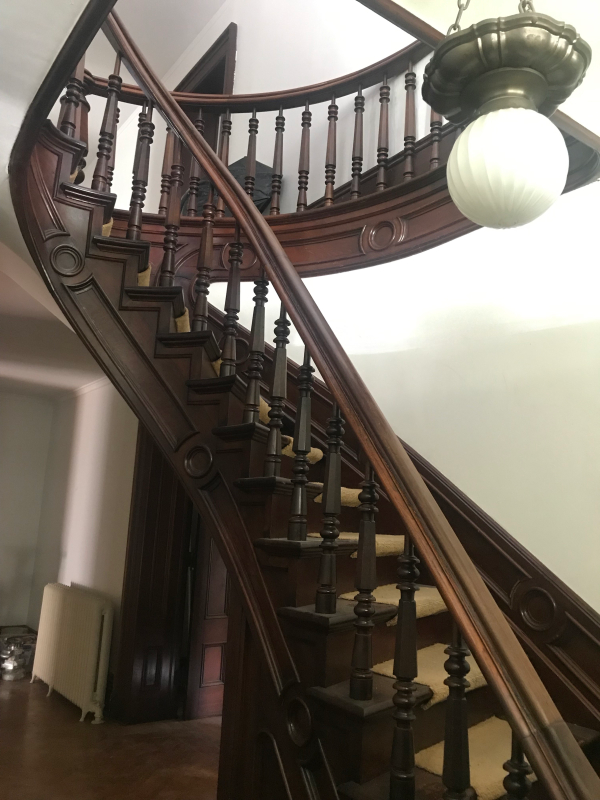
Main staircase drama (I'll need to replace the runner once all the upstairs painting is finished):

Uploaded image

One of the neat things about the house is that many of the original details have been preserved, like the doorknobs:

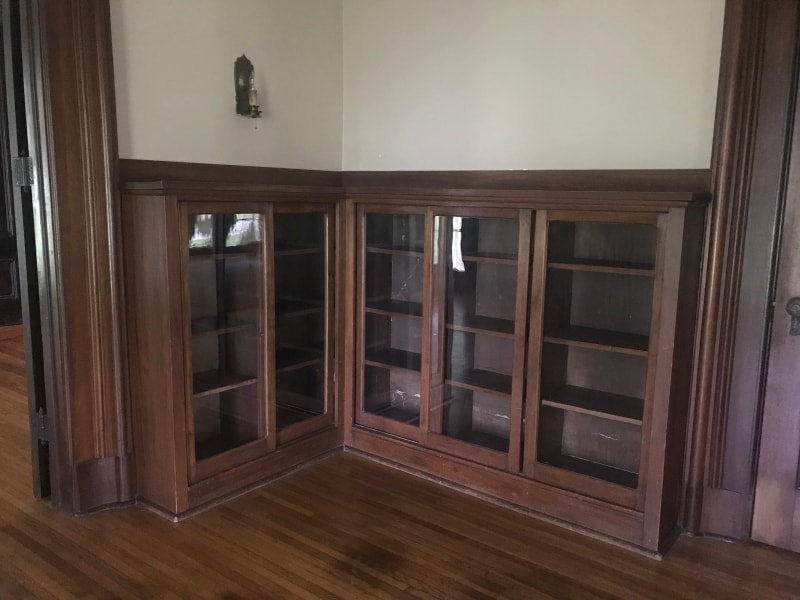
Nineteenth-century glassed-in bookcases in the second parlor:

Uploaded image

If nothing else, I will now have 19th-c. vibes to help me while I write.

On first looking into sixteen years of blog archives

Some months back, I began to think about moving the blog over to Wordpress, where it would become part of a professional site independent of my college homepage.  I soon rethought my thinking, as it were, because the blog has accrued a few scholarly citations over the years (in large part thanks to "Rules for Writing Neo-Victorian Novels"), and it would inconvenience a number of other people if their footnotes were to suddenly go--to use an advanced term--kaflooey.  However, although I decided to leave the blog in its current spot, I also decided that it was time to give the archives a severe going-over.  I've always been upfront about considering blog posts to be the equivalent of rough drafts and works-in-process, and one of the things that a writer eventually has to do with a rough draft is edit it.  In the end, after making multiple backups of the entire blog, I deleted about nine hundred posts--

OUTRAGED READER: Nine hundred posts!!! You monster!!!

--which leaves about twenty-six hundred posts still up.

OUTRAGED READER: ...ah.

In a nutshell, this is what I learned from rereading sixteen years of my blog:

1) Early academic blogging was Twitter.  There was no pre-Twitter Eden of Profound Academic Prose, from which we fell into Superficial Tweets after eating the apple from the Tree of Social Media.  Beyond the endless listicles, memes, pets, and YouTube video links, there were a lot of conversations across blogs that were delivered in posts that, in retrospect, sure look tweet-length.  Twitter helped do in academic blogging because most academic blogs (this one included) lost most of their material.  Moreover, academics have other outlets for longform writing, like Medium.  

2) A lot of urgent kerfuffles proved ephemeral.  I came across blog posts on Some Issues of Great Import and...couldn't remember why on earth I wrote them.  Nobody reads these posts (trust me, I can check my stats).  Nobody else remembers these people or these topics.  

3) The links, they have rotted.  So many dead links.  So many.  We're talking posts that are the equivalent of the walking dead.

4) While you could make a case that individual posts might belong in a tenure file, you couldn't do the same for the whole blog.  Out of everything I've written on this blog, there are perhaps two or three posts that have had a real academic afterlife.  But again, even my most serious posts are still nothing more than rough drafts, nowhere near publication-worthy.  They're just rough drafts that happen to be out in public.

So what did I delete?

1) Memes, listicles, and "linking about" posts (the last because of #3).  

2) Just about everything that was the length of a tweet, including almost all of the "news" posts (we don't need to know about a then-new and probably now non-existent web resource twelve years on).

3) Video links.

These first three categories accounted for the bulk of my deletions.  Then:

4) Anything I felt was superficial (e.g., book or film posts that, in retrospect, didn't say much of anything), irrelevant (parodies that had lost their targets, discussions of classroom technologies no longer in use, the umpteenth complaint about long-gone Chronicle of Higher Education columns, etc.), incomprehensible (to me!), or just bad.

What did I keep?

1) Just about everything under "books" and "religion" in the archive stuck around.

2) There are some now-dated posts that I decided might still be useful to younger scholars because they discussed research as a process--problems you encounter, questions that get raised as you go along, practical issues, and so on.  I also kept a number of older posts about issues in the profession that I think are still germane beyond their original occasion.  

3) I kept the year-end reading roundups, because people seem to enjoy them, and, despite the dud links, the Halloween posts (it's often possible to find the titles elsewhere).

4) The parodies that still make sense.

5) I've fallen behind on the acquisitions posts, but I've been told that people find them helpful, so I kept the category.  

6) It's the Internet, so the cats aren't going anywhere.  

Why you should look suspiciously at Google Scholar citation rankings: an ongoing saga

I previously discussed the oddities of Google Scholar in 2011 and 2015.  Another four years have passed, and yet...

1) Something there is that doesn't love a (moving) wall.  As I noted in a Twitter conversation a few weeks ago, it has become clear that GS scrapes a lot of its data from JSTOR.  But JSTOR's moving wall means that there is at least a three-year delay on journal issues becoming accessible in its database.  And, as it turns out, the knock-on effect for our purposes is that it can take a similar three years (or more) for citations to appear in your profile.  (One reference to Book Two from 2015, for example, cropped up only this year.) 

2) When Springer and Palgrave Macmillan attack! Books published by Palgrave Macmillan and available through Springer show up in GS as both individual titles and individual chapters.  As a result, GS inadvertently generates duplicate citations--an article with six citations may actually only have one.  

3) GoogleBooks blues.  Not surprisingly, one of GS' primary sources for book citations is GoogleBooks.  But this means that GS replicates all of the notorious metadata errors in GB.  Moreover, if, as is sometimes the case, there are multiple versions of the same book in the GB archive in slightly different formats, GS will simply pick them up as different citations.

4) Book review aggregation.  GS seems to have a hard time with the publication format of book reviews, as it is often the case that one ends and another begins on the same page.  It thus may count a review twice--once individually and once as part of a larger set of reviews treated as a single article.  (Moreover, it will do this both with reviews you have written and with reviews of your work.)

5) Amazingly, there are academics on this planet who do not write in English.  GS' access to non-Anglophone scholarship seems to be...scattershot.

My advice remains as it has been for the last eight years: anyone using the numbers for purposes of hiring, tenure, and promotion (or polemic, for that matter) needs to treat them as approximate, at best, and proceed with due caution.  

If academic conflicts were plotted like Star Trek: Discovery

WARNING: If you have not yet finished watching season one of Star Trek: Discovery, there is a MASSIVE SPOILER in here. 


[As the episode opens, the CAMERA flies by a series of slightly-familiar academic buildings, now augmented by centuries of technology.  A female voice speaks.]

PROFESSOR OF XENOSCIENCES MICHAEL BURNHAM: Each day we awaken to the promise of new beginnings and new challenges.  We face forward into the impenetrable depths of innumerable galaxies. Our lives may be forever changed by the mysteries that elude our ever-questing gaze.  Today…

[The CAMERA zooms in through a window.  We see a DEPARTMENT CONFERENCE ROOM, occupied by two yet-undifferentiated ACADEMICS.]

BURNHAM: …I stare into the abyss of the unknown and, quite possibly, the unknowable…

[The CAMERA focuses on two DEPARTMENT CHAIRS, PIKE and LELAND, who scowl at each other across a DESK.  The DESK’s surface is covered with rapidly-flashing but indecipherable displays.]

BURNHAM: …can my department chair finally convince the dean that Xenosciences needs 250 more credits for that new undergraduate game lounge?

[CLOSE-UP on BURNHAM’s concerned face as she peers into the room through an observation window.]

LELAND: I don’t mind telling you, Chris, that Xenoliteratures has been monitoring your department’s attempt to monopolize the dean’s discretionary funds very closely.  Very closely.  Not least because you refuse to acknowledge anything that happened last semester—

PIKE [lolling casually in his chair]: Now, I know Xenoliteratures is where you’ve got that hermeneutics of suspicion thing goin’ on, but really—

LELAND: Burnham set off a major turf war with Xenosports over undergraduate recruitment, and it’s still in the local press.

PIKE: Yeah, but the system gave her “Professor of the Year” honors at the end, so it’s all good.

LELAND: Culber’s contract got cancelled, but somehow he’s back in the classroom.

PIKE: The termination was just an administrative error, Leland! He wound up with an…extended sabbatical.

LELAND: And now Saru, the guy who ran screaming at the very sight of an Assistant to the Vice President, is leading demonstrations in the quad!

PIKE: He got tenure, for cryin’ out loud!

LELAND: Professor Tyler—I mean Voq—I mean Tylvoq—I mean Tylvoqer—oh, the hell with it—here has been running your communications with the dean through our new Discursive Deconstructor Apparatus—it’s ex-clu-sive Xenolit tech, you wouldn’t understand—and he has arrived at some pretty damning conclusions.  Haven’t you, Tyler?

TYLER: The rhetoric of your most recent email once again highlights your failed attempt to encode a subversive neo-Vulcanian rhetoric of post-positivistic logicality within the confines of academic praxis.

[TYLER pauses.  PIKE stares.]

TYLER: Seriously, what kind of cost-benefit analysis did you perform before you sent that email? Have you even heard of economic forecasting models?  Did you even stop to think that an appeal to rational self-interest might be mutually profitable for all departments concerned?

[TYLER pauses.  PIKE stares.]

LELAND [whispering]: It’s…yeah, it’s the interdisciplinarity.  The part of him that got a BA in Economics just will not go away.  [Louder] Anyway.  We know what evil plans you’re hatching over there, and we intend to infiltrate—I mean, stop them by any means necessary.

[CUT to the HALLWAY, where BURNHAM is watching this exchange with obvious anxiety.  ASSISTANT PROFESSOR SILVIA TILLY and PROFESSOR PAUL STAMETS stand next to her, fidgeting.]

TILLY: This, is, like, soooo annoying.  Like, can you believe the nerve of these Xenanities people, coming over here with their freakin’ EX-CLU-SIVE tech and telling us, us, that they’ve got some sort of [waves hands around] super-duper-high-powered insight into our motives? I mean, like, this is totally grody—

[STAMETS shoots her a look.  TILLY deflates and looks repentant.]

TILLY: Sorry, I’ve been researching twentieth-century slang to help me deal with the whole cursing thing.  There was this all-female secret society called “Valley Girls,” who I guess lived in valleys and had a hard time communicating with people who lived on hills, and…anyway, what I mean is: can’t we get the credits from somebody else?

STAMETS: I’ve hunted up and down the mycelial network to find a suitable research grant.  Nobody wants to fund an undergraduate game lounge, even though I’ve identified 323.8 potential academic uses for it—interactive physics simulations,  five-dimensional juggling exercises, Vulcan hopscotch—

TILLY: --You know that the powers that be only pay lip service to pedagogical innovation, right? It took forever to get the administration to approve my pilot course on using roguelikes to study starship engineering—“fix the nacelles before you get stung to death by a soldier ant,” that sort of thing.

BURNHAM: We’re doomed.

STAMETS: …Pretty sure that’s the other show with a “Star” in it.

[ASSOCIATE DEAN PHILIPPA GEORGIOU suddenly appears out of nowhere.]

GEORGIOU: Only the weak bother asking for money.  The strong know that the best way to get it is to strike early and hard.

[She pulls out a fountain pen and burnishes it for emphasis.]

BURNHAM [wearily]: Insights like this are what I get for saving your career.

GEORGIOU: “Saving my career”?! I had wealth, power, legions of faculty at my feet, an Instagram feed with 1.3 million followers—

BURNHAM: --You ran a diploma mill called “Hahrverd.”

[GEORGIOU sniffs.]

BURNHAM: Besides, shouldn’t you be on the dean’s side? Or Leland’s, even?

GEORGIOU: Leland wouldn’t dare cross me—at least, not after I let him know that I know about his little escapades with the student fees for the Xenoliterature Club newsletter.  As for Dean Cornwell [evil chuckle], you do realize that she’s working with the administration to rebrand this  division as a Xenoculinary school? Right?

EVERYONE: NOOOO!!!

GEORGIOU [to Stamets]: And your mushrooms will be first on the menu.

STAMETS: We can’t let them turn the mycelial network into cream of mushroom soup! 

TILLY: We need help!

BURNHAM: What we need is a deus ex machina!

[On cue, a mysterious RED BEING appears, accompanied by COPIOUS CGI.]

BURNHAM: Look, a mysterious being of hitherto unfathomable power!

GEORGIOU [suddenly transforming her fountain pen into a tricorder]: Its energy readings exceed all known measurements!

STAMETS: It appears to exist simultaneously in multiple positions along the space-time continuum!

TILLY: Yes, but can it save the mushrooms?

[More COPIOUS CGI.  After it dies down, BURNHAM, TILLY, and STAMETS find themselves in the conference room.  Nobody else is present.  BURNHAM picks up a PADD from the table.]

BURNHAM [reading]: “…Our conversations with faculty stakeholders have been mutually productive”—where do they get these writers?!—“and we have decided that it is in the best interests of our academic community to delay implementing Section 31 of our Intragalactic Academic Presence Plan.”

STAMETS: I’m guessing that my mushrooms are safe.

TILLY: Is there anything there about the game lounge?

BURNHAM [scrolling down]: Let’s see…ah, yes.  “In order to promote student success, we have decided to develop a new undergraduate game lounge, to be [shocked pause] shared by Xenanities and Xenosciences”?!!

[They stare at each other in horror.]

[Cut to the DEAN’S OFFICE, where CORNWELL, PIKE, and LELAND are glowering at each other.]

CORNWELL: Stuff it, guys.  Just because there’s no plausible reason for you two to work together doesn’t mean that I can’t make you do it anyway.

LELAND [glumly]: I knew I should never have let you audit that creative writing course.

PIKE [with a forced smile]: Well, old buddy I haven’t spoken to in about a decade except when forced to by Dean Cornwell here, I look forward to meeting you in the new holographic Andorian tennis simulator.

LELAND [equally forced]: And I look forward to sitting down with you over a nice cup of Tellarite tea and discussing the newest engagement of antestructuralist theory with warp physics.

[Looking over their heads, CORNWELL catches a glimpse of GEORGIOU watching them through an observation window.  They share a meaningful glance…]

[Roll CREDITS.]
In which, once again, I ruminate about conferences

By which I don't want to paint myself as "anti-conference," if there is such a thing; after all, I recently sent out a proposal to a conference whose theme aligns neatly with work I have in process.  But I have become more and more "not pro-conference," for a number of reasons--not just because we lost that tax deduction, which leaves everyone unable to obtain sufficient funds for conference travel permanently out of pocket.  My qualms have multiplied:

1) Four years ago, I noted that I wasn't really on board with reasons to continue interviewing at conferences.  I am now, I think, completely overboard.  I really cannot see how we can be justified in expecting graduate students, contingent faculty, and even junior scholars on the move to spend $$$ that will never be reimbursed.  As a 70s TV show once said: we have the technology.  

2) The obvious corollary to this position is that we need a "honey, I shrunk the MLA" moment.  Without the jobseekers, attendance would drop drastically, and not just from the side of the jobseekers--you'd also lose the people who are only attending because they're on a search committee.  Fewer attendees = possibility of smaller cities as hosts = more affordable conference for people who want to be there, as opposed to have to be.  (And perhaps we could schedule the MLA at a time of year when, you know, the likelihood of being trapped by an INCREDIBLY LARGE SNOWSTORM is somewhat lower.)

3) I believe universities should put the proverbial money where their proverbial mouth is.  (I'll note in passing that my own little regional comprehensive has actually done so.) Even if you get a roommate (not practical or desirable for everyone), and spend all of your time eating at McDonald's, tickets, room, and food are still pricey.  If faculty must attend conferences to show professional engagement or development or whatever the APT document says it is, then the university needs to pick up the entire tab.  That tax deduction for unreimbursed employee expenses let universities off the hook.  (Have I mentioned that we lost the tax deduction? Let me mention it again.) Of course, there are other alternatives to paying conference stipends...like raising faculty salaries to compensate.  (And salaries for contingent faculty.  And graduate student stipends.) Oh, wait--conferences aren't that important, you say? Hmmmm.  

4) Well, perhaps conferences aren't that important.  And there is such a thing as attending too many conferences, especially at the graduate student level.  In years past, folks critical of the publish-and-perish mentality have suggested limiting the number of publications that can be submitted for tenure; in practice, I suspect people might be more willing to get on board with limiting the number of conference presentations.  Or simply rendering them optional.

Academic Life: Spring 2019

I don't think I did this update in the Fall! In any event, here's this semester in the life of a full professor at a regional comprehensive college.

Teaching:

  • I have two classes this semester, as I have a course release for an administrative assignment (see "service," below).  I don't have new preps this semester, although I'll make up for that next year.  This time around, it's Introduction to Literary Analysis, which is in the Hamlet rotation for the second half of the semester (Hamlet, Stoppard's Rosencrantz and Guildenstern are Dead, Bailey's The Astrologer, some Victorian retellings for children, and Kurosawa's The Bad Sleep Well) and Women and British Short Fiction, a lower-division course that fulfills a number of gen ed requirements and thus isn't all English majors.  The literary analysis course is all poetry, all the time for the first half of the semester.

Service:

  • I'm still Associate Chair.
  • I'm also on the Curriculum Committee, which this semester means wrangling people for assessment.
  • We have Periodic Program Review, which is ongoing and won't wrap until near the end of the semester.
  • Over the break, I chaired a search committee for an administrative position.  
  • There is usually an honors and awards committee assignment that will happen somewhere down the line.
  • Profession-wise, I'm now a book review editor for a small online journal (incidentally, let me remind people that if you're interested in reviewing for us, please drop me a line).  The first set of reviews should arrive at the end of next month, so I'll need to put my copyediting hat on.

Professional:

  • I've been working for a few months on a book proposal, which is now almost completely drafted.  
  • I have...four? articles coming out this year, and should see proofs on one and possibly two of them within the next couple of months.  (One of these articles has been gestating for something close to sixteen years, so I'm glad it's finally out the door!)
  • I have three relatively short pieces I need to write: the longest, for a Cambridge Companion, is due in June, plus a 2000-word encylopedia entry in September and a book review sometime this summer.  I've also got a couple of ideas for pieces related to the book that isn't the one I was asked to propose. 

Things not to do, #1291: insult graduate students who have dropped out of your special issue

It is not a good advertisement for one's feminist journal to tell a graduate student that having to pull out of a special issue because of financial exigency is "frankly unacceptable."  It's not just egregious, but reeks of--dare I say it?--the kind of privilege that feminist journals are purportedly in the business of undermining.  As someone who has worked (and is once again working) the other side of the journal production fence, the entire scenario is bizarre.

Reason #1: Contributors were told that "withdrawing was not an option"? Somebody always has to withdraw.  Always.  As in, you assume that a contributor will vanish into thin air because of family issues, or illness, or unexpected emergencies, or something.  This is true in both edited collections and special issues.  (My article in that Blackwell companion to the Brontes that came out a couple of years ago was in fact supposed to be two entirely different articles; the late Diane Hoeveler, who edited it, contacted me late in the process to explain that a contributor had stopped responding to emails, and could I, you know, maybe spend more time on the Methodists?)  In this case, the journal has not even received essays yet, which means that there's time for any number of stopgap measures--like putting out an emergency CFP, begging one's friends, or dredging through the journal backfile.  

Reason #1a: On what planet are contributors possessed of prophetic abilities? Nobody knows what's going to happen to them a few weeks or months down the line! Why are you blaming them for wanting to eat?

Reason #2: The deadline you tell the contributors should not be the actual deadline, precisely to avoid the emergencies associated with Reason #1.  (Yes, I'm giving away an important secret there.)

Reason #3: I''m in agreement with those in the responses who pointed out that professors operating a journal do, in fact, receive "compensation."  (The editorial assistant is probably the only person receiving immediate $, although perhaps not very much.  A senior U of C professor asked me if the job paid "moderately well"; I responded, "it pays moderately.")  Such work goes on your annual report as service to the profession and thus counts towards contractual service obligations, promotion, evaluation of performance at rank (important if your university does post-tenure review), and bonus pay.  It also confers at least some degree of power, inasmuch as controlling access to your journal affects careers, possibly world-wide.  

(I am paid for my research, as well as my new job as a small-scale book review editor, because it's part of my contract.  That thing which stipulates what I need to do in order to earn my salary. If I go above and beyond expectations, I get additional compensation.  Now, we can talk about disproportionately exorbitant journal subscription fees, the impossibly high price of many academic books, and so forth, but that's not the same thing as saying "I'm doing this for free."  By contrast, an unemployed graduate student or underemployed adjunct really isn't being compensated for their research or service work.)

My Year in Books

  • Favorite fiction: Kate Atkinson, Transcription; Richard Beard, Lazarus is Dead; Hamish Clayton, Wulf; Barbara Hanrahan, The Albatross Muff; Jeannette Ng, Under the Pendulum Sun; Caryl Phillips, A View of the Empire at Sunset; Adam Roberts, The Black Prince.
  • Favorite historical mystery: Elizabeth Haynes, The Murder of Harriet Monckton.
  • Detective with most eye-watering dress sense: Richard Jepherson in Kim Newman’s The Man from the Diogenes Club
  • Weirdest take on Christianity: Robert Shearman, “Pumpkin Kids.”
  • There are unpleasant boarding schools and then there are…whatever this is: Colin Winnette,  The Job of the Wasp.
  • Novel that made me want to yell “Why on earth would you ever keep doing this?!” over and over again, which is pretty awkward when you’re on a plane to the UK: Neal Stephenson and Nicole Galland, The Rise and Fall of D.O.D.O.
  • Novel reread for the first time since I was about ten: Louisa May Alcott, Little Women.
  • Best novels reread for class: Laura Fish, Strange Music; Caryl Phillips, Cambridge; Ford Madox Ford, The Good Soldier.
  • Most fun novel to teach: Ford Madox Ford, The Good Soldier
  • Now I’m seeing it everywhere: The result of teaching a Pilgrim’s Progress course. 
  • Actually Dickensian neo-Victorian novel: Stephen Jarvis, Death and Mr. Pickwick.
  • Most unusual bildungsroman: Lorna Gibb, A Ghost’s Story.
  • Best unintentional demonstration that nineteenth-century economists were not necessarily brilliant novelists: Robert Torrens. 
  • Discovery resulting in a moment of existential despair: Turning up far too many Victorian epic poems about the Crusades.  (It has occurred to me that I should really do some writing about Victorian religious poetry.  However…)
  • What is this I just read: A Christian with Two Wives.
  • There are times one suspects the author lacks inspiration: The first name of the Lady Macbeth equivalent in Jo Nesbo’s Macbeth is…Lady. 
  • Most unusual Sherlock Holmes pastiche: Gordon Alpine, Holmes Untangled.
  • Funniest Sherlock Holmes pastiche: G. S. Denning’s ongoing Warlock Holmes series.  OK, the humor is broad, but I laughed anyway.
  • Sherlock Holmes mashup trend that is not perhaps entirely necessary: Do we need two different series in which Holmes gets mixed up with the Cthulhu mythos?
  • Sherlock Holmes anthology that best created the fiction of a singular voice: Christopher Sequeira, ed., Sherlock Holmes: The Australian Casebook.
  • Most wearisome ongoing Neo-Victorian trend: Given the number of Jack the Ripper copycats wandering through nineteenth-century London, it’s amazing that England made it into the twentieth century with most of its female population intact. 
  • Monograph finally discounted enough for me to purchase it: The third volume of Michael Watts’ study of Nonconformity in Britain. 
  • Most antiquarian purchases: Barbara Hofland’s The Blind Farmer and His Children and a first edition of Grace Kennedy’s Father Clement, both 1823; Elizabeth Sandham, Providential Care, a Tale Founded on Fact, 1825.     
  • The duplication blues: Yet again, I somehow managed to purchase books I already owned. 

Mowgli: Legend of the Jungle

The selling point of Mowgli has been its "dark" quality, in comparison to the song-and-dance animated Jungle Book feature and, for that matter, the more recent live adaptation (the film which came, saw, and conquered this one, cinematic-release speaking).  In practice, this results in a kind of tonal dissonance: Mowgli's frequently light-hearted coming-of-age narrative runs smack into a much bloodier story about the ethics of hunting.  (TL;DR: hunting for food, good; hunting for sport, bad.)  As a result, it's not always clear whom the film is for, a problem accentuated by the sometimes odd CGI (Shere Khan and Father Wolf are especially...off) and the sometimes cartoonish, sometimes very brutal violence. Interestingly enough, Mowgli turns out to have its competitor's problem with the in-universe politics of Mowgli's identity as a human being, and yet solves them it in a way that arguably out-Kiplings Kipling.

Mowgli's narrative combines the Mowgli tales from the first Jungle Book, including Shere Khan's manipulation of wolfpack politics, Mowgli's kidnapping by the Bandar-Log (here just known as the Monkey People), and Mowgli's time in the village, although it concludes by foreshadowing his afterlife as Master of the Jungle in the Second Jungle Book (without mentioning that, in his late teens, he returns to his adoptive family).  Moreover, there is a new addition who serves as a pivot point, a deconstructed Great White Hunter (seriously) with a drinking problem and the perhaps somewhat odd habit of lugging all of his hunting trophies around with him.  (Lockwood's obsession with Shere Khan turns out to be a sort of discount Moby Dick plot.) . Much of the tension in the film's first half derives from a rite of passage nowhere in Kipling, the "running," which qualifies the cubs for full membership in the pack; Mowgli's physical inability to keep up with the other cubs, which marks him out as a "freak" alongside his runty albino friend Bhoot, would disqualify him, were it not that he learns to master tree-climbing instead.  It is only Bagheera's deliberate intervention that cheats Mowgli out of winning the contest and inadvertently leads him to being captured by the Bandar-Log.  Mowgli's desire to be accepted, just like everyone else--one of the most popular plots in all of children's and YA film--supplants the original story's explanation for the loathing with which the other wolves regard him: "The others they hate thee because their eyes cannot meet thine; because thou art wise; because thou hast pulled out thorns from their feet—because thou art a man" ("Mowgli's Brothers").  Instead of the film's more generic "we're special!" with which Mowgli's buddy Bhoot tries to console him, the short story very clearly insists on the animals' instinctive recognition of human superiority.  By the same token, the film displaces just about all of the nastiness of human nature (aside from some children being jerks) onto Lockwood, the aforementioned hunter; the villagers, it is made clear, have every right to want to eliminate Shere Khan (who is eating their cattle and, of course, has a history of eating them as well).  Notably, Mowgli never speaks with another human being, although the stories emphasize that he picks up the language very quickly--a kind of distancing that makes it easier for him to abandon the village at the end in order to return to the jungle.

Structurally, as the film makes explicit in Kaa's concluding voiceover, Lockwood and Shere Khan are two aspects of the same violation of jungle law.  Early on, Bagheera explains to Mowgli that hunting for food is both "sacred" and a "right," but one must never hunt for pleasure.  Shere Khan, who kills cows for the fun of it (an especial violation of the law, as it brings humans into the jungle seeking vengeance), is the animal equivalent of Lockwood, a sportsman who displays rather than eats his kills.  (It doesn't help that Lockwood's trophies include half of one of Hathi's tusks and, alas, the taxidermied Bhoot.) Lockwood's implied alcoholism functions similarly to Shere Khan's limp, inasmuch as both have problems with mobility (and, unfortunately for Lockwood, aiming).  Moreover, it is clearly the manner of killing that is also at issue.  First, in a reworking of the original, Akela evicts Mowgli from the pack for saving him with fire, a human weapon; later, Lockwood gifts Mowgli a knife with which to hunt.  Mowgli's success at killing Shere Khan (here, with the help of elephants instead of buffalo) is the moment when he truly establishes himself as a successful man-wolf hybrid: Mowgli can kill Shere Khan because he isn't a wolf, and uses the knife to finally finish him off, but he also kills using the same intimacy prescribed by jungle law.  Lockwood, by contrast, uses a gun, and the gunsight paradoxically makes him unable to see his own oncoming death.  Having erased both the law-breakers and the overly-hidebound from the narrative--Akela dies fighting with Shere Khan, another deviation from Kipling--the film leaves the field open for Mowgli's creativity to rejuvenate jungle law.  Being different, rather than being human, turns out to save the day--and yet, in the end, Mowgli's difference remains predicated on his being human.