Victorianist and inveterate book buyer.  

Posts tagged with scattered-musings

In which I check in

Life has been interesting! Also, I am behind on an article, and as I had to request an extension, I felt guilty about doing much in the way of blogging.  Nevertheless, a couple of things have happened:

1) I'm writing a book about...Charlotte Bronte! An author of whom people have actually heard! This is a momentous occasion that may never occur again, so mark the date.  (Religion, however, is still involved.  Religion is actually the point.)  In any event, the book is under contract for OUP's "Spiritual Lives" series, with a manuscript delivery date of 2024.  

2) I purchased a house with my parents, so I have been dealing with putting my current house on the market, packing up (I move next month), and handling contractors.  Needless to say, this has been eating a lot of my spare time since about March.  The new house is a Victorian mansion--

BLOG READERS: Oh, she's speaking figuratively--

--No, I mean, it's an actual 7200 sq ft Victorian mansion from 1850--

BLOG READERS: What the--

--With, um, parlors, cool decorative ceilings, lots of mahogany--

BLOG READERS: Are you even kidding me--

--OK, so we just had to install a third furnace--

BLOG READERS: Please describe your thought processes--

--It's...just a really cool house, OK? (Also, the twentieth-century section of the house is suitable for long-term parental stays, which was the point.). The twentieth-century addition has to be completely redone, but the original house, most of which will be given over to yours truly, just needs cosmetics (floor restoration, painting) and some electrical updating.  

I am now officially banned from ever complaining about a lack of space for books.

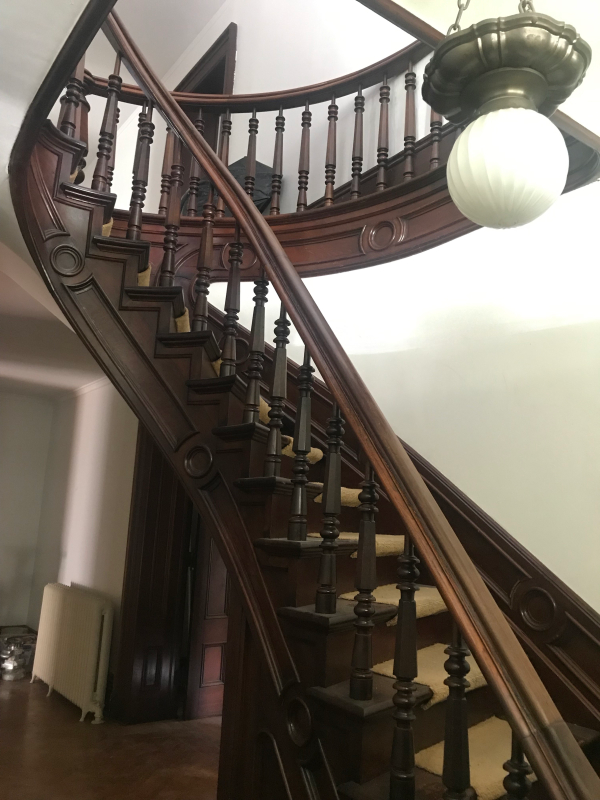
Main staircase drama (I'll need to replace the runner once all the upstairs painting is finished):

Uploaded image

One of the neat things about the house is that many of the original details have been preserved, like the doorknobs:

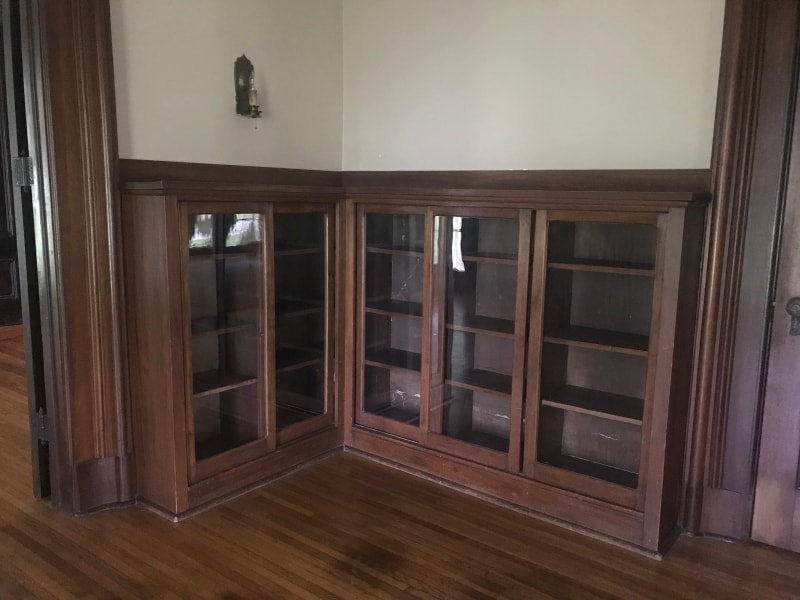
Nineteenth-century glassed-in bookcases in the second parlor:

Uploaded image

If nothing else, I will now have 19th-c. vibes to help me while I write.

Peerless

Via Facebook, this essay by Mieke Bal advocating against the current system of peer review.  In the essay's numerical spirit, some thoughts:

1) Are "only the less active and less brilliant scholars" really the ones primarily involved in peer review? This seems an overstatement (and, perhaps, rather inadvertently insulting...).  Ironically, there are reasons that you might not want active and brilliant senior scholar X peer to referee a paper, for the same reasons that, as I discovered when working at Mod Phil, you might not want them to review a book--the activity meant nothing on their CVs and was valued accordingly.  For someone more junior, peer review is proof of both reputation and professional service.  In any event, see my initial caveat.

2) I'm not sure who ought to be having the "quality discussions" (the editors? the editorial boards? acquisition editors? publisher's review board?), although I agree that "duration" is an issue.  

3) On the one hand, I'm sympathetic to the argument that requests to cite X can be burdensome, irrelevant, or even reactionary.  (On more than one occasion, I have had to write a footnote that, in effect, serves to announce "Here is X.  X has no relation to the argument.  Nevertheless, X is here.")  On the other hand, I have seen so many articles that would not exist if the author had shown signs of reading X--because X had already written that article (or book)--that my sympathy boomerangs in the opposite direction.  In fact, there have been times when I wanted to be told to do more reading, because I knew there had to be something out there I was missing but couldn't find.  Over the years, I've developed a rule for myself that if I suggest more reading, it's incumbent on me to explain how the reading will help develop the argument.

4) There appear to be multiple levels of "know" here.  There is "know" as in "I will send this to my buddy to referee," and then there is "know" as in "help, it's an article about religious fiction, I haven't the slightest clue who Frederick Robinson is, let's send it to MB because we know she writes about this stuff."  Further, there's "we've sent articles to MB to referee before, let's keep her in mind for later work."  Most of the time, I've been approached to referee solely on the grounds that I've written something that was vaguely in the immediate near ballpark of the topic, not because the editor had ever spent time in my company.  One edited collection in which I appear did, we were told, run into the "turf policing" issue, so I'm aware of the problem--but I'm not sure there's a good solution (even just reducing things to an editor and editorial board won't eliminate the risk of an author inadvertently stepping on somebody's sprained toe, figuratively speaking).

5) I suppose you could up-end the "hierarchy" somewhat by leaving the authors anonymous and forcing the referees to sign their names, but there again you would have a different set of problems (not least because like doesn't necessarily referee like--what if a more junior referee fears retribution if they write a negative report about a senior scholar's work?).  However, here I began to wonder if our academic contexts are different enough that there are unwitting conflicts at stake in how we respectively understand the peer review process...

6) How do we define "adequate"? I have sudden visions of all the scholars working on religious fiction (all...ten of us or so?) being stuck refereeing each other, in a vicious circle.  The JBS article I published last year had extremely helpful referees, but it was clear that the editor had had to assemble multiple people from different walks of life to deal with the manuscript, and some people had never heard of the periodical at the center of my argument.  Even a reviewer who isn't up on the finer points of mid-Victorian Scottish anti-Catholic periodicals, though, can still assess whether or not the article makes logical sense, identify where the author appears to be confused, or catch holes where something has clearly been under-researched.

7)  No argument that peer review is slow.  The only way to fix that, quite frankly, is for editors to keep a close eye on their timelines, pull back articles from referees who don't get the job done, and then expedite another review--keeping the author in the loop along the way.* 

8) This problem--graduate students needing to publish for in-house reasons during the three or four years allotted for doctoral work--does not seem applicable to the United States (not least because the timeline is considerably different).  Most graduate students publish one or two articles prior to finishing the dissertation and going on the market, but that's a different can of worms; slow peer review is much more anxiety-provoking when it comes to tenure, especially when some prestigious university presses have been known to take up to a year to offer a contract (or remember the manuscript's existence, even).

9) And this makes even less sense in the United States, where humanities refereeing is double-blind.  It's difficult to wage scholarly vendettas against other scholars (let alone their students) if you haven't the slightest idea whom you're reviewing.  I suppose it's more possible with books, which may be refereed single-blind, and of course it's always possible to figure out by internal clues, as Bal points out, who the reviewer or reviewee is; I (correctly) identified the Ashgate referee for my first book, for example.  But this isn't a universal problem with peer review.

10) Bal appears to mean by "authoritative mentality" something akin to a herd mentality, which goes back to her critique of peer review's "conservative" pressures in #3.  But surely eliminating the peer reviewers and, say, keeping everything in-house (all decisions made by an editor and editorial board) doesn't eliminate this problem along with it? Publishing still implies that somebody is going to make a judgment call somewhere, and the editorial board is no less suspect to the temptations of ego &c. than random referees, even if more easily discoverable.  

*--Which reminds me that I need to write the final paragraph of a book review that was due on the 1st.  Whoops!

Close to year twenty

I arrived in Fall '99, which makes this my nineteenth year here, I do believe.  (Or twentieth, depending on how you look at it.  If I get an invitation to the annual twenty-year landmark dinner, we'll know which one the college thinks it is.)    Instead of being one of the youngsters, I'm now one of the senior faculty, which feels rather alarming; my youthful starry-eyed visions (well, the stars were always rather blurred) have given way to the realities of everyday life, like assessment and periodic program review.  (Guess what we're doing this year?)  In any event, after nearly two decades of telling students that they must read The Pilgrim's Progress, probably to no avail,  I decided to put the proverbial money where the proverbial mouth is and teach a course on TPP and some responses thereto--Bronte, Dickens, Hawthorne, Alcott, DuBois, Plaatje, and Vonnegut.  (There will be some additional reading options for the papers, some of which I may swap in if I teach the course again.)   Meanwhile, I went through my British Literature II syllabus and...shortened it.  We've now had several years to acclimatize to fifty-minute classroom sessions, as opposed to one hour, and it's taken me this long to resign myself to the fact that losing those ten minutes really does affect what you can do in the space of one meeting. 

I've probably done my fill of conferences for this year, as while I'm not so overcommitted to writing projects as I was in '16-'17, I still have enough deadlines that I don't think I can fit in yet another paper.  It doesn't help that the new tax code has made the prospect of spending another $1K or more out of pocket on conference travel somewhat, shall we say, unappealing, given that we can no longer write off unreimbursed business expenses.  (I do think that there will have to be a reckoning somewhere about what the changed fiscal realities mean for expectations about conference participation, especially for graduate students, adjuncts, and junior faculty.  Perhaps this will help stimulate a turn to virtual conferencing or other alternatives?)

Meanwhile, yet another installment of what a full professor at a regional comprehensive does with her semester:

Teaching:

  • Two courses, Rewriting the Pilgrim's Progress and British Literature II.  I have a course release for administrative work (see below).  TPP is a new prep.  Right now, my Brit Lit II is overloaded, so it currently has 46 students; the other course is much smaller, but will probably get some more students next week during final registration. 

Service:

  • I'm now officially Associate Chair.  In the Fall, this means helping to coordinate PPR, along with the more usual duties (being in charge of undergraduate registration, assisting transfer students, wrangling faculty for events, and helping the chair with whatever the chair needs to be helped with).
  • Curriculum Committee.  The department has acquired two new major tracks (long story) and a new minor (for which I'm partly responsible), so there will be a fair amount of work involved in getting them off the ground.
  • Professional service-wise, I have an article to referee.

Research:

  • I'm finishing the first "r" in an r-and-r that I got over the summer; this has to be done within the next couple of weeks. I'm mostly finished with it, but the article is in the "let me cut out all this material/wait, now I need to put in this other material/arrrgh, now it's too long" phase. 
  • I'm writing a short article about Mrs. Humphry Ward's Eleanor, which is due at the end of October.
  • Another short article for a Cambridge Companion, this time on early 19th-c. religious fiction.  This is due at the end of the school year.
  • Two book reviews.
  • A book proposal, of which more anon if it's successful.  (It's not Book 3 1/2, which is, yes, still ongoing--the r-and-r above is part of it.)  Most likely to be finished towards the end of this semester. 

I am the very model of a pundit academical

(Inspired by some...larger tendencies, some contradictory, not by anyone or any outlet in particular.  Though I've certainly detected some of these habits in myself...)


I am the very model of a pundit academical,

I've idées fixes artistic, scientific, and political;

I’ve a hundred ways to call the admin highly hypocritical,

And sometimes it’s in phrasing that descends to the emetical;

I'm very well acquainted too with matters pedagogical,

Which I pronounce on in a tone that's truly theological,

About research esoteric I am tweeting with so much abuse,

Although the second reader called my book proposal too diffuse! 

[Although the second reader &c.]


I'm very good at clickbait that's superbly supercilious,

I know exactly just the thing to make my colleagues bilious,

In short, in fields artistic, scientific, and political,

I am the very model of a pundit academical.


I know our storied theorists, from Cleanth Brooks to Derrida,

I lecture long on p-hacking, I ponder Disney's Merida,

I’ve versified Greenblatt's The Swerve in macaronics marvelous,

And pontificate on syllabi while never seeming querulous;

I can tell Baudrillard from Wittgenstein and H. Cixous from F.  Tönnies,

I sneer at frauds while hyping my unpublishable masterpiece,

Then I can pitch a hot take on something I’ve not read before,

And if no-one will run it, well that’s what my dormant blog is for!

Then I can speak of budgets in a manner tropological,

And turn the latest scandal into something anagogical;

In short, in fields scientific, artistic and political

I am the very model of a pundit academical.


In fact, when I know what's meant by “committee work” and “overload”;

When I can tell at sight a learning outcome from an add/drop code;

When such affairs as meetings and advisement I’m more present at,

And when I know a mortarboard and tassel from a bowler hat;

When I can name five colleges whose halls are hardly ivy-decked,

When I can update Blackboard without losing all my self-respect,

In short, when I get that scholars unlike me are really not suspect,

You’ll say a pundit academic’s never been so ego-checked!

For though the language in my op-eds is particularly visceral,

I fear (alas) my wisdom’s proving eerily ephemeral,

But still, in fields artistic, scientific, and political,

I am the very model of a pundit academical.

Much as the middle class is always rising, the academic book is always falling

Predicting the decline and fall of monographs--or, for that matter, desiring same--has been on the agenda for about as long as I've been an academic.  It would be nice if the discussion was a bit more grounded in data that we don't yet seem to possess.  For one thing: we know anecdotally that once one leaves the more rarefied air of R1s, R2s, and some of the ritzier SLACs, humanities programs (that is, the book-heavy disciplines) are much less likely to require a book for tenure.  There are c. 4627 colleges and universities in the USA; it's likely that the largest population of monograph-writers is clustered in only a small number of schools.  But nobody has really done a study verifying the numbers across the humanities, although there have been occasional stabs at individual fields.   (My own campus, incidentally, does not require a book for tenure.  My department, which has fairly heavy requirements for our kind of institution--we ask for five articles--only requires a book for promotion to full.)  The point being that most institutions are not research-intensive, although they may have faculty who pursue research agendas anyway, and it's not clear how that ought to frame this kind of debate.  Most faculty aren't churning out articles, let alone books; the majority response to "move away from monographs!" is probably "we weren't aware we had moved toward them in the first place."  (There's also the persistent belief that in the ever-dwindling t-t market, one needs a book to get a job--which is an understandable belief, but doesn't seem to be reflected either in candidate CVs or actual hires.  Again, though, this has not been a data-driven discussion.)  Certainly, campuses whose faculty are not expected to be writing hand over fist will also not support research libraries, which further restricts the market for ever-more-expensive monographs.  When we discuss academic libraries purchasing books, I wonder if we don't really mean "200 or 300 out of 4600+ academic libraries purchasing the majority of the books..." 

For another thing: we don't know how many academic books are read, because read ! = cited.  (The same goes for articles.) My shelves are full of books that have been extremely helpful in all sorts of indirect ways, but which have never been directly relevant to the article or book in progress.  And one never knows what might be useful.  (That being said, I do hope people aren't using GoogleScholar to identify how often a given book in the humanities has been cited, because GoogleScholar raw numbers are terrible: they miss references or double-count them, lump things like "books received" in with everything else, and so on.) 

Howl! The Annual Horde of Halloween Horrors: Desert Island Edition

It's just you, a desert island, and ten nineteenth- and early-twentieth-century horror stories from the UK and Ireland.  Which do you choose?

I did my best to throw in a few more unusual choices, but some stories simply refused to be left out.  I didn't, after all, want to be haunted...

In alphabetical order:

  1. E. F. Benson, "The Room in the Tower": Successfully conveys the kind of inevitable, looming horror that one associates with nightmare logic.  A fine example of the scary artwork genre. 
  2. Mary Elizabeth Braddon, "At Chrighton Abbey": Not, in fact, frightening at all, but notable for its alienated narrator and her just-detectable longings.  Especially worth reading if you're a Jane Eyre fan. 
  3. Elizabeth Gaskell, "The Old Nurse's Story": I tried to resist including it here, but couldn't.  This one makes everyone's list of must-read Victorian ghost stories, and it's easy to see why--an eerie tale of frustrated desire and vengeance. 
  4. Henry James, "The Private Life": While the scenario is potentially horrific, this story, like "At Chrighton Abbey," is really more devoted to exploring psychological issues--in this case, the strange nature of identity. 
  5. M. R. James, "Wailing Well": James clobbers the English public school story really, really hard. 
  6. Joseph Sheridan Le Fanu, "An Account of Some Strange Disturbances on Aungier Street": Slowly ratchets up the dread as the nice, rational students discover that...something...is sharing the house with them.  Nicely illustrates one of the key lessons of the Gothic and horror genre in general--namely, rental properties are always hazardous to your health. I keep coming back to this one over the years--it's one of the truly great Victorian ghost stories. 
  7. Edith Nesbit, "The Power of Darkness": An example of psychological, rather than supernatural, horror, involving two young men, jealousy, and a waxwork exhibition. 
  8. Margaret Oliphant, "The Secret Chamber": A young Scottish aristocrat discovers his family's weird secret.  Interesting for both its open-ended construction and its muted reflections on Scottish history. 
  9. Walter Scott, "Wandering Willie's Tale": Striking inset narrative from Redgauntlet, featuring a jaunt to the nether regions. 
  10. Oscar Wilde, "The Canterville Ghost": Best ghost story parody of the nineteenth century and, quite possibly, of any century. 

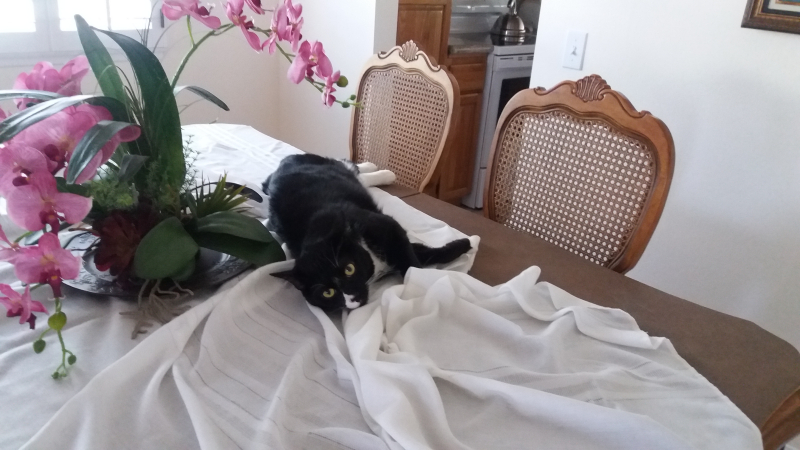
Still Life with Artificial Plant and Cat

Uploaded image

Title: Still Life with Artificial Plant and Cat.

Materials: Cat (Amigo, age four); artificial plant; tablecloth; table.

Commentary: In this deconstruction of the relations between artifice and nature, human and animal, object and living creature, the cat's own artistic agency asks the viewer to reflect on our assumptions about the act of aesthetic production.  By crumpling the tablecloth, the cat subverts human attempts to impose order on a chaotic universe, while also repurposing single-use domestic consumer goods for his own playful mode of being.  The cat's gaze further implicates the photographer in the act, inasmuch as the "appropriate" response (as determined by the parents of said photographer) would be to summarily remove the cat from the table in order to save the tablecloth from the cat's claws.  By photographing the cat and uploading the photograph to the Internet, the photographer attempts to recuperate the cat's carnivalesque disruption of the social order (which forbids cats from being on the dining-room table, for example) for the well-known genre of the "cute cat photo"; however, the cat's knowing gaze suggests the extent to which such recuperation can only be partial, as the tablecloth's displacement remains as the trace of the cat's rejection of human norms.  Moreover, the juxtaposition of the artifical plant with the cat troubles the always-porous boundaries between the natural and the (art)ificial: in its hyper-realism, this representation of a cultivated flower hints again at human attempts to exert control over the natural world, even as it also necessarily hints at the extent to which the real flower evades capture, much like the paradoxically non-domesticated domestic animal on the table. 

Unmarked: An Academic Mystery

I slouched into my office like a sagging sock, slammed the door behind me, and collapsed into my favorite faux leather chair, recently bought on sale at Wal-Mart for $39.95.  That investigation into the disappearance of the conference room clock had been long and grueling, and the administration was still reeling from my revelations about the "clocks for cookies" exchange being held every afternoon in the faculty parking lot.  My energy level was so low that even an ant could step over it.  It was all I could do to crack open a can of Diet Coke and turn on my favorite e-cigarette.  But then she walked into my office.

The woman's gaze hit me hard, like the Norton Anthology of English Literature dropped from a great height, the hardbound version, not the subdivided paperbacks. She had the drained appearance of someone who had corrected one too many comma splices.  I could see that she had a problem.  A major problem.  And that meant her problem was about to be my problem, for the low, low price of $24.99/hour, plus all applicable sales taxes.

I offered her a Diet Coke.  She knocked it back like someone who had been drinking Diet Cokes all her life.

"The English Department is in the midst of a crisis," she murmured, toying with her Samsung phone (not, I was relieved to see, one of those exploding tablets, because that would have been distracting, and besides, it's been a while since I replaced my fire extinguisher).  "Someone has been stealing the dry erase markers.  We suspect a conspiracy."

"Going from zero to sixty pretty quickly there," I remarked, with a dramatic vape.  "There could be a grey market in markers that you don't know about.  Maybe somebody is collecting them on the sly, in hopes that their descendants can take them on the Antiques Road Show.  Could be some kids at work on a postmodern art project involving erasable ink.  Why a conspiracy?"

She stared at me as though I had turned into an especially odious misplaced modifier.  "We're English professors.  We never arrive at the simplest conclusion when a more complicated one would do."

I was about to suggest that the Philosophy Department might lend out a handy Ockham's razor to help them solve that problem--most people don't know this, but they come cheap at the local drugstore--but something about her expression told me that I would be deconstructed on the spot.  So I handed her an invoice instead.

***

 My rusty Ford Focus spluttered to campus, looking as decrepit as I felt. I parked it in an out-of-the-way spot where it wouldn't be seen by any suspicious types, and strolled inconspicuously to the humanities building in my blue suede shoes, whistling a tune from Andrea Chénier and keeping on the lookout for any clean whiteboards.  

And soon, I saw them.  I peeped quickly into each classroom, earning myself glares, hisses, and scowls from faculty members who didn't appreciate that I was on their side.  But none of these professors were writing on the whiteboards that festooned the rooms like outdated ghost advertisements that ought to be painted over, except the locals are really attached to that ad for soap that nobody manufactures anymore, and so they all write letters to the local papers, and then it gets into the city papers, and before you know it, social media has got a hold of the whole deal, and--

"I don't understand,"  said one professor, looking especially tweedy, "why you are in the back of my classroom, eavesdropping on our discussion of Ada Leverson."

"To begin with," I responded, somewhat huffily, "I was developing an epic simile about whiteboards, which you interrupted.  Also, I'm investigating the disappearance of your dry erase markers."

Her grimace smeared across her mouth.  "Do you realize how much time I've spent trying to convince students not to use 'also' as a transition word?"

This was clearly going nowhere good, so I changed tactics faster than a kid hitting the "like" button on Facebook.  "Look," I said, "you clearly aren't writing on the whiteboard.  Is this because you're worried that there's no stable relationship between the signifier and its signified?  Or are you just tired from playing one too many games of Nethack when you really ought to be reading rough drafts?"

She rolled her eyes.  "You apparently haven't read any literary theory published since the 1980s.  And I'm not writing on the board because there isn't anything for me to write with."

I was about to say something brilliant in return, maybe a wisecrack about epistemes, but then the solution smacked me in the noggin like a Riverside Chaucer hurled at high speed.

***

She was back in my office, nibbling on a decadent-looking mascarpone brownie studded with Ghiradelli's chocolate chips--semi-sweet, from the look of them.  I tried not to drool.

"There's no conspiracy," I proclaimed grandly, with a flourish of my e-cig.  "Just open your briefcase."

This earned me the kind of scorching glare you'd expect from somebody who hatched dragon eggs in funeral pyres.  "My briefcase, young woman," she said sternly, "is sacrosanct. It contains nothing but the manuscript of my latest book project, a paradigm-shattering monograph on novels featuring romances between vampires and werewolves at academic conferences, especially the MLA, which I am writing in longhand so that none of my competitors can hack into my computer and steal it."

My long-suffering sigh gusted across the room like an unexpected windstorm in March.  "I think you'll find," I said, "the answer to the mystery."

Rolling her eyes,she unsnapped her briefcase.  "There's nothing--" she began, and then stopped abruptly, her mouth slowly fluttering agape.  I grabbed the briefcase from her, and shook it.  Dry-erase markers tumbled to the floor.  Pink ones.  Black ones.  Green ones.  Red ones.  Most of them didn't really match my 1970s-era orange shag carpet. 

"You, and all the other faculty," I trumpeted, gesticulating with a convenient can of Diet Coke (which, unfortunately, was open, sending a flourish of soda across my desk), "have been absent-mindedly taking the markers with you every time you leave the classroom.  You, and you alone, are to blame for the marker shortage!"

She clutched her head in horror.  "What am I to say at our next department meeting?" she moaned, resembling nothing so much as a student who has just discovered that their fifty-page research paper had been due the week before.

I grinned.  "Just say that the case of the little missing markers is solved."

And I handed her the bill. 
Two cheers for academic blogging?

To what extent has academic blogging, and the rise of alternative (non-peer-reviewed) online publishing venues more generally, transformed our approaches to scholarly activity? As Scott McLemee points out in his fine tribute to the late Scott Eric Kaufman, early huffing-and-puffing about academic blogging has long since been consigned to the realm of "dumb controversies."  But in practice, what has this meant for academic work? Rohan Maitzen's recent account of her university's nominal vs. actual attitude to public engagement, however that is to be defined, is illustrative.  Some administrations encourage faculty to engage in social media "outreach"; others advise graduate students and junior scholars on the market to develop an online professional "presence."  At this point, academic blogging has lost most of its novelty in relation to other forms of social media--I've been blogging for, good heavens, about fourteen years now.    Some impressionistic thoughts on what has and has not transpired--

The most important changes, it seems to me, have taken place outside individual university folds, not within.  Certainly, blogging has helped some academics loosen up their clogged prose.  More seriously, blogging and social media have undeniably facilitated networking, especially for scholars with limited travel funding, and in some cases online scholarly communities.  Academics like myself, who work on--ahem--more abstruse subjects, have found support in sometimes unexpected places. Blogs have also promoted public outreach--but I suspect that the outreach in question has been most successful (or, at least, most far-reaching) when the academic in question works on questions related to contemporary politics, or, at least, spends a lot of time talking about questions related to contemporary politics.  That many of us have no actual skill in politicking is beside the question (I confess that too much time spent reading academics blogging and tweeting about politics has rendered me somewhat cynical on this front).  Political debates and social issues in general seem (note the emphasis) more accessible than discussions of Kant or the Geometric period, after all, and thus are more likely to draw audiences from outside academia.  The flip side of such popular appeal, of course, is that it may bring the university what we might politely call "unwanted attention," from all political sides, with results not necessarily conducive to a continued academic career.  Institutions do love their publicity, except when they find it inconvenient, at which point they don't. 

At the same time, because most academic blogs and other social media accounts tend to be "mixed"--that is, a combination of straight-up scholarly writing, memoir, sports commentary, Game of Thrones fan blogging, the occasional cat photo--they are difficult to categorize.  Scholar X, a specialist in eighteenth-century French poetry, can't really submit their scintillating commentary on the most recent Dodgers game as an example of their professional work.  There are many ways to negotiate around this confusion--for example, by pointing to the scholarly impact of a particular blog post, rather than shoehorning the entire blog into the "Scholarship" section on one's annual report.  But this takes time and narrative, and committees may well feel about extensive self-justification the same way that nature feels about a vacuum.   For, despite academics' purported love of all things complex, we tend to like our "outputs" (ack) or "products" (ick) easily categorized and numbered; indeed, faculty are often as guilty of such bean-counting as are our much-maligned administrations.     And, as Rohan pointed out, you can't actually do "professional" (peer-reviewed) work alongside more popular work at the same time and at the same rate; hence this blog's recent moments of prolonged silence while I dispatch several articles (three down! two to go!).  

Universities are, after all conservative.  No, not that way.  I mean that, like any other bureaucracy or system, universities and the individuals who work within them seek to maintain themselves in a state as close to the status quo as possible, sometimes by ignoring large elephants in the center of the room (see under: adjunctification).  Hence the frequently-observed phenomenon of faculty (or administrators) pushing for policies that seem to be in direct opposition to their own supposed politics, but which maintain their current positions, advantages, and/or cash flow.  If research universities have warmed up--at least to a lukewarm temperature--to peer-reviewed online publication, they have not shown much in the way of similar fondness for anything that carries the faintest whiff of "the popular."  Even teaching-centered campuses, which have traditionally been open to valuing a wider range of academic work (e.g., textbooks, general-interest magazine writing), still look askance at blogging.  Where, they want to know, is at least an editor, the guardian at the academic gate? Or, to put it differently: if the publication process appears to be the same thing, even when the final version appears in a new medium, then everyone (at least, everyone on the relevant committees) is reasonably pleased.  Professional norms exert a gravitational pull of sorts, so that anything that seems to escape from orbit is, to a certain extent, pulled back and regularized.  You can publish online in a "real" journal, and that's OK; but despite gestures to the contrary, there's no sign of any mass movement away from peer review. 

RIP: Scott Eric Kaufman

As many of you will have already heard, Scott Eric Kaufman has died.  Scott was part of the first wave of academic bloggers, as notable for his absurdist accounts of life as a UC Irvine graduate student (undergraduates doing what in his office, now?) as for his accounts of his scholarship, including his later work on visual rhetoric.   He was one of the first online personalities I had the pleasure of meeting, and was as engaging (and wry) in person as he was in pixels.   He will be very much missed.  

Help! It's the Annual Horde of Horrific Halloween Happenings!

This year's theme is one familiar to any Victorianist: the ghastly and ghostly experiences of the Victorian professional man.  With the occasional bonus student.

  • The Phantom Woman (?).  A lawyer becomes obsessed with the woman he sees through a window.  (You may need to scroll down to this story.)  
  • Algernon Blackwood, Keeping His Promise (1906): A student studying for his exams receives an unexpected visit from an old friend. 
  • Mary Elizabeth Braddon, The Shadow in the Corner (1879): An academic is deeply skeptical about what the new servant claims to see in her room. 
  • Wilkie Collins, Miss Jeromette and the Clergyman (1875): A clergyman reveals to his sister that he knows more about an old murder case than she suspects.
  • Charles Dickens, To Be Taken with a Grain of Salt (1865): The head of a banking department finds himself on the spot while sitting on a jury. 
  • Arthur Conan Doyle, The Captain of the 'Pole-Star' (1883): The ship's doctor becomes increasingly concerned about his captain. 
  • Amelia B. Edwards, The 4.15 Express (1867): The lawyer who shared my carriage is what?
  • M. R. James, Oh Whistle, and I'll Come to You, My Lad (1904): An academic does some ill-advised archaeology while on vacation, with the usual unfortunate results.
  • ---, The Stalls of Barchester Cathedral (1910): An archdeacon finds himself besieged by whispering, mysterious cats, and...some other entities.
  • Rudyard Kipling, The Phantom 'Rickshaw (1888): A minor civil servant in India breaks off an adulterous affair, but finds that things do not go quite as planned. 
  • J. S. Le Fanu, An Account of Some Disturbances in Aungier Street (1853): Two doctors-in-training have a nasty encounter with the ghost of a hanging judge.
  • ---, Green Tea (1872): A clergyman finds himself seeing...things.
  • Louisa Murray, Mr. Gray's Strange Story (1892): A Presbyterian minister tells the story of a man unhappy in love who shows up when least expected...
  • "Q. E. D.," A Fight with a Ghost (?): A doctor reminisces about the time he had to deal with something that looked like a haunting, in any event.  (You may need to scroll down.)  
  • Bram Stoker, The Judge's House (1891): A student studying for his exams has a nasty encounter with...well, see "An Account of Some Disturbances" above.

Ten Moderately Light-hearted Victorianist Pet Peeves (in no particular order)

  1.  "Victorian novels are so long because authors were paid by the word, right?"
  2.  "You study Victorian fiction? You mean like...Jane Austen?"
  3. Bookdealer lists a novel first published in 1930 as "Victorian."
  4. "Victorian values"
  5. Confusing Tim Burton with Lewis Carroll
  6. "Those Victorians all hated sex."
  7. Endless stories about Jack the Ripper
  8. Those naughty piano legs
  9. Victorian...France?!
  10. "Dickensian"*

*--the adjective, not the TV series, about which this Victorianist has no opinion as of yet

Columns for which Inside Higher Ed should give me money

After reading this postmodern contribution to contemporary discourse on the state of higher education, I believe that it's time for me to pitch a few ideas to IHE.  To clarify matters, of course, I will identify the allegorical correspondences between my columns' ostensible subjects and their real meanings.

  • Today, I threw a lot of toy catnip mice for my three new kittens.  They charged up and down the room, looking excited.  (How to conduct effective college orientation sessions for incoming students)
  • Getting your old car repaired can be really expensive.  (What's the best way of raising funds to replace aging campus infrastructure?)
  • How many of you have baked brownies and discovered that they just wouldn't set? (Counseling faculty with research productivity problems)
  • I hate carrots.  (Faculty resistance to assessment procedures)
  • Is there anything more refreshing than a can of icy soda on a hot day? But too much soda can have consequences for your health.  (Pros and cons of merit increases)
  • Mac or PC? (Online vs. face-to-face instruction)
  • The weather.  How about it, eh? (The problem of course evaluations)

RIP Victoria, 1999-2015

I used to say that, unlike her late brother Disraeli, Victoria had been appropriately named.  Perhaps, though, I should have called her Maggie, because she turned out to be Iron Cat.  In 2013, Victoria was diagnosed with cancer, and I was told she wouldn't survive the year.  She did.  Then, a couple of months later, she went into chronic renal failure, but persisted in remaining alive (despite having to put up with a daily regimen of subcutaneous fluid injections).  Finally, if that wasn't enough, she developed inflammatory bowel syndrome, which is exactly what it sounds like, but  she managed to handle it for several months thanks to steroid therapy.  The vet was amazed.  But last week, shortly after reaching her sixteenth birthday, Vicki suddenly stopped eating, and it became clear yesterday that the cancer had expanded into her abdomen.

Of the two cats, Vicki was far more outgoing and assertive; she was the kind of cat who insisted on supervising the contractors whenever work was going on in the house (which she would keep up for hours, I was told), and wanted to socialize with any and all visitors.  Not surprisingly, she was extremely chatty, usually trilling, chirping, and grunting instead of meowing.  Meows were generally reserved for informing me not that she wanted to be fed, but instead that "I am going downstairs to eat now."  (Obviously, it was important to announce the fact.)  She very much wanted to hang with her human, whether on my lap (the preferred spot), the back of my office chair, or on the top of my desk; if I neglected to pet her with the appropriate attention, she tapped my arm imperiously.  Late in life, she developed the habit of climbing on my stomach while I was sleeping--which led, on more than one occasion, to me petting her while still asleep.  She was, in other words, firmly in charge of the place.