The Statue Room (Vol. II)
Once more unto the novel. Will it turn into a hitherto unacknowledged masterpiece of English fiction, soon to be celebrated alongside the likes of Clarissa and Pride and Prejudice?
You make the call.
(II.5): Adelfrida is on the verge of "present[ing] the Duke with a pledge of their mutual love." Or, as we postmodern degenerates would say, she's about to have a kid (soon to be dubbed "Romelia Catherine"). Amazingly, she has managed to near the delivery date without anyone at court becoming suspicious. I suppose those dresses could hide any multitude of sins.
Incidentally, in a major instance of typesetting FAIL, page "6" has somehow become page "9."
(II.8): Noooo! One of Adelfrida's few BFFs has died while out riding! It wouldn't be a Gothic if Adelfrida were to be happy for any length of any time, after all.
(II.10): One of the remaining BFFs, the Marchioness (aka Elizabeth's girl crush), undertakes to explain the situation. To cushion the blow, she initially tells Adelfrida that "nothing very particular" has happened--people dying suddenly in riding accidents being not very particular, one gathers.
To make matters worse, the Marchioness *gasp* lies to Adelfrida, telling her that the letter is actually from deceased BFF, now upgraded to "indisposed." But...but...lying is bad! The novel has told us so! Repeatedly!
(II.11): Matters are not improving, as Adelfrida remains convinced that BFF is "dying." Right verb, wrong tense. Winning the prize for Least Tactful Observation in an Eighteenth-Century Novel, the Marchioness offers the following bit of sage advice: "'Well, my love, suppose she is, you cannot be of any service to her."
(II.12): And...it's not clear why the Marchioness bothered to lie, because Adelfrida figures it out anyway and promptly goes into "fits" and a "fever." Telepathy, I see, is a prerequisite for being a Gothic heroine. However, she finally has a "perfect recovery," which presumably means that we'll never hear about Dead BFF ever again.
(I.13): We are belatedly informed that the Duke loses consciousness whenever he smells roses. This is one of those health problems one would hope to know about well before a novel's second volume.
(II.14): Needless to say, the Duke obligingly goes out like the proverbial light just as Elizabeth swans in. Really, the novelist could have achieved the same level of plausibility by having a giant helmet fall out of the sky and clonk him on the head.
Oh, wait...
(II.18): For lack of anything else better to do, Elizabeth poisons Adelfrida with a glass of lemonade.
It has occurred to me that the novelist seems to be mildly prejudiced against Elizabeth I.
(II.19): One must say that despite being in the throes of poison (as opposed to the throes of passion), Adelfrida remains remarkably articulate.
(II.21): Amazing. Adelfrida actually died. And yet the novel has over one hundred and thirty pages to go.
(II.25): We start off Book Four with yet another Mangled Motto. This time, Edward Young's "Night Thoughts" gets the treatment.
Should Motto Mangling be considered a felony? Or a misdemeanor? Let us pause to consider this for a moment.
(II.25): Meanwhile, the Duke is dying. For some reason, the novelist has neglected to inform us of what actually happened just before his death.
(II.26): Yet another child to be raised in secret. I gather this runs in the family; is there a gene for this?
(II.30): Sixteen years have passed, and Romelia Catherine feels an understandable compunction about visiting a nation "governed by the murderer of my mother." Something tells me Elizabeth won't be too excited to see her, either.
(II.31): Scratch that: Romelia, being a teenager, decides after all that she'd like to see the "female monster." Kids. What can you do?
(II.32): For some reason, the Marchioness thinks that it would be a great idea to tote Romelia along on a visit to Elizabeth, even though Romelia is now fantasizing about being a "basilisk" and murdering the queen. This will certainly be an exceptionally warm and cheery visit, that's for sure.
(II.33): So, the Marchioness knew that bringing Romelia along would be a bad idea, and yet did it anyway? The novel's aversion to common sense reasserts itself.
(II.36): Romelia gets married; the Marchioness' daughter gets married; and now the novelist decides to change things up and make her book into an epistolary novel.
Why anyone thinks it's a good idea for Romelia to remain in England is not, in fact, immediately obvious, but then again, given that this novel sneezes whenever introductory logic comes up, I shouldn't be surprised.
(II.38): Well, things were happy for about two pages.
(II.39): Romelia's hubby Henry has died for reasons not yet disclosed, so Romelia now takes the opportunity to do a rather bad Ophelia imitation.
(Speaking of dead people, we have indeed not heard of Deceased BFF ever again.)
(II.43): Er, wait, hang on. Henry didn't die. False alarm! Instead, he almost drowned during a shipwreck, but was actually cast ashore "just at Romelia's feet." Because doesn't that always happen during violent storms?
(II.46): I'm getting a little confused about the chronology here. First he was dead. Then he wasn't dead. Now he's arrested for treason. Or was he arrested for treason before? (I think he was arrested for treason when this letter started, bringing on the Ophelia, but the writer's phrasing is awfully confused.)
The writer of this letter, Romelia's sister-in-law, has a code in the node, but that probably doesn't rank quite so highly in the traumatic scheme of things.
On a more positive note, Romelia has recovered from her attack of Ophelia.
(II.47): I do like how after this chronicle of horrors, the writer asks the recipient to "[r]emember me kindly" to her friends.
(II.52): Romelia is off to London to beg the Queen to pardon her Henry! Elizabeth, of course, tells Matilda (the sister-in-law) that the "'image of Adelfrida constantly haunts me'"--because, after all, murderers always spout off about their guilt to everyone within reach.
(II.55): That didn't go so well, so now Romelia adopts the age-old strategy of dressing as a page boy. But for what purpose? Only the Shadow knows.
(II.59): Of course, she doesn't do the dress-up bit particularly well, as she's called "Lady" only four pages later.
(II.60): Hey, it's the Duke's valet! For some reason, he seems to think that asking "what the heck are you doing here?" (er, my translation) falls under the heading of "impertinent questions." I dunno--it seems like a perfectly reasonable question to me.
Oh, that's right--we don't do "perfectly reasonable" in this novel. My bad. Carry on.
(II.61): The valet has been living in the same house for sixteen years, and has apparently never noticed that it has a mysterious door. I am speechless.
Luckily, I'm typing this post, so my lack of speech will have no effect.
(II.63): The door leads to a room with exterior (albeit ivy-covered) windows. Exterior windows.
My speechlessness continues. Perhaps I should have waited until after tomorrow's class to read this novel?
(II.65): Uh-oh. Has Elizabeth done something not so nice to Romelia?
(II.68): Or...not?
(II.69): OMG! We've finally found the Statue Room, only 3/4 of the way through the novel!
(II.71): Oh, look, it's Henry. This is one of the weirder locations to stow a prisoner.
(II.73): The jailer (er, gaoler), the Earl of Shrewsbury, walks in, and of course, Romelia immediately mouths off to him. Because that is, after all, the most intelligent thing to do when you're caught trying to break your husband out of his somewhat odd prison. Shrewsbury seems rather unimpressed.
(II.79): Shrewsbury promptly chucks Romelia into a teensy cell. For some reason, she's shocked by this turn of events, suggesting that her education did not involve any tutoring in cause and effect.
(II.80): In a burst of anguish, Romelia misquotes William Shirley's Edward, the Black Prince (1750). I suppose we ought to forgive the misquotation; it's so difficult to quote from a play published well over a century after one's death, after all.
(II.82): The ghost of Adelfrida appears and asks Romelia to "avenge" her. Real? Hallucination? Given that Romelia can quote from eighteenth-century dramas, anything is possible.
(II.83): There's an unlocked secret door in Romelia's cell. Security in Elizabethan England seems rather subpar.
(II.84): The Earl's son, Walter, is remarkably blase about finding himself in the same garden with an escaped prisoner. So they have a little chat.
(II.85): Romelia was in a "more secure" prison than the one before?! What, the first cell had no doors at all?
(II.88): Whee! Everyone has escaped, thanks to the help provided by the Earl's son! (No clue as to whether or not he'll be executed for abetting a traitor, but such things are beneath the novel's notice.) Now we're going to live happily ever after, right?
Right?
(II.90): Gulp--the Earl's daughter Julia has succumbed to Throes of Passion for Henry, while Walter is equally in the Throes for Romelia! And now Romelia "must be moved" (II.91)!
This is a complication.
(II.93): Julia's confidante Adela admits to being of Ill Repute, thanks to Elizabeth's example. At this rate, I expect Elizabeth to be making dalmatians into coats, or something.
(II.94): In yet another amazing chronological leap, Adela manages to quote from Aaron Hill's Shakespeare knockoff King Henry the Fifth (1723). You know, I wonder--when I'm in an emotional tizzy, can I too quote from works written over a century in the future? There could be a market for this. Philip K. Dick might get a novel out of it, even.
(II.96): Adela proceeds to utter an especially distorted version of a speech from Hannah Cowley's Albina (1779). This flash-forward manner of quotation probably does introduce some distortions into the mix.
(II.97): I suppose there's a reason that Adela writes down the order she gives to her servant, but I cannot imagine what it could be.
In the meantime, Adela gives Julia some handy hints about how to screw up the Henry-Romelia marriage.
(II.99): Now Matilda gets into the quotation biz, coming up with a rewritten snippet from Nicholas Rowe's The Fair Penitent (1754). If this author comes up with a quotation that's actually from the right period, I'm going to faint--first making sure not to fall on my cat, who is next to the chair.
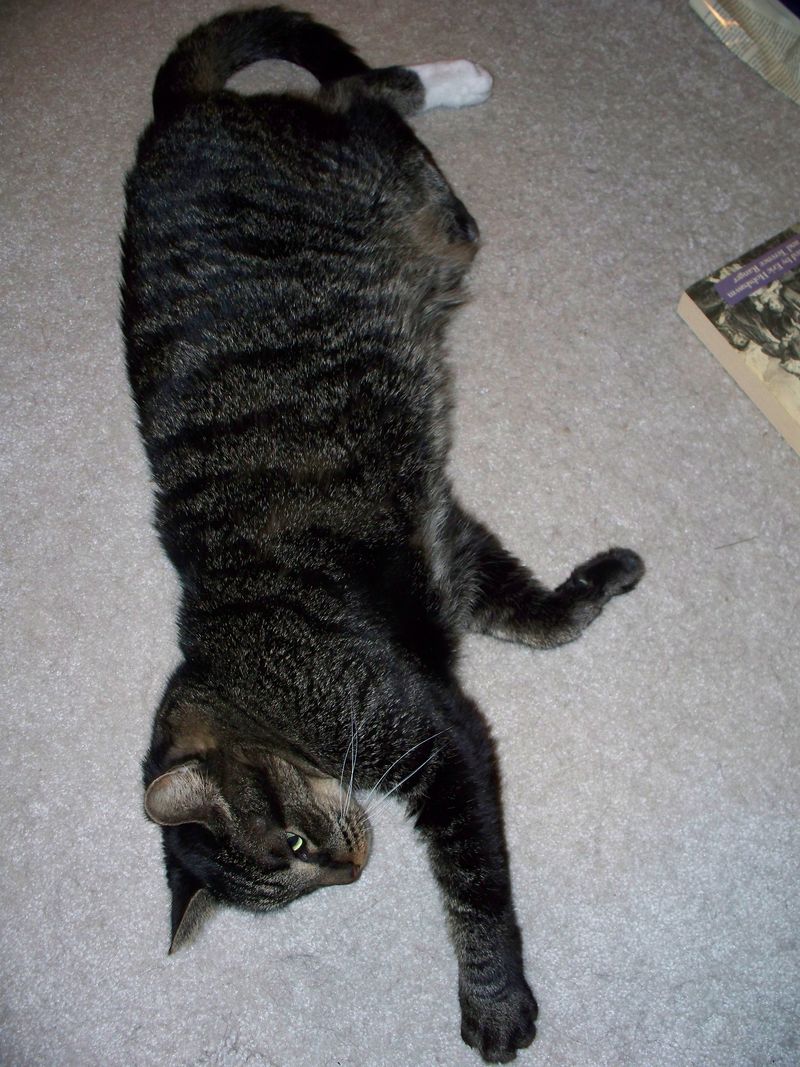
Yes, that was a gratuitous photo of Victoria, guarding me from The Invention of Tradition. I thought we could all use a cat photo right about now.
Where were we?
Ah, yes. Somewhat inconveniently, Matilda applies the adoring quotation to Julia, the "angelic" and "delicate" being out to bust up her brother's marriage. It's, like, the author wants us to note the irony, or, like, something.
(II.100): Heavens, these Throes of Passion are catching. To recap: Henry and Romelia are in love with each other; Julia is in love with Henry; Walter is in love with Romelia; and now Matilda is in love with Walter, who she knows is in love with Romelia (although she doesn't know that Julia is in love with Henry). This seems a bit much, even for your average daytime soap opera.
(II.106): And now, to lather up the soapsuds even more, Adela has arrived, and is out for revenge on...Henry? Apparently, he's the one responsible for her Ill Repute. Or, at least, I guess he is, because there's absolutely no other reason for her to be ticked off at him. Things are a bit confused here.
Then again, how is that news?
(II.107): Adela manipulates the "angelic" (ahem) Julia into writing fake letters incriminating Henry and Romelia. This is actually a relatively intelligent callback to Elizabeth's botched effort with the letters in vol. I, so I will give the author marks for continuity.
Let me stop for a second, and marvel at the fact that I paid Miss Ballin a compliment.
I promise that it won't happen again.
(II.109): Adela proves strong with the marriage-busting force. Henry thinks he catches Romelia encouraging Walter's Grand Passion, except that Romelia thinks she's encouring Walter's Grand Passion for Matilda. Ah, well. It's not like Henry can be bothered to trust the woman who was willing to break him out of prison, or anything.
(II.113): Alas, Matilda now suffers from Ophelia, as Walter has gone to the great Inkwell in the Sky.
(II.115): And Julia has poisoned herself, which isn't stopping her from writing a perfectly coherent letter to Henry, 'fessing up.
(II.119): The 'fessing seems to have worked, because Henry and Romelia have reconciled. The author seems to have believed that actually representing this get-together would exhaust her not-so-copious imaginative powers, so we'll just have to take her word for it.
Oh, and Matilda is feeling better.
(II.121): Oops, spoke too soon. Adela returned, like an overdue interlibrary loan, and stabbed first Henry, then herself. On a positive note, we'll soon be out of characters, meaning that the novel will have to come to an end.
(II.125): Matilda buries Henry and Adela together. Because burying a suicide and the man she murdered together is just the most incredibly romantic thing evah.
For people who are very different from you and me, that is.
And now we get the backstory about Henry's relationship with Adela?! I don't suppose we could engineer some sort of timewarp-thingy and drop Miss Ballin in a modern creative writing workshop?
(II.135): Romelia has just shot at Elizabeth. In public. Somebody forgot to include this assassination attempt in the history books.
(II.136): After accusing Elizabeth of murder, Romelia promptly shoots herself, also in public. As vengeance goes, this seems rather inefficient. Also rather ineffectual.
(II.141): It wouldn't be right for any of the main characters to survive the novel, so Matilda dies of something-or-other, once she escapes England.
(II.144): Matilda is buried, and...uh...that's that. If Miss Ballin was aiming for Shakespearean tragedy, she kind of missed, I think.
FINIS.