Updated Advice to Graduate Students on the Fine Art of Buying Books (in the Age of Digitization)
Eleven years on from this post, buying books has undergone some interesting twists. Here is some updated advice.
1) To Kindle/Kobo/Etc. or not, that is the question. Bear in mind that not all journals and publishing houses will accept loc. cites, meaning that if your scholarly ebook has no page numbers, it's useless as anything other than a placeholder until you get your hand on a physical copy. If you were trying to get out of ILLing everything in sight, this means that you will still be ILLing everything in sight--just not at the same stage of the game. Meanwhile, from a strictly pragmatic POV, academic ebooks may save physical space without helping your pocketbook. Observe, for example, the Oxford Handbook of Conversion, which as of this afternoon was cheaper (er, "cheaper") in hardcopy than Kindle, and which when at full price is virtually the same cost in both formats. Finally, you may have concerns about DRM, ownership (as in, you don't actually own an ebook...), resale (that thing you can't do), etc.
2) The incredible lightness of scraped books. A number of extremely low-end on-demand publishers are devoted to scraping GoogleBooks et al. and then printing the results in cheap paperbacks or pricier hardcovers. To say that the results are a crapshoot is an insult to crapshoots. First and foremost, these are not worthwhile unless, as is not infrequently the case, the scraper has somehow managed to get their hands on a book that is not public-facing at any of the major free archive sites (GoogleBooks, archive.org, HathiTrust, in some cases the British Library). Second, even if this book is only available via scraper, the result will not be useful unless it's a facsimile. Here, for example, is one such book.
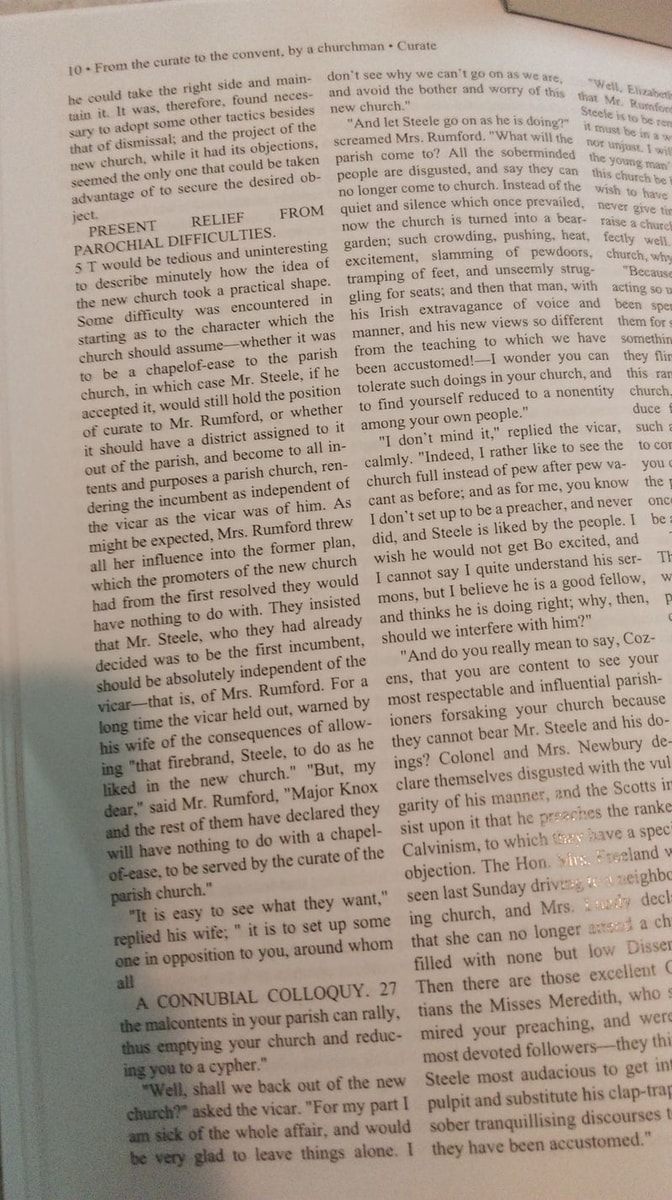
Aside from the triple-column format, this OCRed version has multiple typos, ranging from missing/misread letters to "what could that have been?!" errors (examples on other pages include an "Mm" out of nowhere, a town name preceded by "1%," etc.) to chapter headings that consistently appear in the middle of paragraphs. Now, this will not do.
It's worth noting that the British Library does release perfectly readable (albeit often somewhat lightly-inked) facsimiles of its books. However, these books are also all available in free PDFs through their main library catalog.
3) Do I rely on GoogleBooks and company? The free archives certainly improve life in any number of ways, especially for those of us who work in--ahem--niche fields. Especially if you live far, far away from a substantial research library, archives such as GoogleBooks, archive.org and HathiTrust are essential. The difficulty, however, is that with GoogleBooks you cannot assume that a book will remain available. GoogleBooks in particular is notorious for suddenly dispatching books to the "no preview"/"snippet view" bins for absolutely no discernible reason whatsoever. In addition, some books become accessible/inaccessible depending on country of origin.
However, one question to ask of any freely-available book is: how reliable is this edition for my purposes? For example, in my line of work, many ebooks of religious tracts/novels are US reprints of UK texts--the American Tract Society and the Presbyterian Sunday-School Union, for example, did a lot of reprinting. But they didn't necessarily leave the texts alone, and the results can be drastic (changing settings, changing theology, etc.). Now, an edition with such changes is certainly viable in specific contexts (e.g., a study of tract literature in the USA), but is not helpful in others (a study of tract literature in the UK). At the same time, one is sometimes faced with the not-unlikely possibility that the American (edited) reprint may be the only extant version. (As I discovered during my last stay at the British Library, an entire shelf range of SPCK tracts that had not been cataloged as "destroyed" was nevertheless missing without a trace.) If a more relevant edition is available in hardcopy, it's probably worth shelling out the cash for it.
4) Free sites in general. Always remember that Internet sites are not permanent. As I mentioned a while ago, when I went through my sidebar I discovered a mass conflagration of e-text sites that included not only privately-run archives, but also many housed at universities. Assume that any freely-available text archive is transient, and act accordingly.
5) Amazon price drops. For no reason that can be ascertained, Amazon has a habit of slashing prices drastically--as in sometimes up to 90-95%--on books. This is random, but worth bearing in mind if you are eyeing books from publishers that normally require you to take out a mortgage to buy anything. If you have a well-curated wish list (or lists), you can drop by from time to time to check if anything you want has suddenly changed price from $150 to $30, or $60 to $3.93.
6) Cheap(er) academic books. If you don't want to buy from Amazon, there are some retailers to keep in mind if you want books at low(er) prices, including Better World Books (which sells library discards) and PostScript Books (UK remainders). PostScript in particular sometimes has astonishing deals on sets from otherwise stratospherically expensive publishers like Pickering & Chatto. BWB also maintains a big eBay shop.