Name-calling
I'm in the middle of Charles Constantine Pise's Zenosius; Or, the Pilgrim-Convert (1845), and have stumbled across an interesting footnote:
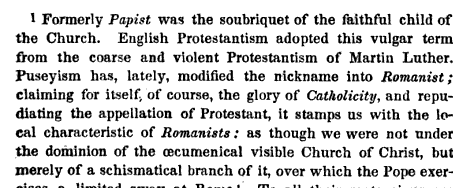
This is the first time I've seen a 19th-c. author try to historicize the use of "Romanist" vs. "Papist," but as far as I can tell, Pise is wrong: "Romanist" appears to be a familiar term of opprobrium in English polemic by the late seventeenth century. That's not to say, however, that "Papist" and "Romanist" don't go through cycles of popularity. After spending years slogging through Victorian anti-Catholic polemic, my impressionistic sense is that "Romanism" and "Romanist" are moderately more common than "Popery" and "Papist," but it's not as though the former pushed out the latter (in fact, the same author or publication often used them interchangeably, sometimes in alternate paragraphs). Ironically, a quick run through my personal library catalog reveals no books with "Romanist" or "Papist" in the title, although I do have eighteen books with "Romanism" and ten with "Popery." I've never actually seen a history of the two terms' relative popularity, although someone armed with a lot of patience should be able to manage a quantitative survey.
Pise's suggestion that "Romanist" is more "local" than "Papist" may be on the right track, although some hair-splitting is involved. Here's a somewhat snarky bit of self-justification from the Bulwark:
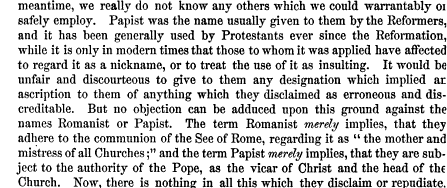
The author, writing about six years after Pise, clearly agrees with him that "Papist" came first, but he doesn't explain when Romanist appeared. Still, he does distinguish between the point of "Romanist" (denoting a particular sect associated with Rome) and "Papist" (denoting allegiance to a particular leader). In practice, though, I'm not sure that anyone really thought about the difference. (The "I don't know why Roman Catholics are so offended" bit is pretty common--scroll down to the footnote for another example.)