"The Lollards' Tower"
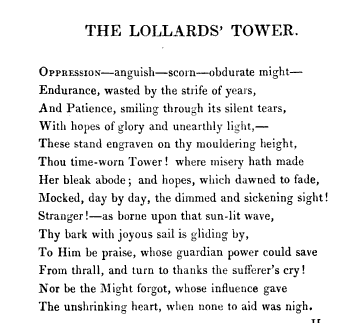
"The Lollards' Tower" appeared in one of the most famous Victorian annuals, The Literary Souvenir, in 1831. It reflects on the fifteenth-century Lollards' Tower at Lambeth Palace, aka the Water Tower or Chichele's Tower. (Somewhat inconveniently, as even the Victorians acknowledged, imprisoned Lollards were probably in short supply at the Lollards' Tower, although other people did have the misfortune of being incarcerated there.) Although one would hardly claim this as one of the more brilliant examples of nineteenth-century sonneteering, it's still worth asking what this poem is trying to accomplish.
To begin with, let's note that this poem, which is more Romantic than Victorian, affiliates itself with the cult of ruins: the Tower is "time-worn" and has a "mouldering height," clearly bearing the scars of both history and mortality. However, the poem seems less to turn the "nation" into "nature," as Anne Janowitz suggests of Romantic ruin poetry [1], than to meditate on history's transformation into something essentially useless--the picturesque. Because, after all, one of the poem's core problems is that the apparently self-evident nature of the Tower's testimony to martyrdom turns out to be, in the end, subjective.
The poem opens with a litany of fragmented agonies, which it initially invokes as abstractions floating free from context or, indeed, syntax; because the poet speaks in nouns rather than verbs, it is not yet clear who oppresses, who is oppressed. Our confusion accelerates once we realize that the “anguish” and the “scorn” could hardly belong to the same people—in fact, where are the people? The octave ducks away from human beings, opting to shift in lines two and three shift from abstract nouns to personifications of “Endurance” and “Patience” (the latter, interestingly enough, left ungendered). People, of course, are not all that’s missing: we have yet to run into the main verb. In the meantime, Patience’s “hopes of glory and unearthly light,” the longest connected thought so far (from fragmentary bursts to Endurance’s one line to Patience’s two lines), momentarily propels us beyond the poem’s laundry list of sufferings and up to that which gives it meaning. And yet, Patience’s hope is a noun, not a verb. Both suffering and hope seem curiously stripped of action, just as they seem curiously stripped of sufferers and hopers.
Once we finally stumble over the main verb, the poet’s decision to dwell in stasis makes more sense. Suffering, concealed within the tower and now forever lost to sight, winds up inscribed on the tower, a “time-worn” historical marker which is also in an advanced state of rot. Again, though, the poet’s coyness about subjects and verbs leaves the legibility of this history open to question: not only must we ask “who reads the Tower,” but also “who writes it?” That is, for whom does the Tower give up its history of martyrdom? The poet never directly represents or names the martyrs themselves, only feelings and personifications of feelings; historical particulars are either less important or more impenetrable to the poet’s gaze than are the passions of martyrdom. “Misery” once dwelled within the Tower, not the miserable. But as the poet’s sudden invocation of the passing “Stranger!” suggests (in a typically Wordsworthian move), the Tower’s fearsome history rests in the mind of the viewer—or doesn’t. Here in the sestet, a person finally enters the poem, in the present and outside the tower. This presentness turns out to be part of the problem. Abruptly juxtaposing the ominous tower to the random stranger’s “joyous sail” on the “sun-lit wave,” the poet calls our attention to the possibility that the Lollards’ Tower may fail to signify anything, other than, perhaps, a picturesque ruin in the landscape. By calling on the stranger--who seems to be cheerfully zipping on by--to thank God, the “guardian power,” the poet demands that the Tower be understood as part of a specific, providential history. The martyrs themselves remain tantalizingly absent, their sufferings understood in only the most abstract of terms, but God’s omnipresence yokes the easy-going present together with the horrible past. God was there. He knows what the poet can only partly imagine, but is nevertheless obligated to remember; this sunny day of sailing, which appears disconnected from the Tower, actually depends on the martyrs’ legacy for its very existence.
[1] Anne Janowitz, England's Ruins: Poetic Purpose and the National Landscape (Cambridge: Basil Blackwell, 1990), 5.