The Maid of Killarney
Here's a Bronte novella with which most readers will probably not be familiar: The Maid of Killarney; Or, Albion and Flora: A Modern Tale; In Which Are Interwoven Some Cursory Remarks on Religion and Politics (1818). Wait, you say--the Brontes couldn't possibly be writing fiction in 1818! Ah, but that's because The Maid was perpetrated written by Patrick Bronte, who also published poetry and the occasional tract. In case you're wondering, Charlotte, Emily, and Anne Bronte absolutely did not inherit their writing talents from their father.
You may take that last sentence howsoever you please.
The Maid of Killarney is, as one would expect from a clergyman, a religious novel, although it would appear that Bronte was unable to decide which sins and/or contemporary trends would be most fun to fulminate against--so he fulminated against all that came to mind. In no particular order, we have:
- Catholic emancipation (bad)1
- War (bad but often necessary)
- Legislative reform (penal laws require adjustment)
- Entertainment (theatre, dancing, cards, all very bad)
- Educated women (bad, ironically enough)
- Deserving vs. undeserving poor (although the novel insists that even the undeserving, ah, deserve charity)
- Juries (frequently bad)
- Irish secret societies like the Whiteboys (very, very bad)
- Atheism (like, super-duper-ultra bad)
He does like the SPCK and the British and Foreign Bible Society, however.
I wish I could say that the book demonstrated some skill in formal construction, but...it doesn't. Characters like the stereotypical Scotsman, Mr. Mac Farsin, are introduced, only to vanish into the ether. Despite the threat of the subtitle, the cursory remarks are not very cursory, and tend to stop what exists of the main plot really most sincerely dead. Bronte's skill with dialogue tends to be, shall we say, somewhat limited, and it's a little awkward to find unintentionally humorous proclamations--"...my shoul is prepared, thank God!--well prepared--well--well--very well prepared" (Works 136)--in the midst of scenes that are supposed to be about devout Christian witness on the brink of death. That being said, the novella's frequent digressions (that aren't really digressions) are in fact characteristic of contemporary religious fiction, which was just as likely to be episodic as plot-driven (possibly so that individual scenes and set-pieces could be easily excerpted for discussion or meditation).
So, the plot. Although The Maid is a religious tract, it's also a national tale clearly rooted in Sydney Owenson, Lady Morgan's The Wild Irish Girl (1806), with an Anglo-Irish marriage plot--our English hero is even named Albion, for goodness sake!--that unites the nations by overriding cultural differences. Although Albion is exposed to some Irish local customs, as well as the sometimes sublime, sometimes picturesque nature of Irish scenery, both the literal and figurative marriages, as James Buzard notes, "will prosper only under the aegis of an evangelized Protestant national Church."2 Irish difference, whether in terms of spiritual practice or dialect, is confined to the peasantry; upper-class Irish Protestants like the Loughleans, by contrast, are already functionally "English." Captain Loughlean is an Irish patriot, but he thinks about Ireland in terms of its relationship to a larger United Kingdom, whether admiring "the mass" of men who fought against Napoleon (146) or praising England for its "discernment and liberality" in its attitude to Wellington (147). The marriage of Albion, who undergoes a conversion experience late in the novel, to Loughlean's daughter Flora (who, like Lady Morgan's Glorvina, plays a harp) consolidates Protestantism's importance in joining the nations both politically and spiritually. Loughlean argues that while the Catholic community as such deserves respect, it would nevertheless become deadly once empowered, thanks to the "influence of the Pope" whose "interest will for ever be opposed to that of the King of Great-Britain" (146). This is what I've called the philo-Catholic position, which is willing to incorporate Catholicism into the nation only if its adherents agree in advance to relinquish all rights to political power.3 As we see in the first of the novel's deathbed scenes, Catholicism operates on a principle of exclusion rather than inclusion, denouncing as a "harrytick" (139) anyone who reads the Bible; while Mr. Mac Farsin concedes that the dying woman is a Protestant "in reality," even though she insists on remaining Catholic, the Catholics offer no such charity. Catholics, that is, disqualify themselves from political power not just because they owe allegiance to a foreign potentate, but also because they cannot imagine that the Other might still be understood, with however much difficulty, as a part of a larger community united by God himself. Hence the novel's insistence that even the badly-behaved poor still deserve relief, whether or not they ever convert.
Most of the novella's readers are interested not in the book for its own sake, of course, but for its influence on the daughters. I was most fascinated by how Charlotte Bronte repurposed this passage (166) in Jane Eyre:
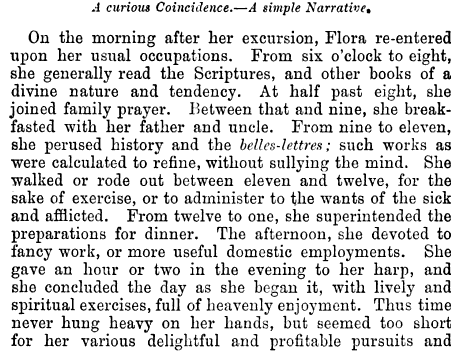
And here is how Eliza Reed manages her time:
"Have you no sense to devise a system which will make you independent of all efforts, and all wills, but your own? Take one day; share it into sections; to each section apportion its task: leave no stray unemployed quarters of an hour, ten minutes, five minutes—include all; do each piece of business in its turn with method, with rigid regularity. The day will close almost before you are aware it has begun; and you are indebted to no one for helping you to get rid of one vacant moment: you have had to seek no one’s company, conversation, sympathy, forbearance; you have lived, in short, as an independent being ought to do." (ch. 21)
For Patrick Bronte, his heroine demonstrates laudable self-discipline in her careful scheduling of spiritual obligations, charitable works, and pleasurable hobbies. Idle hands, devil's playthings, etc. This self-regulation does not signal isolation from her community--she spends time with her relatives and sees to the poor--but, rather, integrates obligations to others within an orderly schedule of intellectual and spiritual self-improvement. Moreover, those things she does alone, such as reading or practicing her music, impact how she interacts with others (conversing; playing for their enjoyment), while her religious devotions link her to God and His invisible church of true believers alike. By contrast, in Charlotte Bronte's satirical reworking of the passage, Eliza self-regulates for the purpose of a wrongly-defined "independence," in which she seeks to be a self entirely without an other. That is, Eliza yearns for individuality that exists in no relationship whatsoever to any community, that denies the need for reciprocity. But Jane Eyre holds up Eliza's vision of independence as, in effect, a narcissism so total as to paradoxically obliterate the self. In regulating herself by the ticking of the clock, Eliza hands her agency over to its cogs. And by aspiring to the condition of God, the perfect "I am," Eliza instead achieves a kind of self-mechanization that the novel will associate with Roman Catholicism--where, of course, Eliza eventually ends up.
1 As Juliet Barker chronicles, Bronte changed his mind later: The Brontes (New York: St. Martin's, 1994), 157-58. Nevertheless, he maintained that Catholics were still a potential danger to the nation.
2 James Buzard, Disorienting Fiction: The Auto-Ethnographic Work of Nineteenth-Century Novels (Princeton, NJ: Princeton UP, 2010), 174.
3 Although, arguing against Juliet Barker, Kathleen Constable insists that Bronte's attitude to Catholicism is merely "solidly prescriptive" and not especially nasty, I'd suggest that the sedate rhetoric conceals some rather unpleasant implications: A Stranger within the Gates: Charlotte Bronte and Victorian Irishness (Lanham, MD: University Press of America, 2000), 46.