"The Ritualists"
I don't usually acquire works of one page in length, but I made an exception for this curiosity: Mary Frances Tupper's poem "The Ritualists. 'Beware! They are Fooling Thee." Here's what it looks like:
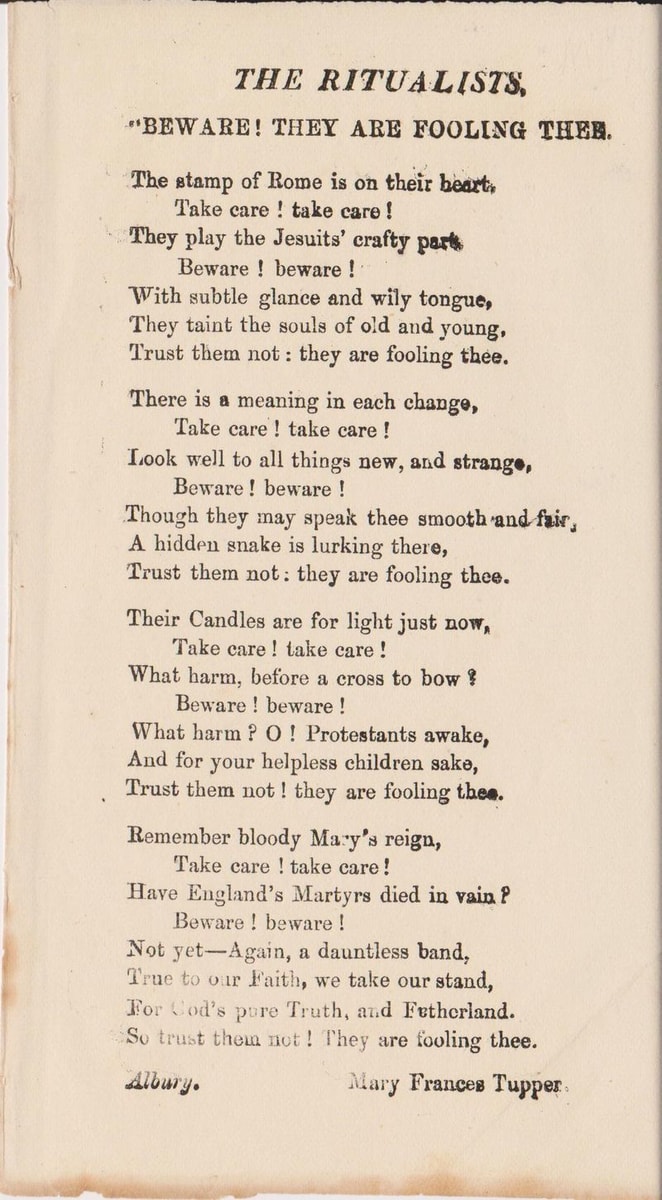
Although you can't tell from the front, the page appears to have been once glued into a scrapbook along one edge.
What is this, you ask? Tupper was a very minor poet whose most significant production was a volume of poetry published with her sisters; she does not appear to have committed many other public crimes against verse that I can easily discover on short notice. She inherited her poetic tendencies from her father, a rather notorious minor poet named Martin Farquhar Tupper. Somehow, probably via Tupper pater, Mary Frances' effusion came to the attention of the even more notorious bibliomaniac Sir Thomas Phillipps, whose book- and manuscript-collecting habits make me look positively parsimonious. And Phillipps maintained his own press, called the Middle Hill Press, which he generally used for publications related to his own massive collection. However, Phillipps also had a loathing for all things smacking of Catholicism, and was not averse to printing anti-Catholic (of both the Roman and Anglo varieties) diatribes by other people, whether in verse or prose.
Clunkiness aside, the poem is primarily remarkable for compressing a number of anti-Catholic and anti-Anglo-Catholic stereotypes into a very small space. As is often the case in such texts, Jesuits enter in even when there is no particular reason for them to do so. Tupper attacks the more "tolerant" reader's trust in Anglo-Catholic surfaces, repeatedly insisting on the real, concealed conspiratorial agenda: the "stamp of Rome" (the mark of the Beast?) is interior, "on the heart"; liturgical novelties conceal a Biblical "snake" in their faux Eden; everything is merely outward performance. The ventriloquized Ritualist, sneaking into the poem in stanza three, endangers England's Protestant fabric by normalizing Catholic behaviors (much as his language, which is not marked off by quotation marks, initially appears to belong to the poet herself). And Tupper concludes with one of the most common rallying cries against all things Catholic--the memory of the Reformation martyrs. To oppose Catholicism means emulating the souls who died in the sixteenth century; by extension, of course, tolerating Catholicism in any form also means running the gothic risk of resuscitating "bloody Mary." There's a bit of rhetorical sleight-of-hand going on: the anti-Ritualist casts modern English Protestants in the spirit of the Reformation martyrs, except that anti-Ritualism is a preemptive protest intended to prevent such martyrdoms from recurring. Ideally, that is, the English anti-Ritualist shows good Protestant spirit and keeps her head at the same time.