Victorianist and inveterate book buyer.  

Posts tagged with arts

Mary, Queen of Scots

As monarchy biopics go, Mary, Queen of Scots does its best to stay in familiar territory.  (Or, as one critic puts it, rather more harshly, "indulges in every threadbare period-film trope.")  The fictionalized secret meeting between the two queens is a dramatic device going back to Schiller; the gendering of the pair, with Elizabeth as "masculine" and Mary as "feminine," goes back even further (arguably back to the lifetimes of the queens themselves); the conflict between private romance and public duty is a staple of the form; even the moment of prophecy at the end has been popular in representations of the Tudors and Stuarts since Shakespeare and Fletcher (who pull this off at the end of Henry VIII).  Unfortunately, I don't remember whether or not I've seen the previous Mary, Queen of Scots biopic, but its trailer indicates that its 2018 descendant has borrowed the mise-en-scene for the moment when Darnley is forced to sign off on Riccio's death.  Strictly speaking, the only real nod to experimentation here is the color-blind casting for supporting actors and extras.

For this viewer, at least, the film's key problem is Mary herself--and, for that matter, what I felt was a discrepancy between the film's purported and actual approaches to her behavior.  On the one hand, the film represents Mary as the modern ideal of royalty: she valorizes emotional authenticity over realpolitik; yearns for real love (and sex, with ironic consequences); tries to model toleration for her subjects; makes a point of connecting with the common people; attempts to make proto-feminist (albeit monarchist) common cause with Elizabeth; and so on.  All of this is in contrast to the performative, insistently celibate, and increasingly made-up Elizabeth, who breaks down only rarely into raw emotional expression.  (Notably, Mary spends a lot more time out in nature than Elizabeth does; even Holyrood is rough-hewn out of rock.)  On the other hand, the film is also stuck with the real Mary's political acumen, or lack thereof, and so it's hard to avoid the conclusion that she self-inflicts more wounds than those suffered by poor Riccio.  Despite the explicit "men, amirite?" tone of the dialogue, Mary's brother James spends most of the film being correct.  No, Mary should not tick off John Knox (who seems badly in need of shampoo); no, Mary should certainly not marry Darnley; yes, marrying Darnley will blow up the Anglo-Scottish detente that James has worked so hard to achieve. While Mary's decision to spare James' life (pesky historical reality again) comes across as yet another example of emotional authenticity, not to mention Christian forgiveness, one can't help noticing that Bothwell has reason to be exasperated.  For that matter, Mary's complete misunderstanding of Bothwell's behavior sums up her utter failure as a politician, let alone a monarch.  Mary's "authenticity" consistently prevents her from listening to or learning from her brother, even though he has actually been running things for years.  It keeps her from judging Darnley's character (the film makes him more of a weasel than even the real Darnley, which is saying something).   And it makes her incapable of grasping that Bothwell, her apparently loyal protector, is as much on the make as anyone else.  Her climactic encounter with Elizabeth--a.k.a. the person with the upper hand--is a mind-boggling miscalculation of epic proportions.  ("Shut up, Mary," wails the viewer, as Mary shoots herself thoroughly in the foot with a cannon.)  Was the irony of the ending, in which a guy ascends the throne and everything is fine, really intended by the filmmakers?
The Favourite

Films set from the reign of George III and later usually face one problem head on: how to justify the ongoing existence of a monarchy in a country where the monarch no longer has any well-defined powers as a ruler.  A few years ago, I argued that from The Madness of King George onwards, the usual solution has been to narrate how the monarch gets his (or her) "glamour" back--how, that is, they reemerge as unifying national symbols who reside beyond the taint of the political, a process that often requires the help of a civilian guide.  Frequently enough, having rescued the country by rescuing the monarch, the all-too-helpful civilian finds himself kicked to the curb at the end (The King's Speech is an important exception to this rule).  All of these things play out before--indeed, require--an eager public to consume the monarch's image. But The Favourite tackles a different problem, yet one recognizably filtered through the preoccupations associated with symbolic monarchy films: what happens to the glamour conferred by divine right when the supposedly powerful monarch is merely a civilian tool? 

The Favourite opens with a nod and wink to King George: whereas that film begins with the king's robing for the opening of Parliament, The Favourite opens with the queen's disrobing after the speech.  Figuratively shedding the mantle of earlier monarchy films, which if nothing else are often Oscar-bait for costume design, The Favourite revels in announcing its disinterest in the history that purportedly underlies its plot.  The film has a complicated relationship to the satires of the real Duchess of Marlborough's friend Arthur Maynwaring; here, the satires don't exist, and are replaced instead by Abigail's initial attempt to blackmail Sarah and then Sarah's own attempt to blackmail the Queen with the Queen's love letters to her.   Abigail loses years off her age--she was considerably Masham's senior--while Sarah loses all her children and Queen Anne her husband. That Abigail was related to both Sarah and Harley goes similarly unmentioned.  Events that took about six years to unfold here appear to transpire in a matter of weeks.  So The Favourite does its best to emulate Her Majesty, Mrs. Brown (also known as the film with the missing Prime MInister) when it comes to cheerfully abandoning all pretensions to accuracy.  At the same time, the contrast between the period interiors and the twenty-first century women's costumes (geometrically-ornamented "sketches," as it were, of appropriate dress), language, and, most famously, dance moves continually reminds the viewer that this film is mediated through our own aesthetics and politics. 

One of The Favourite's most interesting deviations from the contemporary monarchy film, in fact, is that the focus is on Queen Anne's relationships to other women: films about Victoria and the two Elizabeths primarily focus on the queen and men, whether as political or romantic objects.  As has been oft-remarked by the critics, the film plays games with gender stereotypes: the men's more accurate costumes appear "feminine" to a modern viewer (men ought to be "pretty," Harley remarks), in contrast to Anne's and Sarah's masculine riding habits and shooting garb.  But the men also spend as much time as the bored queen playing silly games like racing ducks and throwing fruit at each other.  Arguably, the only character in the film with a gimlet-eyed approach to politics is Sarah--even her romantic relationship with the queen is integral to her agenda.   Moreover, because the Queen actually makes decisions, instead of being reduced to a ventriloquist's dummy (in theory, anyway), the division of power by gender becomes much more complex: the politicians can try to manipulate the Queen, but they can't make a move without her giving the OK; if they do manipulate the Queen successfully, it's through the medium of another woman.  Indeed, the women (even the Queen) are much more alert to the politics of sex and courtship than the men.   

The public/private split that takes up so much of the post-George films' attention here reappears as the conflict between Sarah (who manipulates the Queen for what she believes is the national good) and Abigail (who has no ambitions beyond ensuring her own safety after years of abuse).  The wider public is noticeably missing altogether: the Queen has no contact with anyone beyond the palace boundaries and only hears about their opinions (and riots) secondhand--foreshadowing the ultimate fate of Sarah's letter at the end.  Wheeled to a dance, the gouty queen must sit by herself and watch, and she clearly spends much of her time alone and self-absorbed.  Thus, instead of focusing on the Queen (re)learning how to perform in order to settle national unrest, the film emphasizes how Sarah and Abigail compete in their performances for the Queen--Abigail's flattery (but is it always?) vs. Sarah's truthfulness (but is it always?).  Sarah, the character who fits most neatly into the contemporary monarchy film's more traditional plot, suffers the usual fate of all non-royal advisers--but without accomplishing her goals.  In a sense, the film acts as a thematic prequel to the symbolic monarchy films, as Anne willingly (if not always wittingly) relinquishes the political power that later monarchs conspicuously fail to possess.  

A lot of viewers were baffled by those bunnies at the end, incidentally.  My own reading of that closing image was that the rabbits (her "children," standing in for the seventeen lost pregnancies and dead children) have represented throughout an emotional alternative to Sarah, Abigail, and all the rest: the rabbits are the Queen's emotional utopia of sorts, an escape to a psychological place in which nothing is demanded of her other than food, water, and petting.  The rabbits have no ulterior motives and make no judgments.  But as the juxtaposition to the Queen's physically and sexually abusive demonstration of power over Abigail suggests, the Queen's love for the rabbits is also amoral (and, of course, vice-versa).  The rabbits are the Queen's fantasy of uncomplicated happiness; Abigail, however, is what the Queen has.  

Mowgli: Legend of the Jungle

The selling point of Mowgli has been its "dark" quality, in comparison to the song-and-dance animated Jungle Book feature and, for that matter, the more recent live adaptation (the film which came, saw, and conquered this one, cinematic-release speaking).  In practice, this results in a kind of tonal dissonance: Mowgli's frequently light-hearted coming-of-age narrative runs smack into a much bloodier story about the ethics of hunting.  (TL;DR: hunting for food, good; hunting for sport, bad.)  As a result, it's not always clear whom the film is for, a problem accentuated by the sometimes odd CGI (Shere Khan and Father Wolf are especially...off) and the sometimes cartoonish, sometimes very brutal violence. Interestingly enough, Mowgli turns out to have its competitor's problem with the in-universe politics of Mowgli's identity as a human being, and yet solves them it in a way that arguably out-Kiplings Kipling.

Mowgli's narrative combines the Mowgli tales from the first Jungle Book, including Shere Khan's manipulation of wolfpack politics, Mowgli's kidnapping by the Bandar-Log (here just known as the Monkey People), and Mowgli's time in the village, although it concludes by foreshadowing his afterlife as Master of the Jungle in the Second Jungle Book (without mentioning that, in his late teens, he returns to his adoptive family).  Moreover, there is a new addition who serves as a pivot point, a deconstructed Great White Hunter (seriously) with a drinking problem and the perhaps somewhat odd habit of lugging all of his hunting trophies around with him.  (Lockwood's obsession with Shere Khan turns out to be a sort of discount Moby Dick plot.) . Much of the tension in the film's first half derives from a rite of passage nowhere in Kipling, the "running," which qualifies the cubs for full membership in the pack; Mowgli's physical inability to keep up with the other cubs, which marks him out as a "freak" alongside his runty albino friend Bhoot, would disqualify him, were it not that he learns to master tree-climbing instead.  It is only Bagheera's deliberate intervention that cheats Mowgli out of winning the contest and inadvertently leads him to being captured by the Bandar-Log.  Mowgli's desire to be accepted, just like everyone else--one of the most popular plots in all of children's and YA film--supplants the original story's explanation for the loathing with which the other wolves regard him: "The others they hate thee because their eyes cannot meet thine; because thou art wise; because thou hast pulled out thorns from their feet—because thou art a man" ("Mowgli's Brothers").  Instead of the film's more generic "we're special!" with which Mowgli's buddy Bhoot tries to console him, the short story very clearly insists on the animals' instinctive recognition of human superiority.  By the same token, the film displaces just about all of the nastiness of human nature (aside from some children being jerks) onto Lockwood, the aforementioned hunter; the villagers, it is made clear, have every right to want to eliminate Shere Khan (who is eating their cattle and, of course, has a history of eating them as well).  Notably, Mowgli never speaks with another human being, although the stories emphasize that he picks up the language very quickly--a kind of distancing that makes it easier for him to abandon the village at the end in order to return to the jungle.

Structurally, as the film makes explicit in Kaa's concluding voiceover, Lockwood and Shere Khan are two aspects of the same violation of jungle law.  Early on, Bagheera explains to Mowgli that hunting for food is both "sacred" and a "right," but one must never hunt for pleasure.  Shere Khan, who kills cows for the fun of it (an especial violation of the law, as it brings humans into the jungle seeking vengeance), is the animal equivalent of Lockwood, a sportsman who displays rather than eats his kills.  (It doesn't help that Lockwood's trophies include half of one of Hathi's tusks and, alas, the taxidermied Bhoot.) Lockwood's implied alcoholism functions similarly to Shere Khan's limp, inasmuch as both have problems with mobility (and, unfortunately for Lockwood, aiming).  Moreover, it is clearly the manner of killing that is also at issue.  First, in a reworking of the original, Akela evicts Mowgli from the pack for saving him with fire, a human weapon; later, Lockwood gifts Mowgli a knife with which to hunt.  Mowgli's success at killing Shere Khan (here, with the help of elephants instead of buffalo) is the moment when he truly establishes himself as a successful man-wolf hybrid: Mowgli can kill Shere Khan because he isn't a wolf, and uses the knife to finally finish him off, but he also kills using the same intimacy prescribed by jungle law.  Lockwood, by contrast, uses a gun, and the gunsight paradoxically makes him unable to see his own oncoming death.  Having erased both the law-breakers and the overly-hidebound from the narrative--Akela dies fighting with Shere Khan, another deviation from Kipling--the film leaves the field open for Mowgli's creativity to rejuvenate jungle law.  Being different, rather than being human, turns out to save the day--and yet, in the end, Mowgli's difference remains predicated on his being human.

The Crown

The second season of The Crown might just as well have been subtitled "The Americans are coming!"  Not that the season is all Yanks, all the time (or even most of the time), mind you, only that one catches slow glimpses of American power waxing as British power further wanes.  The Kennedys, says Philip (of all people!) are like "royalty," and even supposedly staid aristocrats respond to them like teenagers with a celebrity crush.  Similarly, Billy Graham cruises through, his emotional revivalism disgruntling the more respectable class of Anglicans.  More ominously, an American historian forces the British government's hand on the Marburg files, which reveal much about the Duke of Windsor's dalliances with the Nazis.  Everyone, especially the Queen Mother, grouses about the strange fissures emerging in British society: too much feeling on display, louder grumbles from the working classes, insufficient respect for the divine right of kings, and an increasingly noticeable unwillingness on some parts of the Commonwealth to continue deferring to the UK's might.  Or lack of might, given that the season opens with Nasser considerably damaging the UK's brand over the Suez Canal crisis.

Historians quip that "the middle class is always rising"; it's The Crown's thesis, meanwhile, that the monarchy is always in crisis mode.  And to solve a crisis, you need to work the optics.  The series' fixation on media is a hallmark of modern monarchy films, including The Crown scriptwriter Peter Morgan's The Queen,* and like The Queen, a good chunk of this season involves us watching the characters on the screen watching screens of their own--that is, when they aren't listening to the radio, reading the papers, dealing with photographers, or watching themselves being satirized on stage by Beyond the Fringe.  In particular, the clashing styles of photographers Cecil Beaton and Anthony Armstrong-Jones embody this season's take on the monarchy's relationship to the twentieth century, with Beaton producing images of an untouchable, otherworldly monarchy and Armstrong-Jones images that seem intimate and stripped of artifice.  (The contrast is further embodied in the technological differences between their cameras.)  The royals have little to do except perform for the media and, in turn, consume their own images through the media.  Lord Altrincham's critique of Elizabeth, as represented here, has nothing to do with substance (as one character points out, the great thing about a constitutional monarchy is that the monarchs have no power) and everything to do with acting; when Elizabeth dines with the hoi polloi in Buckingham Palace, she behaves with outward grace and a distinct lack of inward graciousness.  Her successful intervention in foreign policy by dancing with Kwame Nkrumah is explicitly staged as a battle of competing photo ops, in which she trumps the Prime Minister and her advisors with a greater display of media savvy.  At the same time, the season drills down on the lack of "humanity" (as Philip glumly observes when he dismisses his errant personal secretary) of this approach to the public eye: Eileen Parker's rage when both Lascelles and Elizabeth try to get her to back down on divorcing her adulterous husband in order to save Philip's reputation is one of the more spectacular examples, as is Jackie Kennedy's sad apology to Elizabeth over what turns out to have been an abuse- and drug-induced spiel of insults. 

Last season's movie camera makes another symbolic appearance, as Elizabeth passes it on to Philip as he goes away to find himself on a five-month Commonwealth tour.  On the one hand, giving Philip the camera hints that Elizabeth has relinquished the director's eye in favor of being the camera's object; on the other hand, it also suggests, as we see with Nkrumah, that she has instead learned to manage the camera from in front.  Philip's travels, though, parallel Elizabeth's later voyage to Ghana in another way.  The Commonwealth tour is supposed to be a largely all-male escape from the cameras--notably, when Philip gives in to "vanity" (his word) and invites a female reporter to interview him in Australia, he quickly discovers that his hormones have kept him from perceiving that the woman might have a brain.  Both Philip and his secretary, Mike Parker, treat the Commonwealth as an opportunity for male adventure; while the cameras linger on natural beauty and partly-clothed bodies, Parker's lascivious letters to the Thursday Club (where waitresses have to deal with pawing hands as part of the job) indicate just how much exploitation is involved.  (That being said, your mileage may vary about just how much exploitation the series is engaging in here.)  Indeed, one of the season's not-so-subtle arguments is that the older men in charge seem entirely incapable of grasping how they're perceived by those not like themselves, whether overseas (Anthony Eden's massive miscalculations) or at home (the painfully out-of-touch speech that Michael Adeane writes for Elizabeth; Macmillan's choice of successor).  The women, one hastens to add, do not actually fare that much better, as Elizabeth's cringe-inducing encounter with Eileen Parker suggests.  But whereas Philip largely treats the Commonwealth as a personal playground of games and dancing that liberates him from the constraints of public life (that is, until Parker's scandal brings everything to a crashing halt), Elizabeth dances the foxtrot with Nkrumah in what both understand to be a significant political gesture.  Elizabeth accommodates herself to life before the camera, and finds a degree of power there, while Philip, who believes that he can escape the cameras, learns otherwise.  Still, as the season's final image of them--a squabbling extended family, not the poised and alone Elizabeth, before Cecil Beaton's eye--suggests, it's difficult to successfully package the messiness of private life. 

*--Alert viewers will probably pick up the direct visual quotation from The Queen: the stag, both alive and dead. 

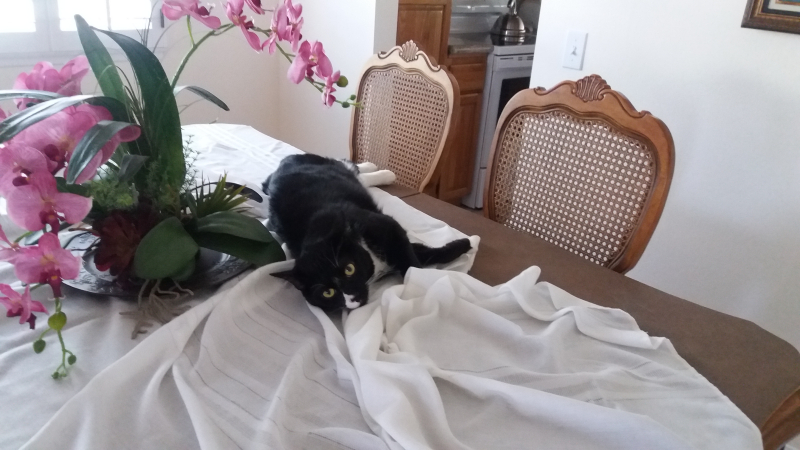
Still Life with Artificial Plant and Cat

Uploaded image

Title: Still Life with Artificial Plant and Cat.

Materials: Cat (Amigo, age four); artificial plant; tablecloth; table.

Commentary: In this deconstruction of the relations between artifice and nature, human and animal, object and living creature, the cat's own artistic agency asks the viewer to reflect on our assumptions about the act of aesthetic production.  By crumpling the tablecloth, the cat subverts human attempts to impose order on a chaotic universe, while also repurposing single-use domestic consumer goods for his own playful mode of being.  The cat's gaze further implicates the photographer in the act, inasmuch as the "appropriate" response (as determined by the parents of said photographer) would be to summarily remove the cat from the table in order to save the tablecloth from the cat's claws.  By photographing the cat and uploading the photograph to the Internet, the photographer attempts to recuperate the cat's carnivalesque disruption of the social order (which forbids cats from being on the dining-room table, for example) for the well-known genre of the "cute cat photo"; however, the cat's knowing gaze suggests the extent to which such recuperation can only be partial, as the tablecloth's displacement remains as the trace of the cat's rejection of human norms.  Moreover, the juxtaposition of the artifical plant with the cat troubles the always-porous boundaries between the natural and the (art)ificial: in its hyper-realism, this representation of a cultivated flower hints again at human attempts to exert control over the natural world, even as it also necessarily hints at the extent to which the real flower evades capture, much like the paradoxically non-domesticated domestic animal on the table. 

Dracula Camps Out

'Tis the season...no, not for Christmas cheer, but for Halloween horrors.  So, being a good little Victorianist, I trotted off to Geva to see Dracula.  Which, as it happened, proved remarkably short on horror.  (I shall refrain from using adjectives like "bloodless.")  Instead, it was quite the funniest Dracula I'd seen in some time, albeit without anyone breaking out a Star of David in lieu of a crucifix.  Some of the humor was, I fear, accidental (Abraham van Helsing sounded like Victor Borge, which distracted somewhat from the atmosphere); some of it was of the Idiot Ball variety (Seward and van Helsing rush off, leaving poor Harker hooked up to a blood transfusion apparatus...with unfortunate results; Seward thoughtfully informs the newly-undead Lucy that she lacks a pulse); and some of it was pure camp (Dracula, otherwise got up to look like Gary Oldman in Francis Ford Coppola's film, swooshing around in a Bela Lugosi-ish cape).  What's going on here?

The play seems sedimented with the weight of post-Dracula films and texts.  Indeed, it starts with a tuxedoed Renfield, breaking the fourth wall as he does throughout the play, complaining that Bram Stoker has given him "immortality"; the post-novel mythos turns out to be its own kind of undeath.  What we get is a kind of decayed Dracula legend.  The Oldman-esque Dracula--they even have the same hairstyle--with nicely-sculpted abs suggests that it may take considerable excavation to locate "Bram Stoker's Dracula," wherever it may be.  Instead of aiming for the kind of terrifying effects enabled by the cinema, the play turns Stoker's purple prose into its onstage melodramatic equivalent: actors chew scenery (and each other), pose and gesture, and declaim their villainy to the accompaniment of Count von Count's private thunderbolts.  The elderly Dracula hisses, snarls, snuffles, and contemplates noshing on Harker (so much for the cultured gentleman with whom Harker initially becomes acquainted).  Even the characters sometimes pick up on the campiness, as when Lucy tries hard not to crack up at Seward's proposal.  It's no accident that the stage is framed by the asylum's rusty iron bars, or that Renfield has perhaps even more stage time than the Count.  The boundary between "sane" and "insane" proves porous, much as the distinction between actors and audience; the Count himself, of course, can dissolve at will. We're being asked to leave our reason at the door. 

Where the play starts getting itself into trouble, I think, is in its uneven reworking of the novel's plot and themes.  Its altered structure (Harker's trip is almost entirely told in flashback) and missing characters (two of Lucy's three suitors exist in name only) are relatively minor changes in the larger scheme of things.  The wrap-up, however, is quite rushed and clunky, even anti-climactic.  There are bizarre dropped threads, most notably Seward running into Dracula-as-Harker aboard the skeleton-crewed ship, then not registering any dismay when, of course, Harker turns out to be in Budapest.   Similarly, Seward's cheerful praise for vivisection and his cruelty to Renfield don't seem to mean much of anything for his role in the rest of the play.   More importantly, the play emphasizes Lucy's eroticism, her unladylike (in Victorian terms) fascination with sexuality and desire, but then insists on her essentially "pure" and "virtuous" spirit; in fact, van Helsing argues that the most virtuous people are also the most susceptible to vampirism.  (According to van Helsing, this Dracula was one righteous dude before being vamped.  Who knew?)  One common reading of the novel is that Lucy gets "punished," in effect, for her flagrant attractions.  In Mina's case, the play clearly links sexual liberation to vampirism: the novel's famously sexualized moment in which Dracula forces her to drink blood from his breast here morphs into her eagerly launching herself upon his (as I said, nicely sculpted) body.   But the post-vampiric Lucy, playing overtly on Seward's lust, is on a continuum with the pre-vampiric one.   The play takes apart the novel's anxieties about flamboyant female sexuality, and indeed female agency, but doesn't do so coherently.  Now it's Mina who really kills Dracula, by kissing him with a communion wafer in her lips (er, how? She shouldn't be able to touch one...), and it's Mina who beheads him--an echo of the male trio's destruction of Lucy.  So the vain and rather flibbertygibbety Lucy turns out be superwoman Mina's spiritual equal (suggesting that sexiness and virtue have nothing to do with each other)? But Mina gets sexed up only after being vamped (suggesting that sexiness is not a virtue)? This doesn't stand up to close examination, although it does inadvertently register how non-revisionist treatments of Lucy are in revisionist Draculas

Helen Rowe Bergtrom: Two Dolls

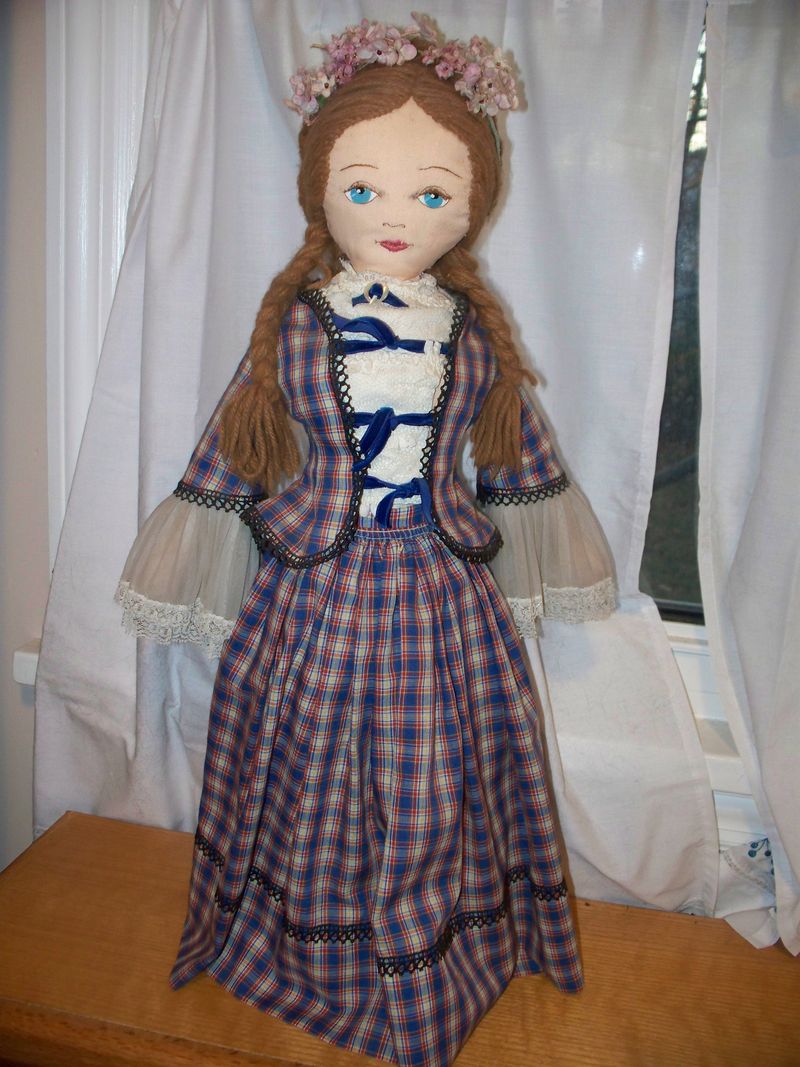
My maternal grandmother, Helen Rowe Bergtrom, died on Sunday at the age of 96.  Grandma Helen was not only a talented painter (my readers may recall that I used to have her self-portrait as my blog's image), but also a gifted seamstress: she quilted, she embroidered, and she made dolls.  I'll post some of her watercolors next week.  Today, though, I've put up some images of two Victorian dolls she made approximately thirty years ago for my sister and me. 

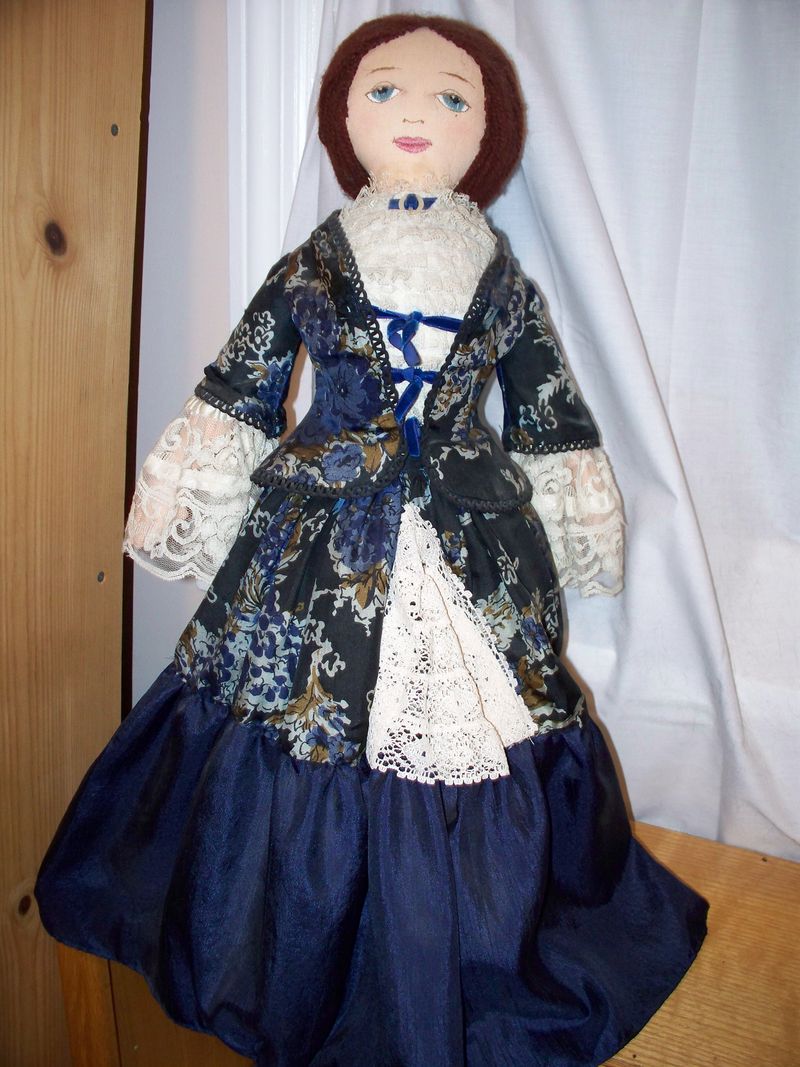
A few years ago, I had the dolls restored at a local doll's hospital.  This one required only minor work (loose stitching repaired and the yarn wig retucked). 

Uploaded image

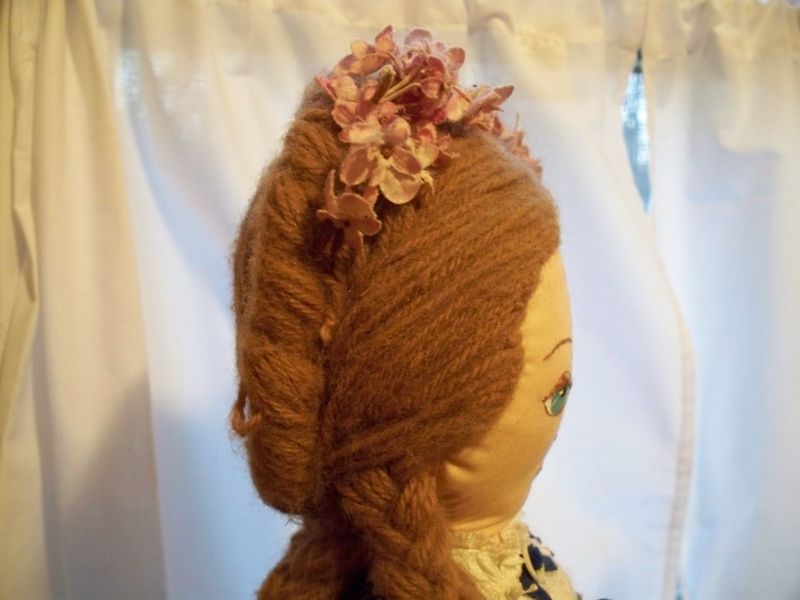
The hairstyle is fairly elaborate:

Uploaded image

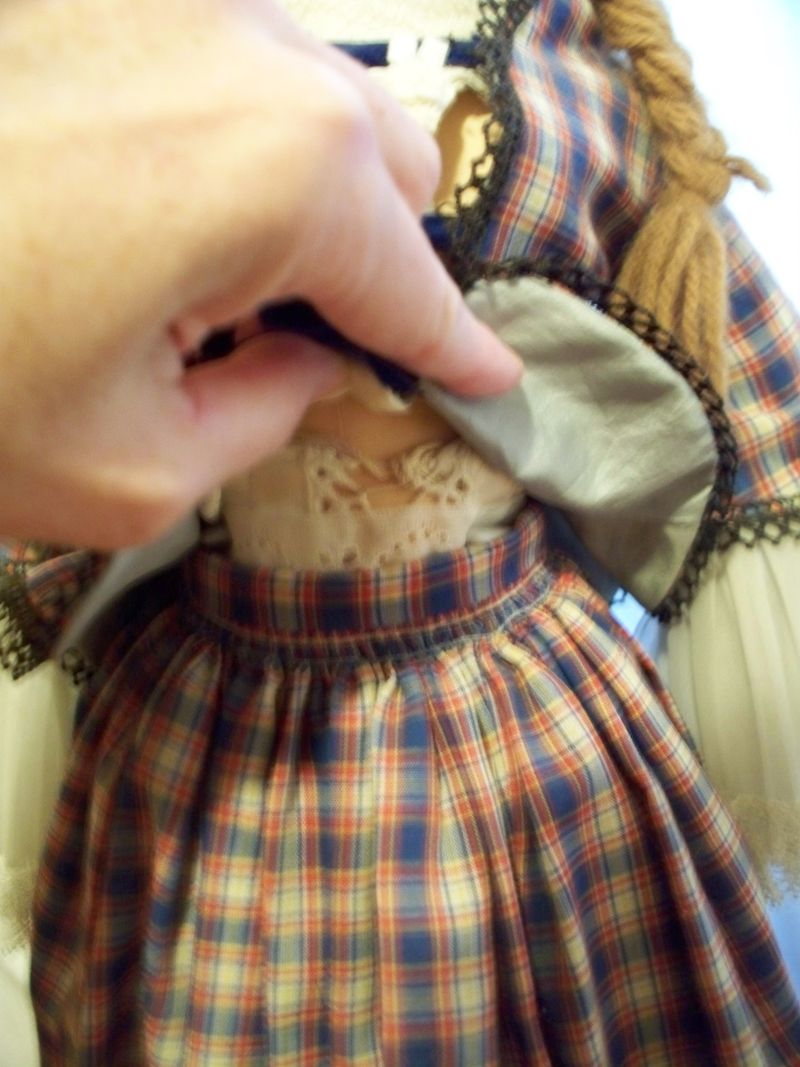
The dolls even have (handsewn) corsets...

Uploaded image

The second doll's silk skirt had to be almost entirely restored (the floral pattern is the original cloth).

Uploaded image

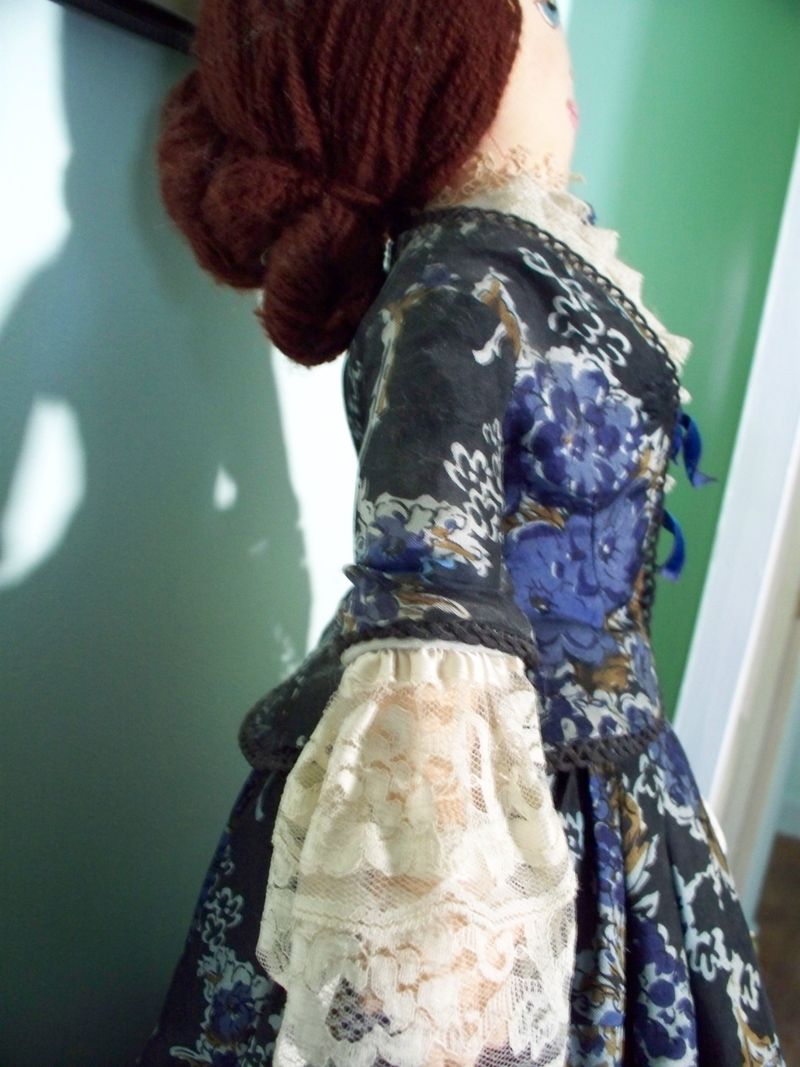
She has a chignon:

Uploaded image