Victorianist and inveterate book buyer.  

Posts tagged with satire

If academic conflicts were plotted like Star Trek: Discovery

WARNING: If you have not yet finished watching season one of Star Trek: Discovery, there is a MASSIVE SPOILER in here. 


[As the episode opens, the CAMERA flies by a series of slightly-familiar academic buildings, now augmented by centuries of technology.  A female voice speaks.]

PROFESSOR OF XENOSCIENCES MICHAEL BURNHAM: Each day we awaken to the promise of new beginnings and new challenges.  We face forward into the impenetrable depths of innumerable galaxies. Our lives may be forever changed by the mysteries that elude our ever-questing gaze.  Today…

[The CAMERA zooms in through a window.  We see a DEPARTMENT CONFERENCE ROOM, occupied by two yet-undifferentiated ACADEMICS.]

BURNHAM: …I stare into the abyss of the unknown and, quite possibly, the unknowable…

[The CAMERA focuses on two DEPARTMENT CHAIRS, PIKE and LELAND, who scowl at each other across a DESK.  The DESK’s surface is covered with rapidly-flashing but indecipherable displays.]

BURNHAM: …can my department chair finally convince the dean that Xenosciences needs 250 more credits for that new undergraduate game lounge?

[CLOSE-UP on BURNHAM’s concerned face as she peers into the room through an observation window.]

LELAND: I don’t mind telling you, Chris, that Xenoliteratures has been monitoring your department’s attempt to monopolize the dean’s discretionary funds very closely.  Very closely.  Not least because you refuse to acknowledge anything that happened last semester—

PIKE [lolling casually in his chair]: Now, I know Xenoliteratures is where you’ve got that hermeneutics of suspicion thing goin’ on, but really—

LELAND: Burnham set off a major turf war with Xenosports over undergraduate recruitment, and it’s still in the local press.

PIKE: Yeah, but the system gave her “Professor of the Year” honors at the end, so it’s all good.

LELAND: Culber’s contract got cancelled, but somehow he’s back in the classroom.

PIKE: The termination was just an administrative error, Leland! He wound up with an…extended sabbatical.

LELAND: And now Saru, the guy who ran screaming at the very sight of an Assistant to the Vice President, is leading demonstrations in the quad!

PIKE: He got tenure, for cryin’ out loud!

LELAND: Professor Tyler—I mean Voq—I mean Tylvoq—I mean Tylvoqer—oh, the hell with it—here has been running your communications with the dean through our new Discursive Deconstructor Apparatus—it’s ex-clu-sive Xenolit tech, you wouldn’t understand—and he has arrived at some pretty damning conclusions.  Haven’t you, Tyler?

TYLER: The rhetoric of your most recent email once again highlights your failed attempt to encode a subversive neo-Vulcanian rhetoric of post-positivistic logicality within the confines of academic praxis.

[TYLER pauses.  PIKE stares.]

TYLER: Seriously, what kind of cost-benefit analysis did you perform before you sent that email? Have you even heard of economic forecasting models?  Did you even stop to think that an appeal to rational self-interest might be mutually profitable for all departments concerned?

[TYLER pauses.  PIKE stares.]

LELAND [whispering]: It’s…yeah, it’s the interdisciplinarity.  The part of him that got a BA in Economics just will not go away.  [Louder] Anyway.  We know what evil plans you’re hatching over there, and we intend to infiltrate—I mean, stop them by any means necessary.

[CUT to the HALLWAY, where BURNHAM is watching this exchange with obvious anxiety.  ASSISTANT PROFESSOR SILVIA TILLY and PROFESSOR PAUL STAMETS stand next to her, fidgeting.]

TILLY: This, is, like, soooo annoying.  Like, can you believe the nerve of these Xenanities people, coming over here with their freakin’ EX-CLU-SIVE tech and telling us, us, that they’ve got some sort of [waves hands around] super-duper-high-powered insight into our motives? I mean, like, this is totally grody—

[STAMETS shoots her a look.  TILLY deflates and looks repentant.]

TILLY: Sorry, I’ve been researching twentieth-century slang to help me deal with the whole cursing thing.  There was this all-female secret society called “Valley Girls,” who I guess lived in valleys and had a hard time communicating with people who lived on hills, and…anyway, what I mean is: can’t we get the credits from somebody else?

STAMETS: I’ve hunted up and down the mycelial network to find a suitable research grant.  Nobody wants to fund an undergraduate game lounge, even though I’ve identified 323.8 potential academic uses for it—interactive physics simulations,  five-dimensional juggling exercises, Vulcan hopscotch—

TILLY: --You know that the powers that be only pay lip service to pedagogical innovation, right? It took forever to get the administration to approve my pilot course on using roguelikes to study starship engineering—“fix the nacelles before you get stung to death by a soldier ant,” that sort of thing.

BURNHAM: We’re doomed.

STAMETS: …Pretty sure that’s the other show with a “Star” in it.

[ASSOCIATE DEAN PHILIPPA GEORGIOU suddenly appears out of nowhere.]

GEORGIOU: Only the weak bother asking for money.  The strong know that the best way to get it is to strike early and hard.

[She pulls out a fountain pen and burnishes it for emphasis.]

BURNHAM [wearily]: Insights like this are what I get for saving your career.

GEORGIOU: “Saving my career”?! I had wealth, power, legions of faculty at my feet, an Instagram feed with 1.3 million followers—

BURNHAM: --You ran a diploma mill called “Hahrverd.”

[GEORGIOU sniffs.]

BURNHAM: Besides, shouldn’t you be on the dean’s side? Or Leland’s, even?

GEORGIOU: Leland wouldn’t dare cross me—at least, not after I let him know that I know about his little escapades with the student fees for the Xenoliterature Club newsletter.  As for Dean Cornwell [evil chuckle], you do realize that she’s working with the administration to rebrand this  division as a Xenoculinary school? Right?

EVERYONE: NOOOO!!!

GEORGIOU [to Stamets]: And your mushrooms will be first on the menu.

STAMETS: We can’t let them turn the mycelial network into cream of mushroom soup! 

TILLY: We need help!

BURNHAM: What we need is a deus ex machina!

[On cue, a mysterious RED BEING appears, accompanied by COPIOUS CGI.]

BURNHAM: Look, a mysterious being of hitherto unfathomable power!

GEORGIOU [suddenly transforming her fountain pen into a tricorder]: Its energy readings exceed all known measurements!

STAMETS: It appears to exist simultaneously in multiple positions along the space-time continuum!

TILLY: Yes, but can it save the mushrooms?

[More COPIOUS CGI.  After it dies down, BURNHAM, TILLY, and STAMETS find themselves in the conference room.  Nobody else is present.  BURNHAM picks up a PADD from the table.]

BURNHAM [reading]: “…Our conversations with faculty stakeholders have been mutually productive”—where do they get these writers?!—“and we have decided that it is in the best interests of our academic community to delay implementing Section 31 of our Intragalactic Academic Presence Plan.”

STAMETS: I’m guessing that my mushrooms are safe.

TILLY: Is there anything there about the game lounge?

BURNHAM [scrolling down]: Let’s see…ah, yes.  “In order to promote student success, we have decided to develop a new undergraduate game lounge, to be [shocked pause] shared by Xenanities and Xenosciences”?!!

[They stare at each other in horror.]

[Cut to the DEAN’S OFFICE, where CORNWELL, PIKE, and LELAND are glowering at each other.]

CORNWELL: Stuff it, guys.  Just because there’s no plausible reason for you two to work together doesn’t mean that I can’t make you do it anyway.

LELAND [glumly]: I knew I should never have let you audit that creative writing course.

PIKE [with a forced smile]: Well, old buddy I haven’t spoken to in about a decade except when forced to by Dean Cornwell here, I look forward to meeting you in the new holographic Andorian tennis simulator.

LELAND [equally forced]: And I look forward to sitting down with you over a nice cup of Tellarite tea and discussing the newest engagement of antestructuralist theory with warp physics.

[Looking over their heads, CORNWELL catches a glimpse of GEORGIOU watching them through an observation window.  They share a meaningful glance…]

[Roll CREDITS.]
I am the very model of a pundit academical

(Inspired by some...larger tendencies, some contradictory, not by anyone or any outlet in particular.  Though I've certainly detected some of these habits in myself...)


I am the very model of a pundit academical,

I've idées fixes artistic, scientific, and political;

I’ve a hundred ways to call the admin highly hypocritical,

And sometimes it’s in phrasing that descends to the emetical;

I'm very well acquainted too with matters pedagogical,

Which I pronounce on in a tone that's truly theological,

About research esoteric I am tweeting with so much abuse,

Although the second reader called my book proposal too diffuse! 

[Although the second reader &c.]


I'm very good at clickbait that's superbly supercilious,

I know exactly just the thing to make my colleagues bilious,

In short, in fields artistic, scientific, and political,

I am the very model of a pundit academical.


I know our storied theorists, from Cleanth Brooks to Derrida,

I lecture long on p-hacking, I ponder Disney's Merida,

I’ve versified Greenblatt's The Swerve in macaronics marvelous,

And pontificate on syllabi while never seeming querulous;

I can tell Baudrillard from Wittgenstein and H. Cixous from F.  Tönnies,

I sneer at frauds while hyping my unpublishable masterpiece,

Then I can pitch a hot take on something I’ve not read before,

And if no-one will run it, well that’s what my dormant blog is for!

Then I can speak of budgets in a manner tropological,

And turn the latest scandal into something anagogical;

In short, in fields scientific, artistic and political

I am the very model of a pundit academical.


In fact, when I know what's meant by “committee work” and “overload”;

When I can tell at sight a learning outcome from an add/drop code;

When such affairs as meetings and advisement I’m more present at,

And when I know a mortarboard and tassel from a bowler hat;

When I can name five colleges whose halls are hardly ivy-decked,

When I can update Blackboard without losing all my self-respect,

In short, when I get that scholars unlike me are really not suspect,

You’ll say a pundit academic’s never been so ego-checked!

For though the language in my op-eds is particularly visceral,

I fear (alas) my wisdom’s proving eerily ephemeral,

But still, in fields artistic, scientific, and political,

I am the very model of a pundit academical.

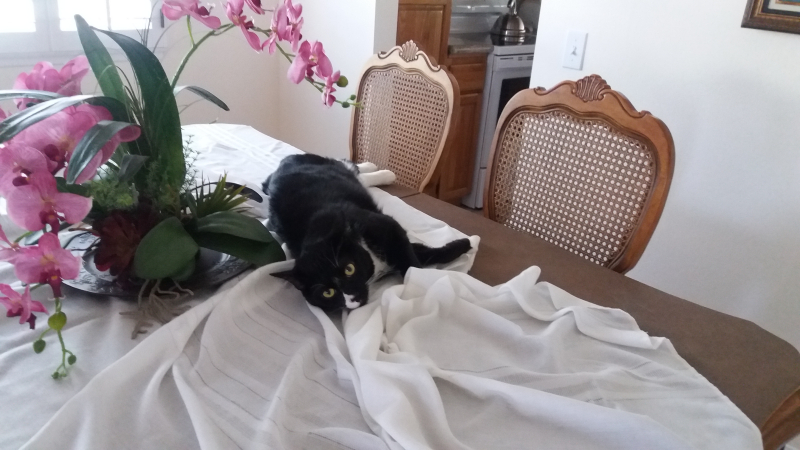
Still Life with Artificial Plant and Cat

Uploaded image

Title: Still Life with Artificial Plant and Cat.

Materials: Cat (Amigo, age four); artificial plant; tablecloth; table.

Commentary: In this deconstruction of the relations between artifice and nature, human and animal, object and living creature, the cat's own artistic agency asks the viewer to reflect on our assumptions about the act of aesthetic production.  By crumpling the tablecloth, the cat subverts human attempts to impose order on a chaotic universe, while also repurposing single-use domestic consumer goods for his own playful mode of being.  The cat's gaze further implicates the photographer in the act, inasmuch as the "appropriate" response (as determined by the parents of said photographer) would be to summarily remove the cat from the table in order to save the tablecloth from the cat's claws.  By photographing the cat and uploading the photograph to the Internet, the photographer attempts to recuperate the cat's carnivalesque disruption of the social order (which forbids cats from being on the dining-room table, for example) for the well-known genre of the "cute cat photo"; however, the cat's knowing gaze suggests the extent to which such recuperation can only be partial, as the tablecloth's displacement remains as the trace of the cat's rejection of human norms.  Moreover, the juxtaposition of the artifical plant with the cat troubles the always-porous boundaries between the natural and the (art)ificial: in its hyper-realism, this representation of a cultivated flower hints again at human attempts to exert control over the natural world, even as it also necessarily hints at the extent to which the real flower evades capture, much like the paradoxically non-domesticated domestic animal on the table. 

Unmarked: An Academic Mystery

I slouched into my office like a sagging sock, slammed the door behind me, and collapsed into my favorite faux leather chair, recently bought on sale at Wal-Mart for $39.95.  That investigation into the disappearance of the conference room clock had been long and grueling, and the administration was still reeling from my revelations about the "clocks for cookies" exchange being held every afternoon in the faculty parking lot.  My energy level was so low that even an ant could step over it.  It was all I could do to crack open a can of Diet Coke and turn on my favorite e-cigarette.  But then she walked into my office.

The woman's gaze hit me hard, like the Norton Anthology of English Literature dropped from a great height, the hardbound version, not the subdivided paperbacks. She had the drained appearance of someone who had corrected one too many comma splices.  I could see that she had a problem.  A major problem.  And that meant her problem was about to be my problem, for the low, low price of $24.99/hour, plus all applicable sales taxes.

I offered her a Diet Coke.  She knocked it back like someone who had been drinking Diet Cokes all her life.

"The English Department is in the midst of a crisis," she murmured, toying with her Samsung phone (not, I was relieved to see, one of those exploding tablets, because that would have been distracting, and besides, it's been a while since I replaced my fire extinguisher).  "Someone has been stealing the dry erase markers.  We suspect a conspiracy."

"Going from zero to sixty pretty quickly there," I remarked, with a dramatic vape.  "There could be a grey market in markers that you don't know about.  Maybe somebody is collecting them on the sly, in hopes that their descendants can take them on the Antiques Road Show.  Could be some kids at work on a postmodern art project involving erasable ink.  Why a conspiracy?"

She stared at me as though I had turned into an especially odious misplaced modifier.  "We're English professors.  We never arrive at the simplest conclusion when a more complicated one would do."

I was about to suggest that the Philosophy Department might lend out a handy Ockham's razor to help them solve that problem--most people don't know this, but they come cheap at the local drugstore--but something about her expression told me that I would be deconstructed on the spot.  So I handed her an invoice instead.

***

 My rusty Ford Focus spluttered to campus, looking as decrepit as I felt. I parked it in an out-of-the-way spot where it wouldn't be seen by any suspicious types, and strolled inconspicuously to the humanities building in my blue suede shoes, whistling a tune from Andrea Chénier and keeping on the lookout for any clean whiteboards.  

And soon, I saw them.  I peeped quickly into each classroom, earning myself glares, hisses, and scowls from faculty members who didn't appreciate that I was on their side.  But none of these professors were writing on the whiteboards that festooned the rooms like outdated ghost advertisements that ought to be painted over, except the locals are really attached to that ad for soap that nobody manufactures anymore, and so they all write letters to the local papers, and then it gets into the city papers, and before you know it, social media has got a hold of the whole deal, and--

"I don't understand,"  said one professor, looking especially tweedy, "why you are in the back of my classroom, eavesdropping on our discussion of Ada Leverson."

"To begin with," I responded, somewhat huffily, "I was developing an epic simile about whiteboards, which you interrupted.  Also, I'm investigating the disappearance of your dry erase markers."

Her grimace smeared across her mouth.  "Do you realize how much time I've spent trying to convince students not to use 'also' as a transition word?"

This was clearly going nowhere good, so I changed tactics faster than a kid hitting the "like" button on Facebook.  "Look," I said, "you clearly aren't writing on the whiteboard.  Is this because you're worried that there's no stable relationship between the signifier and its signified?  Or are you just tired from playing one too many games of Nethack when you really ought to be reading rough drafts?"

She rolled her eyes.  "You apparently haven't read any literary theory published since the 1980s.  And I'm not writing on the board because there isn't anything for me to write with."

I was about to say something brilliant in return, maybe a wisecrack about epistemes, but then the solution smacked me in the noggin like a Riverside Chaucer hurled at high speed.

***

She was back in my office, nibbling on a decadent-looking mascarpone brownie studded with Ghiradelli's chocolate chips--semi-sweet, from the look of them.  I tried not to drool.

"There's no conspiracy," I proclaimed grandly, with a flourish of my e-cig.  "Just open your briefcase."

This earned me the kind of scorching glare you'd expect from somebody who hatched dragon eggs in funeral pyres.  "My briefcase, young woman," she said sternly, "is sacrosanct. It contains nothing but the manuscript of my latest book project, a paradigm-shattering monograph on novels featuring romances between vampires and werewolves at academic conferences, especially the MLA, which I am writing in longhand so that none of my competitors can hack into my computer and steal it."

My long-suffering sigh gusted across the room like an unexpected windstorm in March.  "I think you'll find," I said, "the answer to the mystery."

Rolling her eyes,she unsnapped her briefcase.  "There's nothing--" she began, and then stopped abruptly, her mouth slowly fluttering agape.  I grabbed the briefcase from her, and shook it.  Dry-erase markers tumbled to the floor.  Pink ones.  Black ones.  Green ones.  Red ones.  Most of them didn't really match my 1970s-era orange shag carpet. 

"You, and all the other faculty," I trumpeted, gesticulating with a convenient can of Diet Coke (which, unfortunately, was open, sending a flourish of soda across my desk), "have been absent-mindedly taking the markers with you every time you leave the classroom.  You, and you alone, are to blame for the marker shortage!"

She clutched her head in horror.  "What am I to say at our next department meeting?" she moaned, resembling nothing so much as a student who has just discovered that their fifty-page research paper had been due the week before.

I grinned.  "Just say that the case of the little missing markers is solved."

And I handed her the bill. 

If William Carus Wilson wrote advice for conference presenters

I was typing up some excerpts from William Carus Wilson's A Child's First Tales this afternoon, and his prose began to slowly worm its way into my once-innocent mind.  Given that "listening to bad conference papers and equally bad comments" is its own genre in the academic complaint literature, I began to wonder if, perhaps, his approach was suitable for delivering admonitions on this all-important matter.  Difficulty level: words of one syllable only, wherever possible, and never more than two.  ("Oh! it is a sad sight" is one of WCW's favorite turns of phrase.)

TALE 1.  THE BAD SPEAKER. 

You will cry when you hear this tale! Sit down in this chair, and look at the front of the room.  There you see a Bad Speaker.  Oh! it is a sad sight! The Bad Speaker was very lazy.  This is what happens to lazy Speakers! First, they wrote their paper on a plane.  Could you write a paper on a plane? The plane bumped, and whooshed, and zoomed! The Speaker was sick, but still wrote.  Was the paper good? What do you think? Their best friend asked, "Did you practice your paper?" The Speaker laughed! "Why would I do that?" Their best friend warned them, but the Speaker went  out to party.  The day of the paper, they were tired and sad, but they still had to speak.  They did not have a paper copy, so had to read off a screen, but their head ached so.  You could not speak that way! Why do speakers do this? They spoke, but their slides were bad and their paper was dull.  People snoozed.  Then the paper went on for too long.  The Chair got mad! Oh! can you see the mad Chair in your mind! How they scowl! Are you scared? Not the Speaker! They kept on.  At last, the Speaker stopped.  They looked up, and saw that there was no-one else in the room.  They were sad, and their best friend laughed at them.  Then they went home.  Do you think the Speaker will mend their ways? I do not.

TALE 2.  BAD COMMENTS.

I told you about Bad Speakers.  But others can be bad, too. This will be hard to hear, so you must sit still and not cry too hard.   People say bad things to Speakers, even to good ones.  It is true! There are people who talk too much.  If only they knew to keep still! Then, others would not roll their eyes so hard.  Some pretend to say nice things, when they want to talk about themselves.  This is called "ego." It is rude! You do not want to be rude.  Some are mean to Speakers. See how one Speaker looks sad, and how this one looks mad! Oh! children, do not be mean.  When you speak, you want people to say good things to you, and help you think.  If you are mean, people will talk about you on Twitter, and then you will be sad too.  But if you are good, and say things that give Speakers new strong thoughts, then you will be liked.  

Wanted: One Op-Ed Writer, "The University"

The Office of Plentiful Pundits, Campus Branch offers a stimulating and highly remunerative position in the Department of Academic Opiners.  We seek a writer capable of creating op-ed product on short notice, to be distributed across all major media platforms.  The successful candidate will be able to analyze and critique all issues touching "the university," "academia," and "academics," including finances, ethics, tenure, pedagogy, scholarship, infrastructure, strategic planning, administration, sports facilities, technology, hiring, politics, investment and divestment, demographics, departmental organization, curriculum, counseling, FERPA, Title IX, student journalism, &c.   Candidates should have a current academic position, ideally at a private R1 such as Harvard or Yale; it is not necessary to have any experience at regional comprehensives, SLACs, community colleges, or other institutions with an emphasis on teaching.   As our readers do not understand that these institutions are not run along the same lines as R1s, candidates do not need to prove any understanding of their teaching loads, hiring priorities, salaries, curricula, budgets, and the like.  Candidates should be widely published in their field, but do not need to demonstrate any grasp of scholarship within the past decade, as that is not relevant to our needs.    Because op-ed writing requires self-confidence, we welcome candidates with impressive research records who nevertheless believe that all other research is irrelevant and a waste of funds.  The position does not require journalistic skills, on-the-ground research, or fact-checking.  Successful candidates will be paid by the column.  Contact [email protected] with cover letters, CVs, eight letters of recommendation, and a writing sample in which the candidate argues that methods in their own discipline were far superior fifty years ago.  Twitter and Facebook accounts required.  

Columns for which Inside Higher Ed should give me money

After reading this postmodern contribution to contemporary discourse on the state of higher education, I believe that it's time for me to pitch a few ideas to IHE.  To clarify matters, of course, I will identify the allegorical correspondences between my columns' ostensible subjects and their real meanings.

  • Today, I threw a lot of toy catnip mice for my three new kittens.  They charged up and down the room, looking excited.  (How to conduct effective college orientation sessions for incoming students)
  • Getting your old car repaired can be really expensive.  (What's the best way of raising funds to replace aging campus infrastructure?)
  • How many of you have baked brownies and discovered that they just wouldn't set? (Counseling faculty with research productivity problems)
  • I hate carrots.  (Faculty resistance to assessment procedures)
  • Is there anything more refreshing than a can of icy soda on a hot day? But too much soda can have consequences for your health.  (Pros and cons of merit increases)
  • Mac or PC? (Online vs. face-to-face instruction)
  • The weather.  How about it, eh? (The problem of course evaluations)

If Social Media Counted Toward Tenure

SELECTED FACEBOOK POSTINGS

"Eating Pizza at Giordano's."  Facebook 4.1.2014.  

A five-paragraph review of Giordano's stuffed spinach pizza, accompanied by a high-res photograph of the pizza in various stages of consumption.  The review applies Bourdieu's theories of cultural capital to the act of eating Chicago-style stuffed pizza, a controversial comestible that pizza aficionados insist is obviously inferior to the New York variety.  There are six comments on the review, including one by someone who claims to be Slavoj Zizek (see my "citations" list in Appendix E). 

"Untitled Passive-Aggressive Venting."  Facebook 6.12.2014.

An essay in which I denounce various unnamed members of a prominent academic organization, although while providing enough clues for an attentive reader to identify said individuals.  The essay articulates its critique through a deconstructive rereading of Foucault, productively melded with a Lacanian interrogation of Horkheimer and Adorno.  It has thirty-nine comments and eight shares; it has also been reposted to Tumblr, where it has garnered 531 notes.  One of the unnamed individuals has informed me in private that s/he intends to sue for defamation, which I consider proof of this essay's subversion of sociopolitical boundaries in elite academic circles (see my supporting documents in Appendix G).  

"Untitled Cat Photo Shoot."  Facebook 8.2.2014.

Six high-res photographs of my cat Twinkums, a Siamese-Scottish Fold mix.  The photographs are accompanied by several fragmentary reflections on the role of cats in the construction of postmodern subjectivity, written in a style intended to evoke a combination of T. S. Eliot and Judith Butler.  This post has nine comments and two shares; in addition, one photo of Twinkums lyingin a sunbeam has been reprinted on CuteOverload.

SELECTED TWEETS

"Untitled tweet on hot fudge sundaes." Twitter 1.3.2014.

A 118-character tweet devoted to a peanut butter and dark chocolate fudge sundae, with the hashtag #OmNomNom.  Part of an extensive discussion devoted to the cultural implications of eating hot fudge sundaes at the MLA instead of going to the cash bars.  This tweet has twelve favorites and thirty-nine retweets, and has recently been linked on Buzzfeed (see "citations" in Appendix E).

"Untitled tweet on television."  Twitter 7.3.2014.

A 39-character tweet in which I insist that serious academics do not watch CSI, with the hashtag #OMGLosers.  A social experiment in which I performed the role of cultural contrarian.  This tweet has eighty-six favorites, ninety-four retweets, and two-hundred-plus responses, including eight responses accusing me of elitism, thirteen insisting that I am a dangerous leftist radical, and four proclaiming me a right-wing fanatic.  The tweet has been the subject of serious discussion in Slate, the Chronicle of HIgher Education, and Reddit (see "citations" in Appendix E). 

"Untitled tweet on The Phantom Menace."  Twitter 10.31.2014.

A 128-character tweet in which I celebrate the radical aesthetics of Star Wars: The Phantom Menace, with the hashtag #AnakinForever.  Although this tweet has no favorites and no retweets, I have been informed that it will be reprinted in an upcoming book on Star Wars as cultural phenomenon--according to the author, I am the only person to have ever said anything complimentary about this film (see "citations" in Appendix E).  

SELECTED YOUTUBE COMMENTS

"Comment on The Hobbit trailer." "The Hobbit: The Battle of the Five Armies Teaser Trailer."  Youtube 8.3.2014.

A denunciation of Peter Jackson's effects on twenty-first century cinema, with reference to the work of Kracauer.  At the time of writing, it has received sixty-eight downvotes (and is therefore invisible on the page), but the strength of this response testifies to the power of its intervention in popular discourse on the cinema.  

"Comment on Matterhorn POV video." "Super Matterhorn Vid!"  Youtube 9.12.2014.

A critique of the video's insistence that rides at Disneyland are fun, pointing instead to the ride's use of the Yeti as a means of sublating contemporary cultural anxieties about ethical tourism.  Incorporates multiple references to Baudrillard.  At the time of writing, it has received ninety-four downvotes (and is therefore invisible on the page), but has also sparked a serious conversation on academic blogs about whether or not YouTube comments inherently support the status quo (see "citations" in Appendix E).

"Comment on Schoolhouse Rock Mashup."  "Schoolhouse Punk Rocks."  Youtube 11.6.2014.

A lengthy (equivalent to an entry in The Explicator) argument that contemporary transnational appropriations of Schoolhouse Rock enact an urgent critique of English grammar in an age of globalization, with extensive references to Linda Hutcheon.  At the time of writing, it has received three hundred and six downvotes (and is therefore invisible on the page), but it is the subject of articles in Slate, Inside Higher Ed, and the Huffington Post on the possibility of serious theoretical interventions in a medium privileging comments that take the form of acronyms (see "citations" in Appendix E).  

Academic Honor Code for a University a Long, Long Time Ago, in a Galaxy Far, Far Away

2002nd revision of the Academic Integrity Policy.  The Policy applies to all students entering in the 50-51 ABY school year.

The following constitute violations of the University's policies.  For a summary of the reporting and appeals process, see the appendix.

1.  Telepathy.  During examination sessions, telepathic contact with students in or out of the classroom is strictly forbidden.  Students may not forcibly initiate telepathic contact with any instructor or proctor.  

2.  Unauthorized contact with Force ghosts.  Force ghosts are not considered reliable, peer-reviewed sources, and should not be cited in academic papers or examinations.  (See the Intergalactic Style Guide, 247th ed., on the appropriate use of sources.)  Students may not use the University to forward any political projects developed by Force ghosts, nor may they assist them in leaving Chaos.  Force ghosts should not be invoked to intimidate faculty, administrators, or other students.

3.  Telekinesis.  Students may not use telekinesis in physical education or dance classes without the explicit permission of the instructor.  At no time may students use telekinesis to manipulate, elevate, remove, or destroy computers, either theirs or another's, during an examination session.  Students may not use telekinesis to defenestrate the faculty, move objects or items of furniture in classrooms, or levitate buildings.  

4.  Protocol droids.  Students may not submit for credit any translation or original work produced by a protocol droid.  Students may not order any protocol droid to complete assignments or examinations, and they may not tamper with any instructor's protocol droid to obtain answers to examination questions. Students who have religious, linguistic, cultural or medical reasons to use protocol droids in class must obtain permission from the Office of Android Management.

5.  Astromechs.  Students may not use astromechs for any purpose related to coursework in coding, engineering, mathematics, or space flight.   Programming astromechs to insult faculty, administrators, or students in Binary is strictly forbidden.  

6.  Joining the Dark Side.  Students may under no circumstances join the Sith to force faculty to grant higher grades. Students who enter into apprenticeship contracts with Sith Lords will be immediately reported to the authorities.  It is strictly forbidden to use Dark Side powers, such as force lightning, to injure faculty, administrators, and fellow students, or to damage electronic devices, droids, and ships.

APPENDIX: Reporting and appealing violations

Faculty or administrators wishing to report violations must use the following procedure.

1.  Documentation of the violation.  Faculty may document the violation using holovid or droid recording capabilities.  The University discourages faculty from citing Force ghosts as witnesses, communicating with the administration using telepathy, or immediately challenging the student to a dual-wielding lightsaber duel.

2.  Report to Department Chair.  The incident should be reported to the Chair using Form 39171(b), available on the University website (see "Disciplinary Forms").  Incident reports must be made within one day of the event.  Faculty must fully complete all 21 pages of the form and forward it to the chair with the accompanying evidence.  Failure to answer all questions correctly will result in instant dismissal of the complaint.

3.  Chair reports to Assistant to the Assistant Associate Dean.  The Chair must evaluate the complaint using Form 3911118(a), and forward that form to the AAAD, together with Form 39171(b) and the documentary evidence.  Reports must be  completed within two weeks of the complaint.  The Chair must fully complete all 48 pages of the form for the complaint to be considered by the administration.  Failure to answer all questions correctly will result in instant dismissal of the complaint.

4.  AAAD reports to the Assistant Associate Dean.  After evaluating the relevant forms, the AAAD should forward their recommendation to the AAD within one year of receiving the complaint.  In general, a one-word "yes" or "no" should suffice.   

5.  AAD reports to the AD.  Once the AAAD's recommendation has been received, the AAD has three years to suggest a plan of disciplinary action to the AD, or to dismiss the case altogether.  Action plans may be submitted verbally over a regulation game of Sabacc.

6.  AD reports to the Dean.  Within five years of receiving the AD's action plan, the Dean should hand down a final ruling.  However, disciplinary action will be voided if either the student or the faculty member is no longer at the University because of graduation, retirement, or other proximate cause.  

Appeals process

1.  At the initial report phase.  Students may challenge the instructor's account of events using Form 3333991 (z).  This Form must be submitted within thirty minutes of notification that a complaint has been filed.  Students must fully complete all 83 pages of the Form or their appeal will be disregarded by the University.

2.  After the Dean's ruling.  Students who for some reason have not left the University at the time of the Dean's ruling may challenge the disciplinary action using one of the following methods: 1) a podrace in the canyons of Tatooine; 2) a game of Dejarik according to Galactic Core standards; 3) a time trial in protocol droid assembly.  Students are required to provide all materials and, if necessary, pay for their own transportation.  Students may not use any University-related funds for this purpose.  A student who loses the challenge must compensate the University for all costs incurred.  

Intergalactic Language Association Job Information List

ASSISTANT PROFESSOR, LITERATURES OF THE KLINGON EMPIRE

KOLOTH MEMORIAL UNIVERSITY--BAT'LETH BRANCH CAMPUS, QO'NOS

The Department of Klingonaase invites applications for an assistant professor in literature of the Klingon Empire, 0 CE-present.  Applicants of any species must be fluent in all Klingon dialects; competency in at least one other relevant language (Romulan, Andorian, etc.) strongly preferred.  Instruction at the university is conducted in tlhInghan Hol; universal translators are not provided.  The applicant's responsibilities include a 5-5 teaching load; a strong research program in comparative imperial literatures; and service to the university, including regular battle drills and collaborative armor repair.  Candidates may be asked to demonstrate their physical fitness during the interview procedure, as the tenure process normally requires extended torture with Painstiks.  Salary is competitive--that is, candidates must compete for their salary, most frequently by unarmed combat with one of the Deans.  Non-Klingon applicants should familiarize themselves with the local culture before applying, as attrition rates are often high, thanks to mortal injuries incurred as part of the everyday academic routine.  

The Ba'atleth campus is nestled in an especially inviting village, close to several picturesque volcanoes and two major deserts.  Although the village is physically isolated and civilians are not permitted to use the transporter, the region is noted for its culture, especially Klingon opera and touring productions of Shakespeare in the original Klingon.  Local attractions include fire pits, combat arenas, and a variety of cosmopolitan dining options, including one restaurant noted for Klingon-Tellarite fusion cuisine.  

Applicants should submit a cover letter, CV, three letters of recommendation, affidavit of battle preparedness (preferrably an advanced certificate of accomplishment in either phasers or swordfighting), writing sample, and philosophy of teaching to Dr. B'UckUp, Chair, by April 1.

VISITING ASSISTANT PROFESSOR, LITERATURES OF THE OUTER RIM

CENTRAL UNIVERSITY OF TATOOINE

The Department of Literature, Philosophy, Astrophysics, History, and Metalworking invites applications for a three-year visiting position in Literatures of the Outer Rim.  The Central University of Tatooine is a post-New Republic institution, with a mandate to prepare promising scholars for careers in interstellar business, exoeconomics, and cyborg management.  Our secondary concentration in Literatures of the Outer Rim is an optional track for majors in Extra-Market Commodity Circulation, an interdisciplinary program overseen by Literature, Economics, and Starship Navigation.  Applicants should be fluent in at least three languages, although this requirement may be waived for those who can prove ownership of a protocol droid.  Teaching responsibilities will include at least two sections of New Republic Literatures and Traditions per semester, as well as one section of Introductory Programming.  We prefer applicants with at least some Jedi training (Intermediate Light Saber certification) who can defend the campus in case of Sith invasion.  Although Central Tatooine does not offer tenure, employees do receive generous benefits, including all-you-can drink nights at the local cantina and full health insurance (loss of arms and hands not covered).  

Despite its reputation,  Tatooine is currently undergoing a cultural renaissance.  The planet recently became home to the Gamorrean Royal Ballet, which won intergalactic plaudits for its new production of Pigs in Space, and the Astromech Color Guard and Rolling Band.  The Central University was recently ranked 211,000th in Corellian News' list of intergalactic institutions, an improvement of nearly 5,000 places over a five-year period.  

Applicants should submit an information chip, midichlorian count, and all transcripts to Dr. Reedic Ulouslang Uage, Chair.  Interviewees should wear comfortable clothing appropriate for sudden sandstorms.  Please note that air conditioning is rarely available on Tatooine.  

ASSOCIATE OR FULL PROFESSOR, WESTEROSI CULTURAL STUDIES

CITY COLLEGE OF KING'S LANDING

The Department of Cultural Studies at the City College of King's Landing is pleased to announce a senior position in Westerosi Cultural Studies.  (Please note that this position is open only to candidates who are not revived from the dead and/or wargs.) After the mysterious deaths of the previous twelve occupants of this line, we are eager to make a permanent appointment.  Candidates should be well-versed in Westerosi popular entertainment, meteorology, blood magic, and contemporary politics (please see "mysterious deaths," above).  We are particularly interested in scholars with a subfield in Boltonian aesthetics, for which there is additional travel funding; for some reason, our previous appointee disappeared near Dreadfort while conducting field research, so we would advise caution.   Although the position requires no teaching, it does require the holder to maintain a rigorous program of scholarship, obtain outside grants, and represent the college at major events (e.g., weddings).  Those who fail to perform their duties adequately will be sent to the Wall.

King's Landing, in addition to being one of the great cultural and economic centers of Westeros, also features unique local furniture and intriguing, if mysterious, cuisine.  The climate is pleasant, although we expect a slight cooling trend in the immediate future.  The political scene is especially entertaining, and subject to change at a moment's notice.

There is no pre-screening for this position.  Please come directly to the college for an interview; bread and salt will be supplied on request.   

If reader's reports looked like wine reviews

This social constructivist reading of the Book of Common Prayer is unusually slick in feel, and redolent of Judith Butler, but startling undertones of Stephen Greenblatt and Gloria Steinem combine to produce an unusual chocolaty aftereffect.  The finish is reminiscent of slightly undercooked green beans, but with an intriguing aftertaste not unlike parboiled Foucault.  Verdict: Revise and resubmit.

Although the multicolored hues of this new digital edition of Eliza Cook’s poetry promise a cherry-like taste, somewhat akin to Lacanian interpretations of Dickens, the actual result resembles nothing so much as a combination of Ouzo and petroleum, liberally seasoned with pizza, and with pulsing undertones of Pepto-Bismol.  The mélange of digital humanities jargon and New Criticism in the body is liable to upset the stomach, rather like subpar Jungianism.  Verdict: Reject.

This exceptionally fruity deconstruction of Emily Sarah Holt has been nicely aged in the author’s hard drive, and thus has pleasantly warm tones of circuit boards and Microsoft Office ’97, with a slightly tart finish.   Close attention to Lollards provides structure to an article that, thanks to its potentially unsettling infusion of Derrida, might otherwise lack body.  Verdict: Accept.

The nose promises a tangy tartness not unlike a sour gumdrop.  But the body of this Foucauldian interpretation of Windows 8 is so acidic as to dissolve all tastebuds in the immediate vicinity.  Unpleasant tones of spoiled milk in the finish merely clinch the final effect.  May benefit from further aging.  Verdict: Revise and resubmit.

As one might expect of a New Historicist analysis of late-Victorian hymnals, the nose combines rag paper, leather, and just a hint of active mold.  It’s a little startling, then, to come across an aroma of overspiced cranberry juice in the footnotes, drifting across the more substantial body of dark chocolate (72% cacao), cinnamon, and neo-Darwinian theory.  Strong notes of Lyotard in the finish make for an unexpectedly pleasant read.  Verdict: Accept with minor revisions.

This article, written on a topic in which I specialize, starts off well, with enjoyable, inviting aromas of slightly overripe pears, well-aged Cheddar cheese, and a slight hint of triple-chocolate-chip cookies.  But the article itself, which fails to reference my seminal contributions to the field, entirely lacks taste.  The ill-judged mix of Derrida, Irigaray, and Bakhtin in the finish reminded me of unwashed socks.  Read my work instead! Verdict: Reject.

A Booke of Proofreading Magick

(Issued as a special appendix to A Compendium of Professorial Magic, available wherever fine gaming accessories are sold.)

O-LEVEL PROOFREADING SPELLS

  • HOUSE STYLIZE.  Reformats entire manuscript to suit publishing house style.  Roll a D12 Citation Check if the manuscript needs to be changed from Chicago to MLA format, or vice-versa.
  • SPELLCHECKAZAM.  Ensures that both the word and the spelling are correct.  May be blocked if Microsoft Word successfully casts a counter-spell of GOOD MANORS.
  • BLOCK PROCRASTINATION: Denies the user access to Facebook, Twitter, and YouTube for the spell's duration.  Does not protect against spells of BARHOPPING or MOVIEGOING.
  • NO DOZE: Protects the user against spells of BOREDOM cast by the MALEVOLENT class of MANUSCRIPT MONSTERS (see Rules, 58th ed., for more information).  Has the same effect as drinking a +3 CUP OF JOE (usually found only on COFFEE SHOP LEVELS).  However, the spell has a 20% chance of misfiring, in which case it will instead DAZE the user.

1st-LEVEL PROOFREADING SPELLS

  • SUPERSTET: Automatically STETs all changes to the user's prose style.  Despite its low level, this spell should only be used by PROFESSORS of Level 15 (ACADEMIC SUPERSTAR) and higher, as it frequently results in a -25 penalty to PROFESSOR-COPYEDITOR RELATIONS
  • PARENTHETICIZE: Transforms any style into MLA format; may be useful in conjunction with HOUSE STYLIZE, above. 
  • BIBLIOGRAPHY CHECK: Matches all bibliographical entries to the appropriate data in the user's discipline-specific databases.  Interdisciplinary users must roll a D20 Transgressing Boundaries check in order to obtain results in more than one field; otherwise, there is a +5 chance of EMBARRASSING ERRORS.
  • FLOATING TEXT: Particularly helpful to users working on scholarly editions.  The spell creates a hologram of the copytext, which can be laid on or next to the user's own manuscript. 

2nd-LEVEL PROOFREADING SPELLS

  • DETECT BRILLIANCE.  Identifies scintillating ideas in need of further clarification.  However, users who fail a D12 Spot Obfuscation check will add +10 to any REVIEWER's resistance rolls.
  • ACTIVATE.  Translates all sentences in passive voice to active.  Must be used with caution, as the spell will work even when the sentence would make more sense in passive voice.
  • OKEYDOKEY: Accepts all COPYEDITOR's stylistic changes to the manuscript, with a temporary bonus of +10 charisma points to the user.  Many PROFESSORS find themselves incapable of casting this spell. 
  • NUMERACY: Automatically fixes errors in page number references.  Especially helpful when used in conjunction with BIBLIOGRAPHY CHECK, above.

3rd-LEVEL PROOFREADING SPELLS

  • PROJECTION.  Telepathically conveys the PROFESSOR's original intentions to the COPYEDITOR.  Highly advisable if the PROFESSOR is utilizing a BLESSED PEN OF JARGONIFICATION (q.v.).  Unfortunately, this spell does not work on REVIEWERS.
  • GO TO LIBRARY.  Teleports the PROFESSOR to whichever library holds a rare reference which s/he transcribed a dozen years ago, and now has doubts about.  PROFESSORS not yet experienced enough to use this spell should contact someone capable of SUMMONING LIBRARIAN.  Users must roll a D6 Shelf Check to see if the reference is still available.  There is a 15% chance that the spell will misfire, sending the user to the wrong library.
  • FOOTNOTE FRENZY.  Wherever possible, adds references to works by PROFESSORS at LEVEL 10 (BIG NAME) or higher, even if the works in question are of only limited relevance.  A double-edged spell: if the spell succeeds, it adds +10 to the user's charisma, but there is a +5 chance that a REVIEWER may counter-attack with an ACCUSATION OF BROWN-NOSING (q.v.); if the spell fails, there is a +10 chance that a REVIEWER will fire a ROCKET OF HIGH DUDGEON (q.v.).  Interdisciplinary scholars have a +30 chance of failure.
  • SPELL NAMES.  Automatically corrects all misspelled names in the text.  Failure to cast this spell may, at the very least, result in a sneak attack by a SHADOW OF HUMILIATION (q.v.).  If the user does not cast the spell, or the spell fails, roll D10 to check whether or not one of the misspelled names belongs to a REVIEWER

James Malcolm Rymer meets Arthur Conan Doyle: The Hound of the Baskervilles; Or, the Bloody Curse at the Hall

I am currently teaching James Malcolm Rymer's (er, maybeVarney, the Vampyre.   And, of course, I am teaching Sherlock Holmes.  Rymer's prose style sets new records for word inflation.  Although his paragraphs are usually quite short, his characters engage in meaningless dialogue, repeat themselves (and other people) endlessly, and inject vapidities everywhere, all in the name of getting each installment to the right length.  Conan Doyle, by contrast, is most economical with his language.  The Rymer/Conan Doyle combination on my teaching schedule has led me to contemplate a proposition that may or may not be brought on by delirium: how would Rymer have written The Hound of the Baskervilles? I offer a sample below.

***

My dear--very dear--quite precious, in fact--friend, Mr. Sherlock Holmes--he of whose exploits I have written in many a narrative, which you may purchase at the nearest bookstall to peruse amidst the noise and bustle of your railway commute--my dear friend, Mr. Sherlock Holmes, as I was saying, who normally slept the sleep of the dead until all hours of the day, unless he he had burnt the midnight oil and thus remained awake until the glorious sun's rising heralded the dawn, was eating toast and jam.  I, who lacked toast and jam and, in any event, preferred marmalade, contemplated the cane that lay before me.

"It is a cane," said Holmes.

"A cane?"

"A cane."

"Indeed."

"Your thoughts?" Holmes inquired.

"About the lack of marmalade?"

"True, I had deduced that you were displeased about the marmalade by the peculiar shifting motions you were making with your feet.  But I meant the cane."

"The cane?"

Holmes sighed.  "The cane."

"I believe it has an owner."

"Excellent, Watson--excellent."

"Its owner is a doctor."

"True, true."

"A wealthy and highly-vaunted doctor."

"Amazing.  A wealthy and highly-vaunted doctor?"

"A wealthy and highly-vaunted doctor."

"Watson!"

"Yes?"

"You are brilliant."

"Holmes!"

"Yes?"

"Finally, you agree!"

Holmes smirked.  "Pray continue."

My self-love now considerably inflated, I continued.  "He is fond of perambulation."

"Perambulation?"

"Walking."

"Thank you, Watson," Holmes said, rolling his eyes, "the word is in my vocabulary."

"As the engraving upon the cane attests, our doctor has been gifted this fine cane from the local hunt, which no doubt appreciated his skill in patching up the broken heads of its members."

Holmes arched one fine eyebrow, stretched out an immaculately-trousered leg, and tapped his right index finger against the table, thereby dangerously jostling the toast and jam.  "Watson, you have out-scintillated yourself on this fine morning. I am impressed.  Impressed, I say.  Impressed!"

"I am glad to hear it, Holmes.  Glad.  Very glad."

"You are, of course, three-quarters in error, but I am impressed, all the same."

"I am glad--wait, three-quarters in error?"

"Three-quarters."

"Not two-thirds? Or perhaps one-half?"

"Neither two-thirds nor one-half."

I deflated.  Manly tears sprang to my half-lidded eyes.  I turned away, weeping, and attempted to console myself by smashing Holmes' pipe-rack to the ground.  Holmes, no doubt distraught at the loss of his pipes--a calabash not among them, despite the wicked misrepresentations of that mountebank William Gillette--nevertheless sprang to my side with offers of coffee, fresh eggs, and toast and jam (but no marmalade).

"No, no, Watson--no--no! Forgive me--forgive! I meant not to cause you such stabs of pain."

I sobbed incoherently. 

"Watson!" Holmes cried, nudging with one booted foot at the shattered remnants of his treasured smoking paraphernalia.  "Watson!"

My skin paled.  I swayed, then swooned to the ground, overwhelmed.  My chest heaved--my eyes closed--my heart hammered.  Dimly, I heard the rustling sounds of our good landlady's skirts, before I was revived by a wholesome splatter of marmalade across my face...

I Am Scrooge: A Zombie Story for Christmas

My first impulse was to describe Adam Roberts' I Am Scrooge: A Zombie Story for Christmas as a "charming concoction."  Except that the book has multiple graphic incidents of various people having their faces chewed off by zombies, which I suspect most readers would not find charming.  Impaled, blasted, and bludgeoned zombies are probably also low on most charm meters.  And yet...despite the zombocalyptic goings-on, this novel's essentially lighthearted approach to its blood-and-guts (OK, brain-and-guts) subject matter is, well, charming

Strictly speaking, the entire genre of zombie/vampire-and-classic lit mashups qualifies as undead literature, and not just because of all the bloodsuckers and brainsuckers shambling about: these are works purportedly re-animated by injections of gore, but the result is at best a Frankenstein's monster (minus any acquaintance with Goethe and Milton).  Not, of course, that the new soft porn-and-classic lit mashups are any less undead.  In any event, Roberts' brief novel--which, not incidentally, is a new work, not Dickens with zombies erupting at random intervals--parodies this trend instead of playing it straight.  As in many of the mashups, the often-digressive narrative traces how our hero, Ebenezer Scrooge, discovers his destiny (or Destiny) as a dreaded slayer of zombies.  At first, Ebenezer is convinced that the lesson he's supposed to learn is one of charity to all mankind: "'I have been a miser and a misanthrope--I have sealed myself away from human company.  But I shall do so no longer'" (62).  Except that, as it turns out, charity is precisely the last thing needful under the circumstances, given the true nature of his mission.  (Indeed, charity is also what gets the Cratchits yearning for brains.)  Instead, Scrooge must learn why he's the only human being immune to zombification, which also unlocks the secret of Ni Timh, or Tiny Tim, who is neither tiny nor in the habit of requesting God's blessing on everyone.  However, his crutch does make a useful tool for spiking zombies.

Roberts actually is a Victorianist, and the novel has good gory fun poking holes in nineteenth-century literary and cultural cliches.  Given that the only way to deal with meandering zombies is to do them in, the novel as a whole mocks Victorian calls for mutual sympathy and identification as the best means of pacifying the impoverished lower orders.  The entire narrative, after all, is about society quite literally eating itself; it's not for nothing that Marley pops in not as a ghost, but as a zombie out to nosh on Scrooge's brains.  No posthumous moralizing there.  (My students, who recently had to suffer through an excerpt from Past and Present, would probably cheer at Thomas Carlyle's decapitated head being toted down the street.)  Similarly, Scrooge's nephew Fred, who turns out to be a self-aggrandizing twit, is a mashup in his own right of Victorian conservatism in matters both political (he reads the zombies in terms of property-smashing radical mobs) and domestic ("'this, our home, is as good as a castle'" [60]).   For that matter, Scrooge's belief in his zombie-motivated redemption--"'this Zombie Catastrophe has been the making of me, as a man'" (96), he explains to a soon-to-be zombified Charles Dickens--seems more than a little callous, requiring as it does the extermination of a considerable proportion of the human race. 

Quite a bit of the humor comes from the galloping anachronisms and literary call-outs--beginning with the title, which pays homage to Richard Matheson's I Am Legend (which I know only in outline, but I Am Scrooge's basic plot does seem to be a Matheson/Dickens mashup--as the complaint about Will Smith in the preface suggests).  At various points, the novel lurches into steampunk and/or H. G. Wellsian science fiction (Wells, like Dickens, puts in an appearance). I was pleased to see that Roberts is about as irritated as I am with Jack the Ripper's omnipresence in neo-Victorian fiction: that gentleman not only appears (gussied up with several Jack the Ripper conspiracy theory details), but, more importantly, gets promptly chomped by a zombified "victim."  Of course, Jack shouldn't be wandering about in 1843, and neither should John Brown (the Queen's favorite Scot, not the abolitionist), but hey.  Alert readers will catch allusions to, among other things, The Pirates of Penzance, Dr. Who, Shakespeare (Christmas Past has a thing for cod-Shakespearean iambic pentameter), W. B. Yeats, The Wizard of Oz, Stephen Hawking, John Tenniel (the illustration of Queen Victoria comes from this caricature), Edward Lear, and quite a few others I'm sure I've missed here.  (The final explanations of what Christmas is really all about, by the way, sound suspiciously...academic, dare one say.)  Overall, a fine antidote to books like this

Inappropriate Disney Films: A Proposal in the Wake of a Certain Acquisition

As some of you may have noticed, Disney didn't just buy LucasFilm; it promised to make yet more Star Wars films.  (Not that there have been any SW films since Return of the Jedi, of course.)  Allow me to modestly propose that Disney has overlooked a back catalog of intellectual properties that could be easily adapted into animated films. 

1.  THE FILM: Bleak House.

THE PRINCESS: Esther Summerson.

HER PRINCE: Woodcourt.

MERCHANDISING OPPORTUNITY: "Little Jo" dolls, accessorized with a broom that has interchangeable bristles ("clean" bristles, "dirty" bristles).

DISNEYLAND ATTRACTION: The Skimpole Maypole (overlay of Dumbo the Flying Elephant). 

THE SCENARIO: After years of being mistreated by her Evil Guardian, young Esther is befriended by an affectionate talking bear named Jarndyce (song: "The Second Key on the Right"), who brings her to a mysterious castle known as Bleak House.  Bleak House, we soon learn, has long been under the spell of a Scary Witch named Chancery Court (song: "Grim Grinning Guineas").  Esther's warm and loving ways soon bring a new light to the castle--so much so that even the spiders decide to help her clean it (song: "Webbing While You Work").  Meanwhile, Jarndyce, in the guise of a performing bear, entices the young nobleman Woodcourt to the castle.  They all live happily ever after, except for...

DISNEY VILLAIN DEATH: ...Chancery Court, who falls backwards off the balcony after she is frightened by one of Esther's much-loved spiders.

2.  THE FILM: Wuthering Heights.

THE PRINCESS: Catherine Earnshaw (you know, the first one).

HER PRINCE: Heathcliff.

MERCHANDISING OPPORTUNITY: Stuffed bulldogs named Mo, accessorized with multiple collars (a spiked collar, a velvet bowtie, and so on).

DISNEYLAND ATTRACTION: Wuthering Heights dark ride, featuring cute creatures on the moors.  Lots of moors.  Pretty much all moors (replaces the Alice in Wonderland dark ride).

THE SCENARIO: After years of being mistreated by an Evil Orphanage Owner, young Heathcliff runs away and finds himself lost on the moors (song: "Step in Grime").  There, he is discovered by the mysterious young Catherine, who lives in a tumbledown farmhouse, Wuthering Heights, with only her pet mouse Nelly Dean for company (song: "Some Day She'll Drop a Crumb").  Heathcliff immediately falls in love with Catherine; however, he soon discovers that she is under a spell cast by the Scary Wizard Edgar Linton, who decided he wanted Catherine for himself after she was bitten by his pet bulldog Mo.  Now, Catherine can only think of Linton's money (song: "I've Got No Rings").  Luckily, Nelly Dean manages to befriend Mo, and they help Heathcliff find the anecdote to the spell.  They all live happily ever after, except for...

DISNEY VILLAIN DEATH: ...Edgar Linton, who falls backwards into a midden after being attacked by Nelly Dean.

3.  THE FILM: Dracula.

THE PRINCESS: Mina Harker.

HER PRINCE: Dracula (come on, it's trendy now, right?).

MERCHANDISING OPPORTUNITY: A line of "Sweet Blood Red" makeup products for little girls, all conveniently available at the Bibbidi Bobbidi Boutique.

DISNEYLAND ATTRACTION: Seasonal Halloween overlay of the Haunted Mansion. 

THE SCENARIO: After years of being mistreated by an Evil Chiropterist, young Dracula escapes to England, where he has a series of comical misadventures involving his dietary habits (song: "Let It Flow, Let It Flow, Let It Flow").  Dracula finally resolves to leave his vampiric ways and become a vegetarian instead (song: "It's Not Easy Eating Green").  However, he soon attracts the attention of a Scary Lawyer, Jonathan Harker, whose beautiful wife, Mina, is under a terrible spell: she cannot eat anything except paprikash prepared by Jonathan's pet dormouse, Hubert G. Thremnodikins III.  Dracula immediately falls in love with Mina, and realizing that Jonathan was the one who cast the spell, he seeks to liberate her with the help of a friendly talking elephant, Van Hulking ("Hi Diddle Dee Dee, Who's Got a Stake for Me").  Together, Dracula and Van Hulking persuade HGT III to put garlic into the paprikash, which breaks the spell.   They all live happily ever after, except for...

DISNEY VILLAIN DEATH: Jonathan Harker, who falls backwards into the Thames after Van Hulking threatens to sit on him.

4.  THE FILM: Jude the Obscure.

THE PRINCESS: Sue Bridehead.

HER PRINCE: Jude Fawley.

MERCHANDISING OPPORTUNITY: Little Father Time wristwatches.

DISNEYLAND ATTRACTION: Stones of Venice Tower of Terror (renamed version of the Twilight Zone Tower of Terror). 

THE SCENARIO: After years of being mistreated by an Evil Renovator, Jude Fawley runs away to build circus tents.  However, he soon becomes fascinated by a beautiful young woman, Sue Bridehead, who is absolutely not his cousin.  Sue makes magical paintings that predict the future (song: "Who's Been Painting My Future Sched?"), and one day sees a Scary Architect (known only as Camden Society) trap Jude in a ruined building.  Fearing for Jude's safety, Sue and her best friend, a cuddly owl named Little Father Time, seek out the Scary Architect (song: "The Flying Buttresses Song").  Together, they manage to avert Camden Society's plot and bring Jude home,  making Sue Bridehead a feminist action princessTM.  They all live happily ever after, except for...

DISNEY VILLAIN DEATH: ...Camden Society, who falls backwards off a gargoyle after being spooked by Little Father Time.

5.  THE FILMDubliners.

THE PRINCESS: N/A.

THE PRINCE: N/A.

MERCHANDISING OPPORTUNITY: "The Dead" snowglobes, featuring Mickey Mouse (as Gabriel Conroy) and Minnie Mouse (as Gretta Conroy) in cheerful Christmas costumes.

DISNEYLAND ATTRACTION: New costumes for the relevant meet-and-greet cartoon characters.

THE SCENARIO: Billed as "Fantasia for the twenty-first century," Dubliners combines classic hand-drawn Disney animation, the 3D experience, and atmospheric music by Elton John.   Beloved Disney characters like Goofy, Donald Duck, the Mad Hatter, and, of course, Mickey and Minnie romp through musical settings of James Joyce's short stories.  Notable episodes include "Eveline" (Ariel the mermaid finds a prince, escapes the sea, and lives happily ever after), "The Boarding House" (Daisy Duck's mother  introduces her to a fine young goose, and they live  happily ever after), "A Painful Case" (Scrooge McDuck meets a lonely Cinderella, discovers the meaning of friendship, and lives happily ever after), and, of course, "The Dead" (Mickey and Minnie Mouse go to a party, sing Christmas carols in the snow, and live happily ever after).

DISNEY VILLAIN DEATH: None.  There is nothing downbeat whatsoever about this film.